

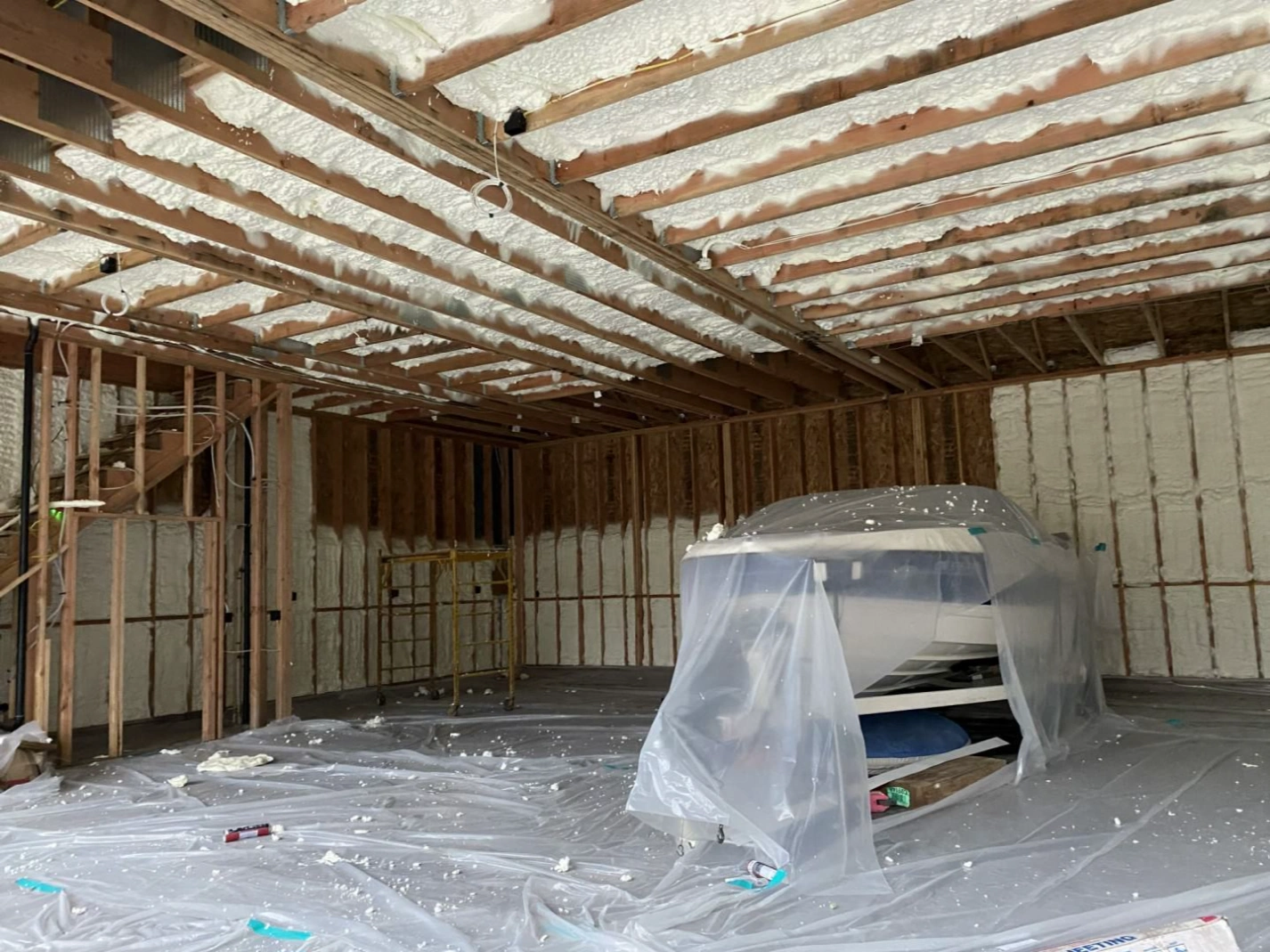
The cost of open-cell spray foam insulation depends on six main factors: total project size, target thickness and R-value, site accessibility, whether the home is new construction or a retrofit, location and travel logistics, and the code-required safety and finishing steps that come with a professional installation. Open-cell is the more affordable of the two spray foam types because it expands up to 150 times its liquid volume, so a small batch of material fills a large cavity. In our service area of Battle Ground, Vancouver, WA and the Portland, OR metro, open-cell typically runs $0.28 per board foot on the low end, $0.32 for an average project, and up to $0.75 per board foot for complex or hard-to-access work. Below, we break down exactly where your money goes and how to keep your total project cost down.
Open-cell price by the board foot. Multiply your coverage area in square feet by the installed thickness in inches, and you get total board feet. A 1,500 square foot attic sprayed 10 inches deep requires about 15,000 board feet.
Open-cell foam costs less per board foot than closed-cell largely because of chemistry and yield. According to the Department of Energy’s Building America guide to spray foam, open-cell expands up to 150 times its liquid volume, compared to 35 to 50 times for closed-cell, which means the same amount of liquid material fills far more cavity. Open-cell spray foam also cures at about 0.5 pounds per cubic foot, one quarter the density of closed-cell foam.
This is the single biggest factor in our pricing: the bigger the project, the less we charge per board foot. Every job carries fixed costs, including crew time, equipment setup, and prep, and those costs get spread thinner as board footage climbs. Homes in our market typically run 1,500 to 2,500 square feet, and whole-home scope delivers a better rate than a single small room.
Greater thickness and higher open-cell spray foam R-value targets increase pricing, period. Open-cell foam delivers about R-3.6 to R-3.8 per inch, so the number of inches you need directly multiplies your board footage. A 2×6 wall cavity filled to 5.5 inches hits roughly R-20, while unvented attic roof decks often call for 10 inches or more. The DOE guide notes open-cell can be applied to full thickness in a single pass, generally up to 10 inches, which keeps labor efficient on deep fills.
Ease of access is one of the main things that lowers pricing on our end. An open attic with a clear hatch, walkable joists, and no stored belongings sprays fast. Vaulted ceilings, cramped crawlspaces, cramped mechanical chases, and furniture that must be masked and moved all slow production and raise the rate.
Open framing before drywall is the cheapest possible scenario because crews work fast with nothing to protect. Retrofits add masking, cutting access panels, and working around finished surfaces and occupants. Our project mix includes both retrofit homes and new construction, and the stage of construction shows up clearly in the final number.
Pricing does change depending on location. Beyond Vancouver and Portland, we serve Grays Harbor, Cowlitz, and Lewis counties, and longer hauls add travel time to the job. Climate zone also shapes cost indirectly: western Washington and Oregon sit in the marine climate zone, where air sealing and insulation deliver an estimated 20 percent savings on heating and cooling costs, per EPA ENERGY STAR modeling, which is why attic depth targets here run higher than in milder zones.
A professional installation includes steps beyond spraying. Model building codes require spray foam in habitable spaces to be covered by a thermal barrier, typically half-inch gypsum board, while attic and crawlspace applications may accept an ignition barrier instead. EPA safety guidance for spray polyurethane foam also calls for occupant vacating, ventilation, and defined re-entry times, since the two-part isocyanate and polyol chemistry only becomes inert after curing. Any honest quote accounts for this work up front.
| Attribute | Open-Cell Foam | Closed-Cell Foam |
|---|---|---|
| Typical low price per board foot (ours) | $0.28 | $1.20 |
| Typical average price per board foot (ours) | $0.32 | $1.50 |
| Typical high price per board foot (ours) | $0.75 | $3.00 |
| R-value per inch | R-3.6 to R-3.8 | About R-6 |
| Density | 0.5 lb/cu ft | 2.0 lb/cu ft |
| Expansion ratio | Up to 150x | 35 to 50x |
| Moisture behavior | Vapor permeable | Acts as a vapor retarder |
| Best fits | Walls, attics, sound control | Below grade, crawl walls, exterior exposure |
| Key limitation | Not for below-grade use | Higher material cost per inch |
Per EPA and building science references, open-cell foam becomes an effective air barrier at roughly 5.5 inches of thickness, and its soft, sound-absorbing structure makes it a popular choice for interior walls where noise control matters.
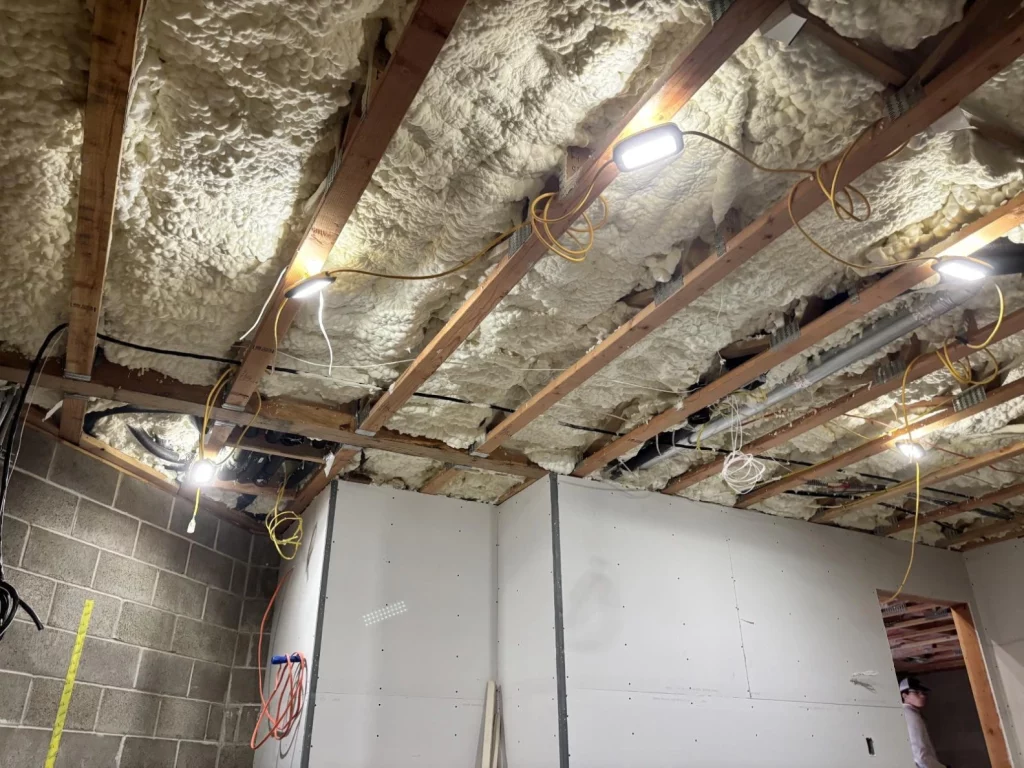
Here is illustrative math for a 1,500 square foot attic sprayed 10 inches deep, which equals 15,000 board feet, using our published rates:
| Scenario | Rate per Board Foot | Project Total |
|---|---|---|
| Straightforward access | $0.28 | $4,200 |
| Average project | $0.32 | $4,800 |
| Complex or tight access | $0.75 | $11,250 |
For broader scopes, our typical whole-project pricing includes crawl space insulation averaging $5,500 (ranging from $1,500 to $35,000), air sealing averaging $4,500 (ranging from $1,500 to $10,000), and pole barn insulation averaging $8,500 (ranging from $3,500 to $50,000).
| Project | Recommended Foam | Key Notes |
|---|---|---|
| 2×6 exterior walls, new build | Open-cell, 5.5 inches | Full cavity fill, about R-20 |
| Unvented attic roof deck | Open-cell, 10+ inches | Single-pass application up to 10 inches |
| Crawl space walls | Closed-cell | Open-cell is not acceptable below grade |
| Floor over crawlspace | Open-cell | Pair with interior vapor control |
| Interior sound control | Open-cell | Absorbs airborne sound transfer |
| Shops and pole barns | Usually closed-cell | Higher R per inch for thin framing |
Spray-On Foam & Coatings installs open-cell and closed-cell spray foam, crawl space insulation, pole barn insulation, and air sealing across Battle Ground, Vancouver, WA, the Portland metro, and Southwest Washington. Our team will measure your space, walk you through the board-foot math, and give you a written quote with no surprises. Request a free quote by emailing [email protected] or calling (360) 667-1993.
Request a Free Quote | Schedule a Project Assessment
The right insulation partner turns a confusing cost into a clear investment you can verify line by line.
At Spray-On Foam & Coatings, open-cell typically runs $0.28 per board foot on the low end, $0.32 for an average project, and up to $0.75 for complex or hard-to-access work. Your total depends on how many board feet your project requires.
Yes. Our closed-cell work runs $1.20 to $3.00 per board foot, several times the open-cell rate, because closed-cell uses far more material per inch. Open-cell’s higher expansion ratio means one batch of liquid yields more finished foam.
Walls usually take 5.5 inches to reach about R-20 in a standard cavity, while attic roof decks often need 10 inches or more. Because open-cell delivers roughly R-3.6 to R-3.8 per inch, thickness is the biggest driver of total board feet.
Not against foundation walls or any below-grade surface, where its vapor permeability makes it a poor fit. It can work between floor joists over a crawlspace with proper vapor control, and we generally recommend closed-cell for crawlspace walls.
Yes. The EPA advises occupants to stay away during application and until the foam has fully cured, with ventilation and re-entry times confirmed by your contractor. Our team gives you a clear re-entry schedule before we begin.