

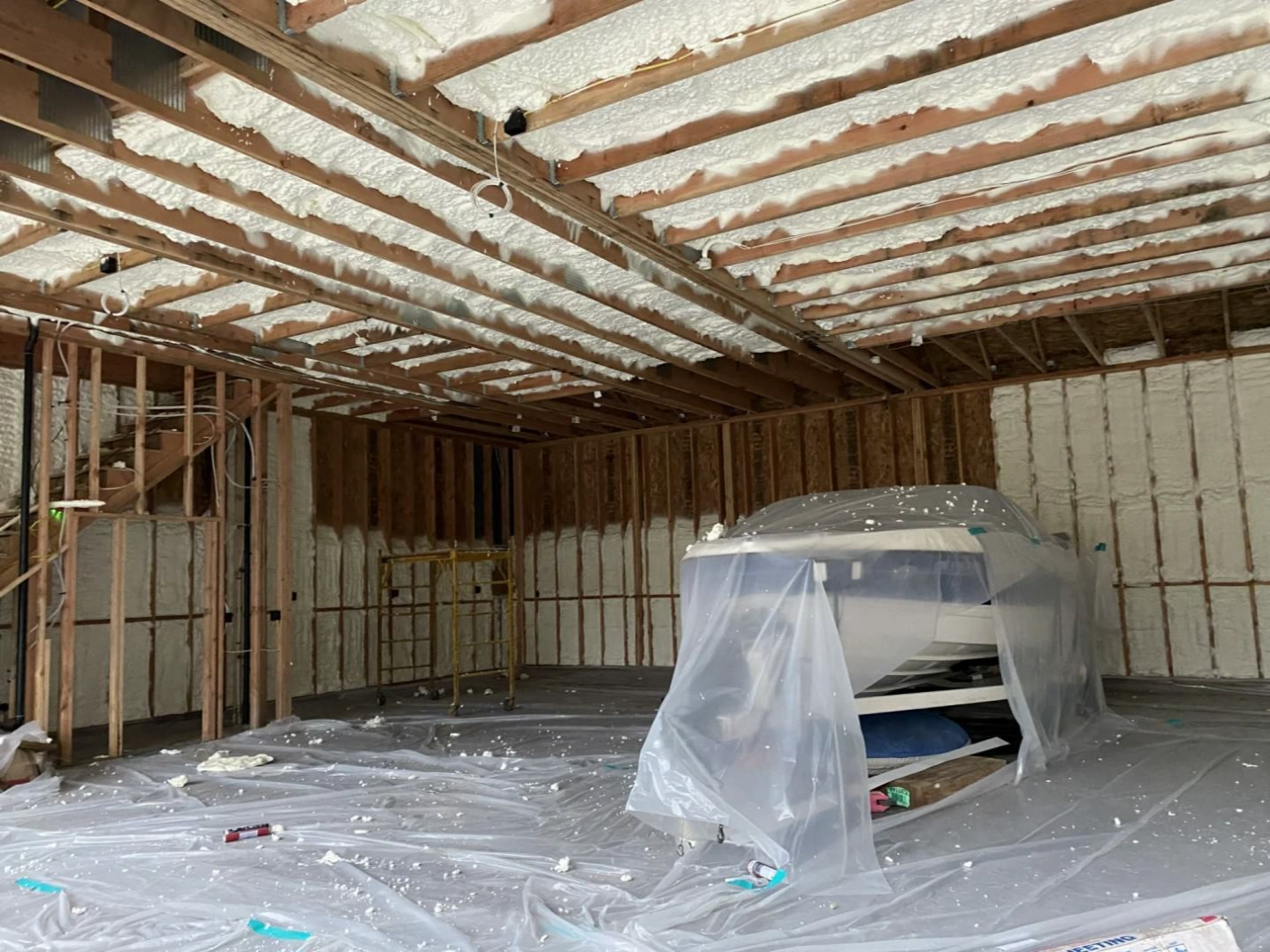
Open cell spray foam insulation in the Battle Ground, Washington area typically costs between $0.28 and $0.75 per board foot, with an average price around $0.32 per board foot. A board foot equals one square foot of area at one inch of thickness, so a 2,000-square-foot attic needing 5.5 inches of open-cell foam would require roughly 11,000 board feet of material. Battle Ground sits in IECC Climate Zone 4 Marine, where winters dip to an average low of 34°F, and annual precipitation exceeds 52 inches, making proper insulation a real priority for homeowners. Open-cell spray foam delivers an R-value of approximately 3.6 per inch, creates an effective air barrier, and is widely used in wall cavities, attics, and above-grade applications throughout the Pacific Northwest.
Understanding the board foot measurement is the first step to calculating your project cost. A board foot is simply one square foot of surface area covered to a depth of one inch. If you have a 1,500-square-foot wall that needs 3.5 inches of open-cell foam, that equals 5,250 board feet (1,500 x 3.5).
Our pricing for open-cell spray foam ranges from $0.28 per board foot on the low end to $0.75 per board foot on the high end, with the typical average project landing around $0.32 per board foot. The final per-board-foot rate depends on several variables we evaluate during every estimate.
| Pricing Tier | Cost Per Board Foot | Typical Scenario |
|---|---|---|
| Low | $0.28 | Large projects with easy access and flexible scheduling |
| Average | $0.32 | Standard residential applications, 1,500-2,500 sq ft |
| High | $0.75 | Small projects, difficult access, or specialized requirements |
Several factors move the needle on your final price. Knowing these helps you plan your project and budget more effectively.
Open-cell and closed-cell spray foam serve different purposes, and the price gap between them is significant. According to the U.S. Department of Energy, both types create effective air barriers, but they differ in density, moisture resistance, and cost.
| Property | Open Cell Foam | Closed Cell Foam |
|---|---|---|
| Cost Per Board Foot | $0.28 – $0.75 | $1.20 – $3.00 |
| R-Value Per Inch | ~R-3.6 | ~R-6.0 |
| Density | 0.5 lbs/cf | 2.0 lbs/cf |
| Moisture Resistance | Vapor permeable; absorbs water | Vapor barrier; water-resistant |
| Best Applications | Walls, attics, sound damping | Basements, crawlspaces, exterior walls |
| Expansion Ratio | ~150x original volume | ~35-50x original volume |
Open cell foam expands significantly more than closed cell foam, which means it fills cavities thoroughly with less raw material. This higher yield per unit of liquid is a major reason open cell costs less per board foot.
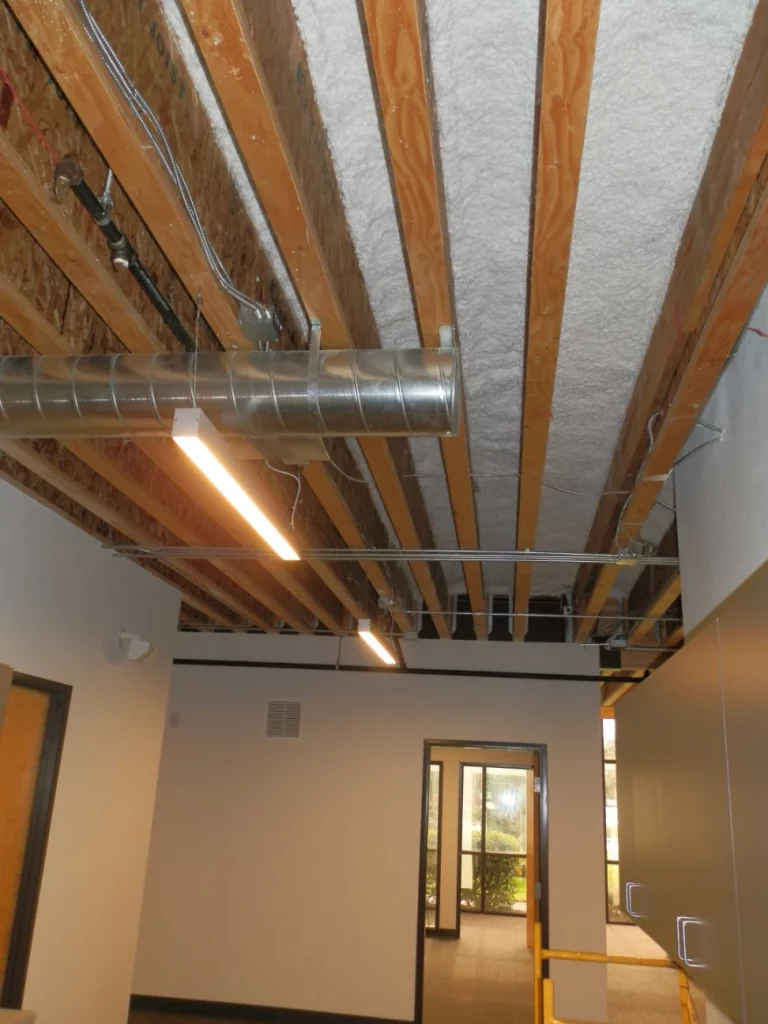
The following table shows realistic project scenarios for Battle Ground area properties using open-cell spray foam at the average rate of $0.32 per board foot.
| Property Type | Location | Application | Board Feet | Estimated Cost |
|---|---|---|---|---|
| 1,800 sq ft ranch home | Battle Ground, WA | Attic (5.5″ depth) | 9,900 | $3,168 |
| 2,200 sq ft two-story | Brush Prairie, WA | Exterior walls (3.5″ depth) | 7,700 | $2,464 |
| 1,500 sq ft farmhouse | Hockinson, WA | Attic + walls (combined) | 13,500 | $4,320 |
| 3,000 sq ft new build | Battle Ground, WA | Full envelope (walls + attic) | 24,000 | $7,680 |
| 1,200 sq ft addition | Yacolt, WA | Wall cavities (3.5″ depth) | 4,200 | $1,344 |
Battle Ground experiences warm, dry summers and cool, wet winters. The Köppen climate classification for this area is warm-summer Mediterranean, with average annual precipitation over 52 inches. Winter lows average around 34°F, and the growing season sees 50-75 frost days per year.
In this marine climate, open-cell spray foam performs well in above-grade applications like wall cavities and attics. The DOE Building America program classifies open-cell foam as “preferred” for cold-climate frame wall applications because of its excellent air-sealing ability and reasonable R-value per inch. The key is pairing it with proper interior vapor control, which our team addresses on every installation.
However, open-cell foam should never be used in below-grade spaces like basements or crawlspaces in the Battle Ground area. Its vapor-permeable nature means it can absorb and hold moisture, creating potential for water damage in below-ground applications.
The DOE Insulation Fact Sheet reports that heating and cooling account for 50% to 70% of energy used in the average American home. Inadequate insulation and air leakage are the leading causes of energy waste. Open-cell spray foam addresses both problems at once by filling cavities completely and creating a continuous air barrier.
According to the DOE guidance, spray foam insulation may qualify for a federal tax credit of 30% of product cost, up to $1,200. This credit applies to insulation and air sealing materials that meet 2021 IECC requirements, which can offset a meaningful portion of your project investment.
The real cost question is not what open-cell foam costs per board foot. It is what you lose when insulation is skipped, underinstalled, or replaced with inferior materials. The DOE Insulation Fact Sheet makes this clear: once energy savings have paid for the installation cost, every dollar of energy conserved is money saved, and savings grow as utility rates increase.
In Battle Ground’s Climate Zone 4 Marine, a home with inadequate insulation loses heat rapidly through walls and ceilings during the long wet season. Drafts, uneven temperatures, and high utility bills are the daily symptoms. Over 10 years, the cumulative cost of wasted energy in an under-insulated home can exceed the full cost of a proper spray foam installation several times over. Getting the R-value right from the start is the difference between a home that performs and one that costs you every month.
Our team at Spray-On Foam & Coatings has been insulating homes and buildings across Battle Ground, Clark County, and the greater Portland-Vancouver metro for years. We understand the local climate, Washington State Energy Code requirements, and the specific challenges of insulating properties in the Pacific Northwest. Every project gets a thorough assessment, honest recommendations on open cell vs. closed cell, and a detailed quote with no surprises.
Request a Free Quote or call us at (360) 667-1993 to discuss your project.
Schedule an On-Site Assessment so we can evaluate your property and recommend the right foam type and thickness.
Let our crew help you lock in real energy savings and year-round comfort for your Battle Ground property.
Multiply the total square footage of the area being insulated by the number of inches of foam depth needed. For example, a 1,000-square-foot attic with 5.5 inches of foam equals 5,500 board feet.
Yes. Open-cell foam is rated “preferred” for cold-climate attic applications by the DOE Building America program, providing both insulation and air sealing in a single step. It expands to fill gaps and voids that fiberglass and cellulose miss.
No. Open-cell foam is vapor-permeable and can absorb moisture, making it unsuitable for below-grade applications. For crawlspaces and basements, closed-cell spray foam is the correct choice because it acts as a vapor barrier and resists water absorption.
Yes. The ENERGY STAR program confirms [ENERGY STAR program] that spray foam insulation qualifies for a federal tax credit of 30% of product cost, up to $1,200, for improvements meeting 2021 IECC requirements. Check with your tax advisor for eligibility details.
A standard 2×4 wall cavity (3.5 inches) filled with open-cell foam provides approximately R-12.6. A 2×6 wall cavity (5.5 inches) delivers approximately R-19.8. Our team will recommend the appropriate depth based on your wall construction and energy code requirements.