
Longview’s commercial builders need to plan insulation early in the design phase, not as an afterthought during final walkthroughs. The Pacific Northwest’s wet, mild winters and warm, dry summers place Cowlitz County in IECC Climate Zone 4C, which means commercial buildings face specific prescriptive R-value and continuous insulation requirements under the Washington State Energy Code. The right approach depends on building type (steel-framed office, metal warehouse, or tilt-up retail), occupancy class, HVAC system design, and whether the project targets code-minimum compliance or above-code performance. Builders who understand modern insulation solutions and their benefits as a coordinated system, rather than a line item tacked onto framing, consistently deliver buildings with lower operating costs, better occupant comfort, and fewer moisture-related callbacks.
Longview and the broader Cowlitz County area fall within IECC Climate Zone 4C, a marine-influenced zone with moderate heating and cooling demands. The Washington State Building Code Council has updated the Washington State Energy Code to align with the 2024 IECC commercial envelope provisions, which means new commercial construction must meet tighter requirements for wall assemblies, roof insulation, fenestration, and air barrier testing than in previous code cycles.
The U.S. Department of Energy‘s Building Energy Codes Program tracks these state-level adoptions and provides resources for builders navigating updated requirements. For builders in Longview, this means that simply repeating the insulation specs from a project permitted two years ago may no longer satisfy current code.
Commercial insulation requirements in the United States follow ASHRAE 90.1, which divides the country into climate zones and sets prescriptive R-value minimums for different wall types. For non-residential steel-framed walls in Climate Zone 4, the prescriptive requirement is R-13 cavity insulation combined with R-7.5 of continuous insulation, while mass walls in the same zone require R-9.5. These continuous insulation layers address thermal bridging through steel framing, a problem that cavity-only insulation cannot solve.
Insulation decisions made during pre-construction have outsized effects on building performance. According to the Insulation Institute, building just to code meets only the legal minimum and does not deliver competitive advantage in energy efficiency, occupant comfort, or acoustic performance. Commercial buildings that exceed code minimums benefit from lower energy costs, higher occupancy rates, and reduced vacancy, which is especially relevant for Longview’s growing retail and office sectors.
The EPA estimates that retro-commissioning existing commercial buildings produces average overall energy savings of 15%, with existing buildings capable of reducing total energy consumption by 20% to 30% through targeted envelope improvements. Designing these savings into new construction from the start, rather than retrofitting later, is always more economical.
Pre-construction insulation planning should cover:
Different commercial building types demand different insulation approaches. The table below outlines common strategies for the building types most frequently constructed in the Longview area.
| Building Type | Common Framing | Recommended Insulation Strategy | Key Considerations |
|---|---|---|---|
| Office / Retail | Steel stud or wood frame | Closed cell spray foam in walls + fiberglass or rigid board in ceilings | Continuous insulation required on steel-framed walls; acoustic performance matters for offices |
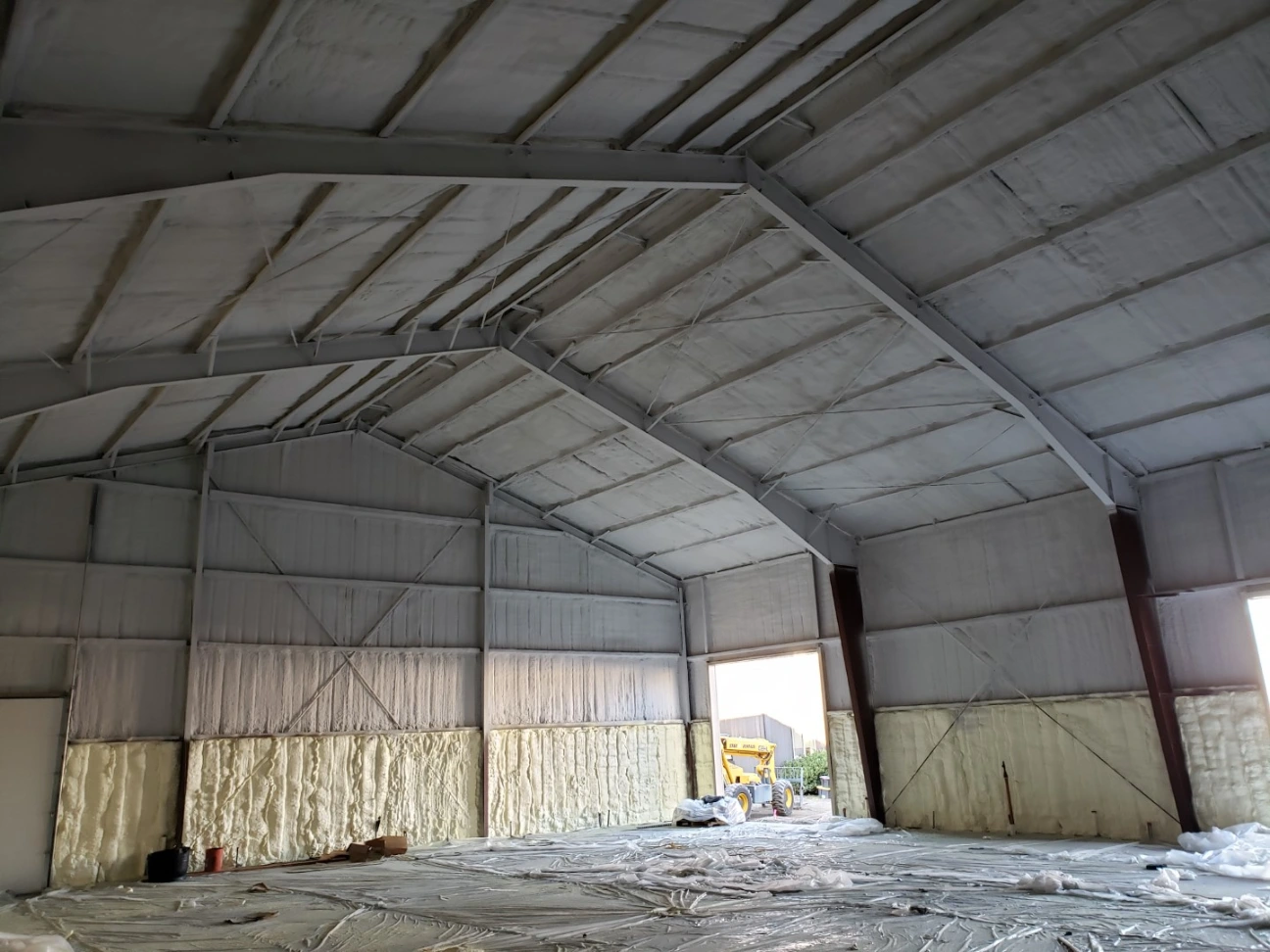
| Warehouse / Distribution | Pre-engineered metal building | Closed cell spray foam on walls and roof deck or insulated metal panels | Thermal bridging through metal purlins and girts; air sealing at all penetrations |
| Pole Barn / Agricultural | Post-frame construction | Closed cell spray foam on walls and roof; spray foam or rigid board in conditioned areas | Condensation control critical in unconditioned spaces; air sealing at eaves and ridge |
| Strip Mall / Mixed-Use | Steel stud or CMU | Closed cell spray foam in stud cavities + continuous rigid insulation outboard | Fire-rating requirements for party walls; acoustic separation between units |
For builders, spray foam insulation in Longview, WA offers distinct advantages for commercial projects. Both open cell and closed cell spray foam products are available, each serving different purposes depending on the application and performance requirements.
Closed cell spray foam delivers higher R-value per inch (approximately R-6 to R-7 per inch), acts as a vapor retarder, and provides structural reinforcement to the wall assembly. It is the preferred choice for commercial walls, metal building envelopes, and below-grade applications where moisture resistance matters.
Open cell spray foam provides a lower R-value per inch (approximately R-3.5 to R-3.7 per inch) at a lower material cost and is vapor-permeable, which allows moisture to diffuse through the assembly. It works well in interior wall cavities, ceilings, and sound-dampening applications where vapor permeability is an advantage.
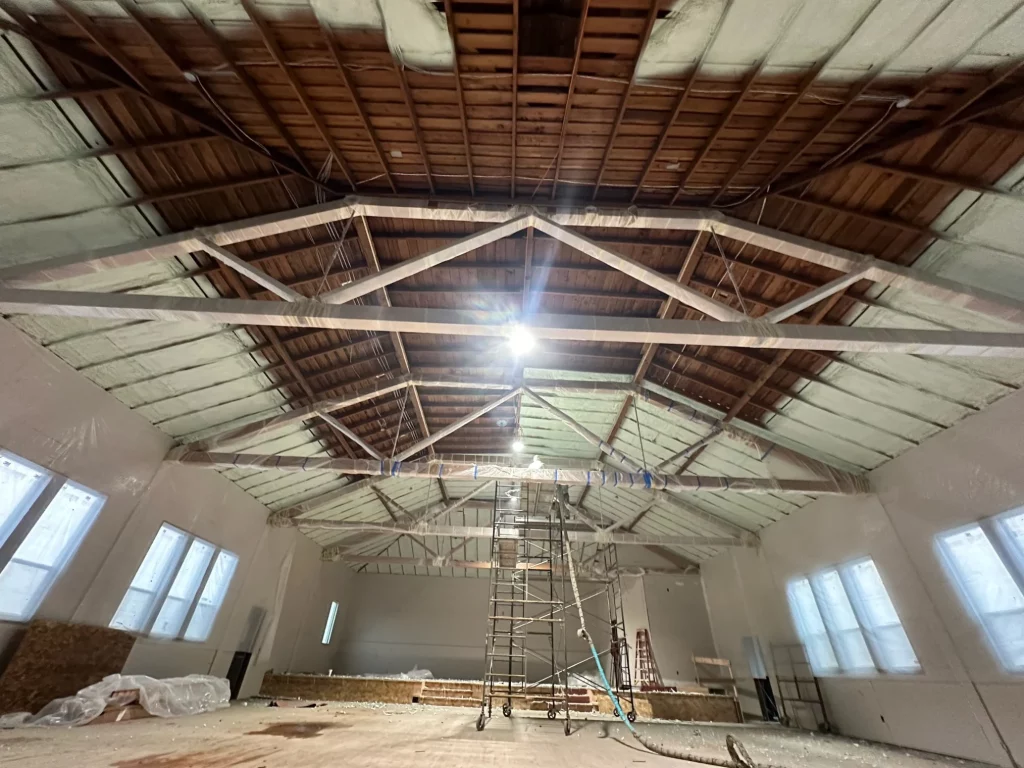
The key advantage of spray foam in commercial construction is that it insulates and air-seals simultaneously. Air leakage through gaps, penetrations, and framing connections can account for a significant portion of a commercial building’s total energy loss. Spray foam expands to fill voids, cracks, and irregular spaces that batt insulation cannot reach, creating a continuous thermal and air barrier.
Air sealing is where many commercial insulation plans fall short. Builders may spec the correct R-value on paper but fail to address the air barrier as a coordinated system. For commercial buildings over 5,000 square feet, updated energy codes increasingly require whole-building air leakage testing, and failure to plan for this during design results in costly remediation at the end of construction. Partnering with a spray foam insulation partner in Longview, WA can help builders coordinate air sealing with the overall building envelope and installation schedule.
Common air leakage paths in commercial buildings include:
Spray foam insulation applied to wall cavities, roof assemblies, and rim joist areas addresses many of these leakage points during the insulation phase, reducing the risk of test failures and the remediation costs that follow.
Longview’s climate presents a moisture management challenge that builders cannot ignore. The marine influence means high relative humidity for much of the year, creating vapor drive conditions that can trap moisture within wall assemblies if insulation and vapor barriers are not correctly detailed.
Key moisture management principles for Longview commercial construction:
For small commercial offices and professional buildings (under 10,000 sq ft): Closed cell spray foam in exterior wall cavities combined with air sealing at all penetrations provides strong thermal performance and simplifies compliance. Target R-13 cavity plus R-7.5 continuous for steel-framed walls. Our spray foam services typically start at $3,500 for small commercial projects.
For warehouses and industrial facilities: Pre-engineered metal buildings benefit from spray foam applied directly to metal roof decks and wall panels, addressing thermal bridging and air leakage simultaneously. For pole barn structures, dedicated pole barn insulation services address the unique challenges of post-frame construction.
For retail and strip mall construction: Focus on party-wall acoustic separation, storefront perimeter insulation, and roof assembly R-values. Closed cell spray foam in stud cavities paired with continuous rigid board insulation on the exterior meets code and improves occupant comfort in tenant spaces.
For multi-tenant commercial: Coordinate insulation specs with the HVAC design early. Right-sizing equipment based on actual envelope performance rather than worst-case assumptions reduces both first cost and operating cost.
Choosing an insulation contractor in Longview, WA for commercial new construction goes beyond finding the lowest bid. Look for these indicators:
Spray-On Foam & Coatings has been helping Longview-area builders and developers plan and install insulation for commercial new construction across Cowlitz County and the broader Pacific Northwest. Our team handles closed cell spray foam, open cell spray foam, pole barn insulation, crawl space insulation, and air sealing for projects ranging from small professional offices to large warehouses. We work with your design team during pre-construction to coordinate insulation specs with framing layouts, HVAC sizing, and code compliance requirements.
Request a Free Quote | Schedule a Consultation
Call us at (360) 667-1993 or email [email protected] to discuss your commercial project. The earlier we are involved in your planning process, the more value we can deliver on insulation performance, code compliance, and long-term building durability.
Longview falls within IECC Climate Zone 4C. Under ASHRAE 90.1, non-residential steel-framed walls in Zone 4 require a minimum of R-13 cavity insulation plus R-7.5 continuous insulation. Roof and slab requirements vary by assembly type.
Closed cell spray foam is generally the better choice for commercial exterior walls in the Pacific Northwest because it provides higher R-value per inch, acts as a vapor retarder, and adds structural rigidity. Open cell spray foam suits interior applications where vapor permeability and cost efficiency are priorities.
Ideally during the pre-construction phase. Involving your insulation contractor early allows coordination with framing layouts, HVAC design, vapor barrier placement, and code compliance, all of which affect final building performance and avoid costly change orders.
Yes. Both open cell and closed cell spray foam create an effective air barrier when applied to wall cavities, roof assemblies, and rim joist areas. This dual function, insulation plus air sealing, is one of the primary advantages of spray foam in commercial construction.
Our minimum project size is $3,500. We handle a range of commercial building types including new construction offices, warehouses, retail spaces, pole barns, and multi-tenant buildings throughout the Longview area and surrounding Cowlitz County communities.