
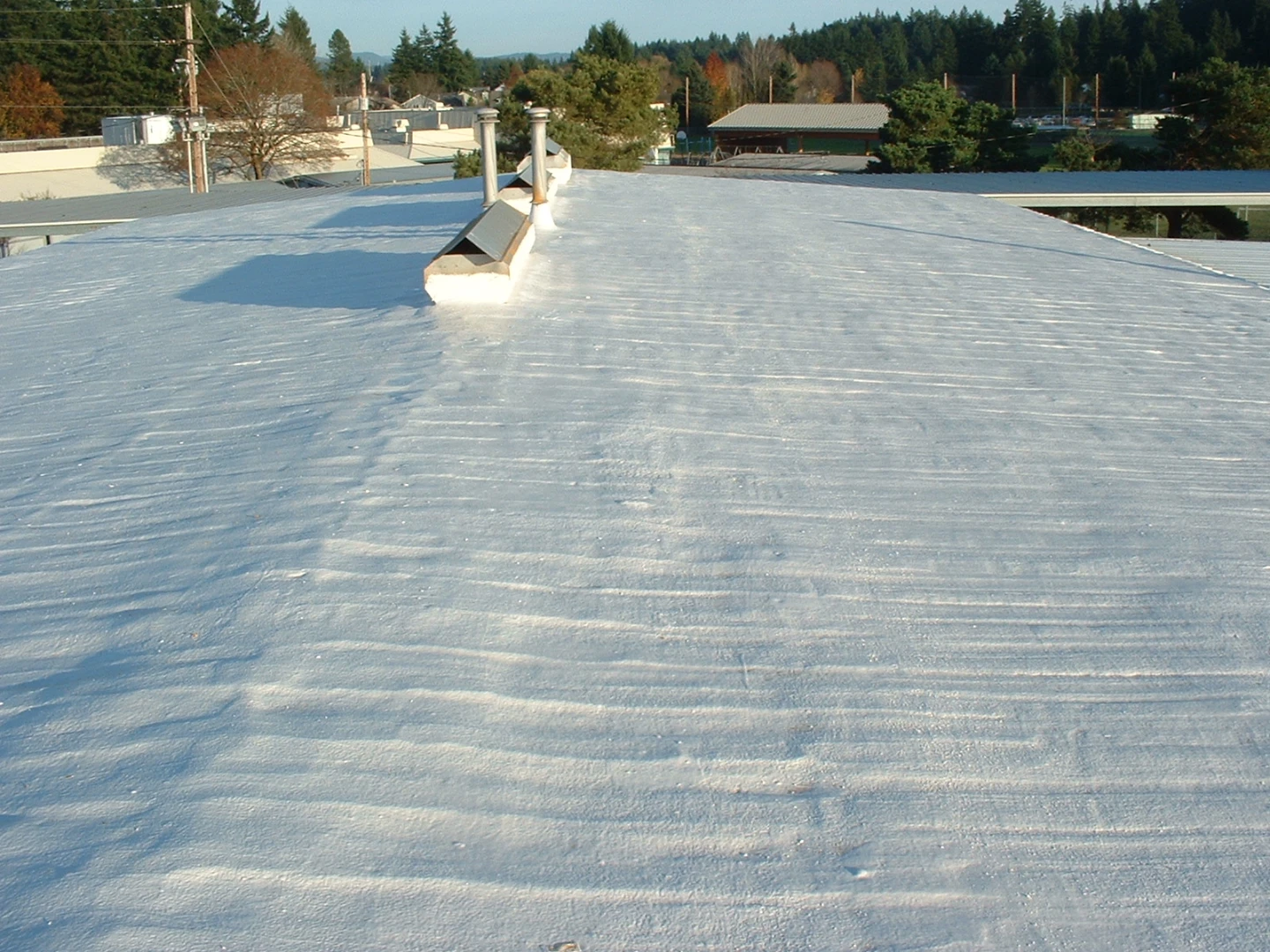
A waterproof topcoat is the external barrier that shields spray polyurethane foam (SPF) from UV radiation, weather exposure, and physical wear. Without it, SPF degrades rapidly when exposed to sunlight, losing both its protective function and structural integrity. The topcoat serves as the waterproofing membrane on top of the foam, creates a seamless seal against moisture infiltration, and reflects solar energy to reduce cooling costs. Choosing the right coating type and applying it at the correct thickness determines whether an SPF roof lasts a decade or performs well beyond 30 years.
Spray polyurethane foam roofing consists of a rigid, closed-cell foam that is spray-applied directly to a roof substrate. According to the Insurance Institute for Business & Home Safety (IBHS), the SPF itself forms a waterproofing membrane and serves as insulation, but SPF surfaces degrade over time when exposed to ultraviolet radiation from sunlight. When unprotected, the foam surface initially discolors and darkens, then the top skin becomes friable, and eventually the foam thickness erodes away entirely.
This degradation process is not a matter of “if” but “how fast.” Even brief UV exposure starts breaking down the polymer structure of the foam. That is why every properly installed SPF roofing system includes a protective covering as a mandatory third component, alongside the substrate and the foam layer itself.
The topcoat addresses four specific threats that would otherwise compromise the foam:
A waterproof topcoat for an SPF roof is a liquid-applied elastomeric membrane. It is sprayed onto the cured foam surface, where it flows into the textured profile, bonds directly to the foam, and cures into a continuous, seamless rubber-like film. This film must meet the same fundamental physical requirement: a minimum of 100 percent elongation, meaning it can be stretched to at least twice its original length and snap back to its exact original dimensions.
Roof coating solution follows a two-step process. The IBHS guide notes that the base coat is applied the same day or within 24 hours after the foam is sprayed, directly onto the SPF surface. The base coat is inspected and repaired before the top coat goes on. Both coats are typically applied in contrasting colors, which allows inspectors to verify uniform coverage and identify thin spots visually.
Total dry film thickness (DFT) is verified by taking slit samples and examining them under magnification. Any areas below the minimum specified thickness receive additional coating before the project is considered complete.
Even though closed-cell SPF is inherently waterproof, the topcoat provides a critical additional layer of water resistance. It seals hairline cracks that can form in the foam from thermal movement, fills micro-voids in the foam surface texture, and creates a continuous membrane that routes water toward drains. In ponding-prone areas where water accumulates, the coating prevents sustained contact between standing water and the foam surface.
Not all coatings perform the same way on spray foam. Each chemistry has specific strengths and trade-offs. The IBHS technical guide identifies five primary coating types used over SPF roofing:
| Coating Type | Key Strengths | Best Suited For | Main Limitation |
|---|---|---|---|
| Acrylic | Water-based, easy cleanup, good weathering resistance, high moisture vapor permeability | Sloped roofs, climates with moderate weather | Shorter service life, poor performance against ponding water |
| Silicone | Exceptional weather resistance, withstands temperature extremes, high vapor permeability | Flat and low-slope roofs, ponding water conditions, hot climates | Higher material cost, slippery when wet |
| Polyurethane | Strong impact resistance, excellent tensile strength, good adhesion | Roofs with heavy foot traffic, industrial facilities | Can be sensitive to moisture during application |
| Butyl | Extremely low water vapor permeability | Cold storage, freezer facilities, cryogenic applications | Requires a topcoat for exterior weathering resistance |
| Polyurea | Fast curing, tough and chemical resistant, wide weather application window | Projects with tight timelines, roofs exposed to chemicals | Requires specialized plural-component equipment and trained applicators |
Acrylic coatings are the most accessible option. They are water-based, which simplifies cleanup and reduces odor during application. Their high moisture vapor transmission rate allows trapped moisture from within the roof assembly to escape without blistering the coating. This makes acrylic a reasonable choice on sloped roofs where water drains quickly. On flat roofs with ponding issues, however, acrylic tends to chalk and erode faster than other options.
Silicone coatings stand out for their durability under direct sunlight and their tolerance for ponding water. Unlike acrylic, silicone does not degrade, chalk, or become brittle from prolonged UV exposure. It erodes much more slowly and retains its flexibility across temperature extremes. This makes silicone the preferred choice for flat and low-slope commercial roofs where drainage is less than ideal.
Polyurethane coatings offer superior tensile strength and impact resistance, making them a fit for roofs that receive regular foot traffic or serve as access points for equipment maintenance. Polyurea takes this further with extremely fast cure times and the ability to be applied in a wider range of temperature and humidity conditions. Both require experienced applicators and specialized plural-component spray equipment.
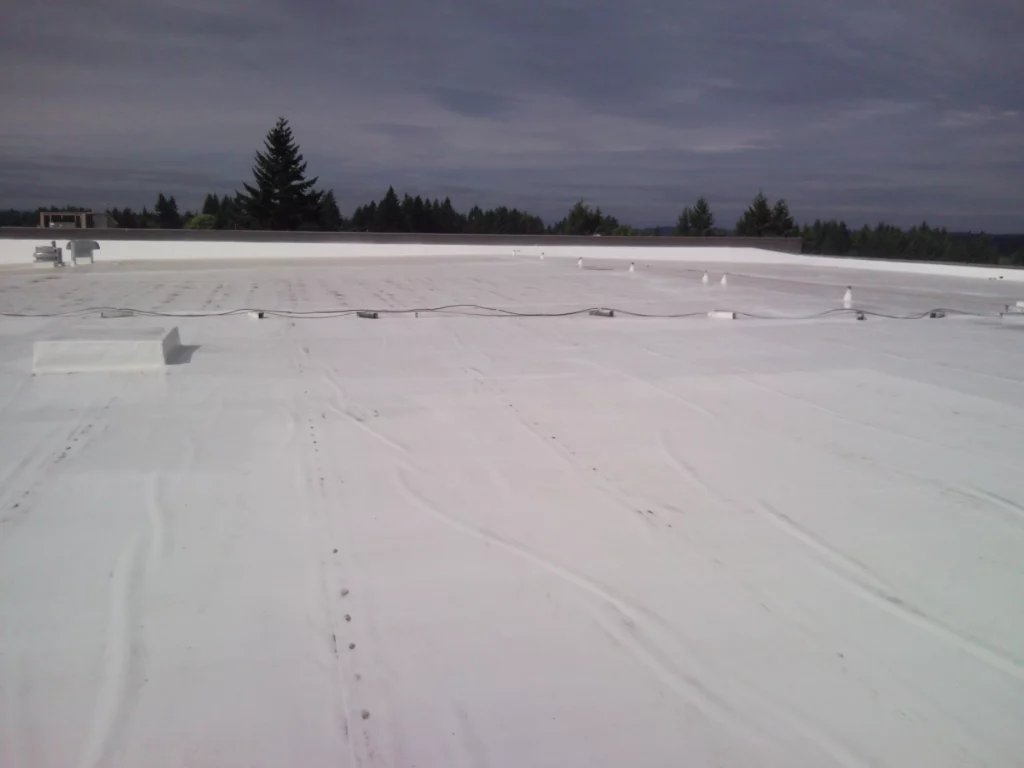
Beyond waterproofing, the topcoat on an SPF roof plays a major role in a building’s energy efficiency. White and light-colored elastomeric coatings reflect a significant portion of solar radiation away from the building. According to ENERGY STAR, a cool roof coating lowers the roof surface temperature and decreases the amount of heat transferred into the building.
The U.S. Environmental Protection Agency reports that in air-conditioned buildings, cool roofs can reduce peak cooling demand by 11 to 27 percent. Lawrence Berkeley National Laboratory data cited by ENERGY STAR shows that a clean white roof reflecting 80 percent of sunlight can stay about 50 degrees Fahrenheit cooler than a grey roof reflecting only 20 percent.
The U.S. Department of Energy’s Federal Energy Management Program has calculated that ENERGY STAR-qualified cool roof products deliver lifetime energy cost savings of at least $0.64 per square foot compared to conventional dark roofs. Best available models can save up to $1.11 per square foot over a 30-year product life.
For SPF roofing specifically, this is a natural advantage. The foam already provides high R-value insulation (approximately 5.5 to 6.5 per inch), and a reflective topcoat reduces the heat load the insulation must manage. Together, the foam and coating create a roof system that simultaneously resists heat transfer through conduction and reflects radiant heat away from the building.
The service life of a topcoat depends on several factors: the coating chemistry, the original application thickness, local weather conditions, roof slope, foot traffic patterns, and maintenance frequency. The IBHS guide reports that coating systems generally need reapplication every 10 to 20 years depending on the generic type and original thickness. Historical data indicates that maintained SPF roofs can last well beyond 30 years.
Natural aging occurs gradually. The coating thins over time from weathering, UV exposure, and surface erosion. When the coating becomes thin enough to expose the underlying foam, UV degradation begins. The good news is that an SPF roof does not need to be torn off when the coating wears out. The existing coating surface is cleaned, repaired, and recoated with fresh material. The foam underneath remains intact and functional as long as it has been protected throughout its service life.
The IBHS recommends inspecting SPF roofs twice per year, once in spring and once in fall, checking for coating wear, exposed foam, cracking, blistering, pinholes, and separation at flashings. Small punctures can be repaired with compatible sealant, while areas of general coating wear are addressed with a full recoat when the coating reaches the end of its serviceable life.
Different building types and use cases call for different coating strategies. Here is guidance based on common scenarios:
Commercial flat roofs with HVAC equipment and regular foot traffic: Silicone or polyurethane coatings provide the best combination of ponding water tolerance, UV resistance, and durability. Polyurea is also a strong option when chemical exposure or fast turnaround is a factor. Specify a higher dry film thickness in high-traffic areas and add embedded granules for traction.
Cold storage and refrigerated facilities: Butyl coating as a base layer provides the extremely low vapor permeability needed to prevent moisture drive from reaching the foam. A silicone or polyurethane topcoat over the butyl protects against exterior weathering.
Residential low-slope and flat roofs: Acrylic coatings offer adequate protection at a lower material cost when the roof has sufficient slope for drainage. Silicone provides a longer service life for flat sections where ponding occurs.
Steep-slope SPF applications: Any elastomeric coating type works on steep slopes since drainage is rapid and ponding is not a concern. Acrylic is the most economical choice for these conditions.
Recognizing when a coating is approaching the end of its service life prevents costly foam damage. Watch for these indicators:
A qualified SPF roofing contractor can assess coating condition through visual inspection, slit-sample thickness testing, and moisture scanning. If caught early, recoating is straightforward and far less disruptive than a full roof replacement.
Spray-On Foam & Coatings provides professional spray foam roofing installation and waterproof topcoat application for commercial and residential buildings throughout the Vancouver, Washington and Portland, Oregon metro areas. Our experienced team evaluates your existing roof substrate, recommends the right coating chemistry for your building type and climate exposure, and applies each system to manufacturer specifications with verified dry film thickness.
Request a Free Quote | Schedule a Roof Assessment
Contact us at (360) 667-1993 or email [email protected] to discuss your roofing project. We install every SPF roof system with the coating it needs to perform for decades, not just years.
No. Unprotected SPF degrades rapidly under UV exposure, causing the foam surface to discolor, become friable, and erode. A waterproof topcoat is a mandatory component of every SPF roofing system.
Coating reapplication is typically needed every 10 to 20 years, depending on the coating type, original thickness, and local weather conditions. Regular inspections help determine the right timing for your specific roof.
White and light-colored coatings reflect significantly more solar radiation than dark coatings, reducing roof surface temperature and lowering cooling energy costs. ENERGY STAR-qualified cool roof coatings can reduce peak cooling demand by 11 to 27 percent.
Yes. One of the main advantages of SPF roofing is that when the coating wears out, the foam underneath can remain intact. The surface is cleaned, repairs are made, and fresh coating is applied directly over the existing system.
Silicone coatings have the highest tolerance for ponding water among common elastomeric coating types. They do not degrade, chalk, or erode from sustained water exposure, making them the preferred choice for flat commercial roofs with drainage challenges.