
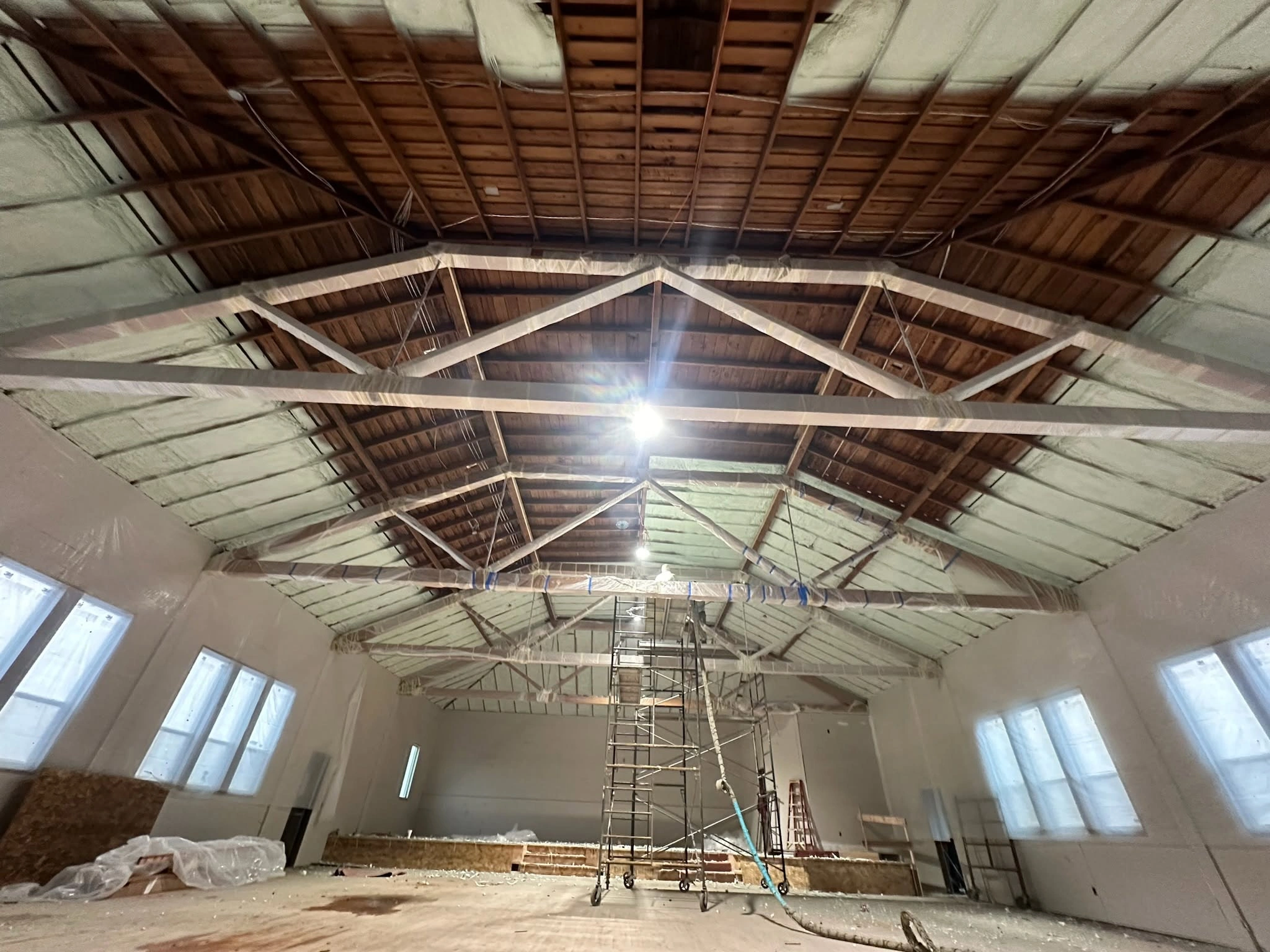
Spray foam insulation in Battle Ground, WA is the most practical way to seal difficult building areas such as rim joists, crawl space walls, vaulted ceilings, cantilevered overhangs, and pole barn framing because it expands 30 to 60 times its liquid volume, filling the irregular gaps that batts and rigid boards physically cannot reach. In Battle Ground, WA, where the area averages 52.37 inches of precipitation across roughly 178 wet days per year, those hidden gaps pull damp air into wall and roof cavities, so closing them protects both your energy budget and your building materials. The right foam depends on the space: closed cell suits wet, tight areas like crawl spaces and rim joists, while open cell excels at sound control and interior cavities.
Battle Ground sits in Clark County’s marine climate, where November, December, and January each average more than 7 inches of rain. That moisture matters because the hardest-to-seal areas of any building, rim joists, crawlspace perimeters, and roof transitions, sit exactly where damp air concentrates.
The physics work against you year-round. Heated air rises and escapes through upper gaps, which draws cold, damp replacement air in through the lower ones. That pressure pattern constantly moves moisture into framing cavities. The EPA’s guidance is blunt: moisture control is the key to mold control, and water-damaged materials must dry within 24 to 48 hours to prevent growth. In our climate, keeping damp air out of cavities in the first place is far easier than drying them after the fact, and the EPA recommends holding indoor humidity between 30% and 50% to stay ahead of condensation and mold.
| Difficult Area | Why Batts and Boards Struggle | How Spray Foam Seals It |
|---|---|---|
| Rim joists and band boards | Dozens of fastener holes and joint seams at every sill | Foam fills every hole and seam in one pass |
| Crawl space walls | Ground moisture, irregular stone or block foundations | Closed cell bonds to masonry and doubles as a vapor barrier at 2 inches |
| Vaulted and cathedral ceilings | Shallow rafter bays crowded with wiring and vent chases | Expands around obstructions without leaving voids |
| Cantilevers and overhangs | Framing open on five sides, floors above stay cold | Fills the entire underside cavity, stopping convective loss |
| Knee walls and bonus rooms | Short, sloped, and angled surfaces that resist flat batts | Foam conforms to any angle with no stapling or support |
| Pole barns and shops | Deep girts, exposed steel, and huge overhead surface area | Sprays directly onto metal and wood, even overhead planes |
These are the spaces where loose-fill and batt insulation lose the most performance. Foam’s most important attribute is air sealing, which blocks convective heat transfer because heat cannot move through the envelope without air movement to carry it. In other words, the material that fills the gap also stops the airflow that makes the gap expensive.
| Property | Closed Cell (ccSPF) | Open Cell (ocSPF) |
|---|---|---|
| R-value per inch | R-5.1 to R-6 (long-term thermal resistance) | About R-3.8 |
| Texture and density | Rigid, medium-density “2 lb” foam | Semi-rigid, sponge-like half-pound foam |
| Moisture role | Air barrier and vapor barrier at about 2 inches | Air barrier at 5.5 inches or more, vapor permeable |
| Best difficult areas | Crawl spaces, rim joists, pole barns, metal, undersides | Interior walls, sound damping, conditioned attic decks |
| Installed price per board foot | $1.20 to $3.00 (average $1.50) | $0.28 to $0.75 (average $0.32) |
A board foot is one square foot sprayed one inch thick. Closed-cell spray foam costs more per board foot because it is denser and does more work: it insulates, air seals, and controls vapor at the same time.
Our rule of thumb is a simple moisture test. Any surface that can get wet from the outside, from ground contact, or from condensation gets closed cell. Dry, interior, noise-sensitive cavities are the natural candidates for open cell, which also absorbs airborne sound. This one test answers the open-versus-closed question for most homeowners we meet in Battle Ground.
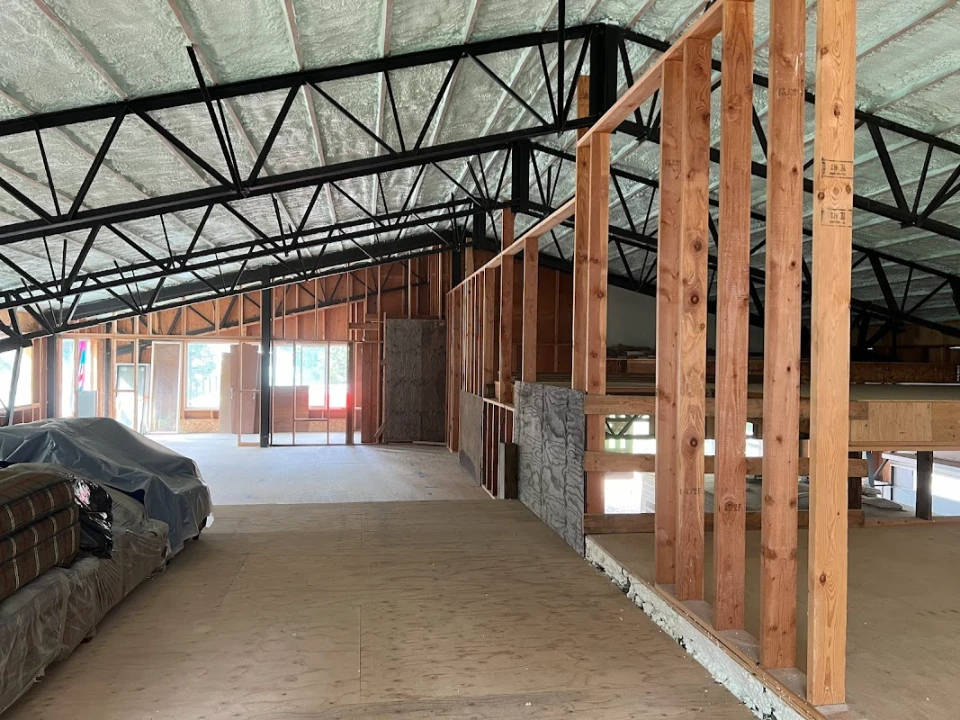
Two liquid parts meet at the spray gun and react on contact, expanding 30 to 60 times their volume before curing into a solid, lightweight structure. That expansion is the entire advantage in difficult areas: the foam flows around wiring, plumbing, duct straps, and doubled framing, then adheres to irregular and angled surfaces so no voids remain behind obstructions. Our guide to spray foam insulation covers more about how this material works and where it can be used. Because it air seals as it insulates, one application replaces separate insulation and air barrier work in most assemblies. Once cured, the foam is completely inert and non-toxic.
The numbers from federal modeling are specific. The EPA estimates air sealing plus insulation in attics, floors over crawl spaces, and accessible rim joists saves an average of 15% on heating and cooling costs, or 11% on total energy costs, based on achieving a 25% reduction in air infiltration. For climate zone 4C, the marine zone that covers western Washington, the modeled savings reach 13% of total house energy and 20% of heating and cooling costs. ENERGY STAR also notes that sealing and insulating can deliver up to 10% savings on total annual energy bills.
Studies cited by the Department of Energy attribute roughly 40% of a home’s energy loss to air infiltration through walls, windows, and doorways, which is exactly the leakage path foam eliminates. Pair that with the EPA’s moisture guidance and the case writes itself in a 52-inch rainfall climate: an airtight, foam-sealed envelope is the cheapest way to keep damp air out of the cavities you cannot see.
Four factors set most project prices in Clark County:
For planning purposes, air sealing projects in our service area run from $1,500 (average $4,500, up to $10,000), crawl space insulation from $1,500 (average $5,500, up to $35,000 for complex builds), and pole barn insulation from $3,500 (average $8,500, up to $50,000 for large agricultural structures). Most residential work lands near the middle of those ranges.
| Building Type | Recommended Approach | Key Notes |
|---|---|---|
| Retrofit homes (1970s to 1990s) | Air sealing plus attic and crawl space upgrades | Largest modeled savings, 15% to 20% on heating and cooling |
| New construction | Closed cell at rim joists, open cell in walls | Foam before drywall, no retrofit access issues |
| Rural shops and pole barns | Closed cell on metal framing and rooflines | Condensation control on steel is the priority |
| Commercial buildings | Closed cell at transitions and penetrations | One product delivers thermal and air barrier |
Retrofit homes gain the most because their batts were never air barriers. New construction lets us sequence the envelope correctly from the start. Shops and barns benefit from foam’s grip on metal, where tape and board products eventually detach.
At Spray-On Foam & Coatings, we specialize in exactly the areas other insulation skips: rim joists, crawl spaces, vaulted ceilings, cantilevers, and pole barns across Battle Ground and the surrounding Clark County zip codes. Our team will inspect your difficult areas, recommend the right foam for each one, and give you clear per-board-foot pricing with no surprises. Call us at (360) 667-1993 or email [email protected] to get started.
Request a Free Quote | Schedule an Insulation Assessment
A building that is sealed right the first time stays comfortable, dry, and efficient for decades.
Once cured, the foam is completely inert and non-toxic. During curing it releases fumes, so our team keeps occupants out of the space until the cure is complete.
Closed cell, because it bonds to masonry and acts as both an air and vapor barrier at about 2 inches of thickness. With our area’s 52-inch annual rainfall, an open cell vapor-permeable application is the wrong call on below-grade surfaces.
Yes. Small holes drilled between studs allow the cavity to be filled with foam without removing drywall, then the holes are patched and finished.
Air sealing projects start at $1,500 and average $4,500, while crawl space projects start at $1,500 and average $5,500. Large or low-access builds can run higher, which is why we quote by board foot and access.
Insulation and air sealing upgrades can qualify for federal residential energy efficiency tax credits. ENERGY STAR maintains current eligibility details, and we will help you document your project.