

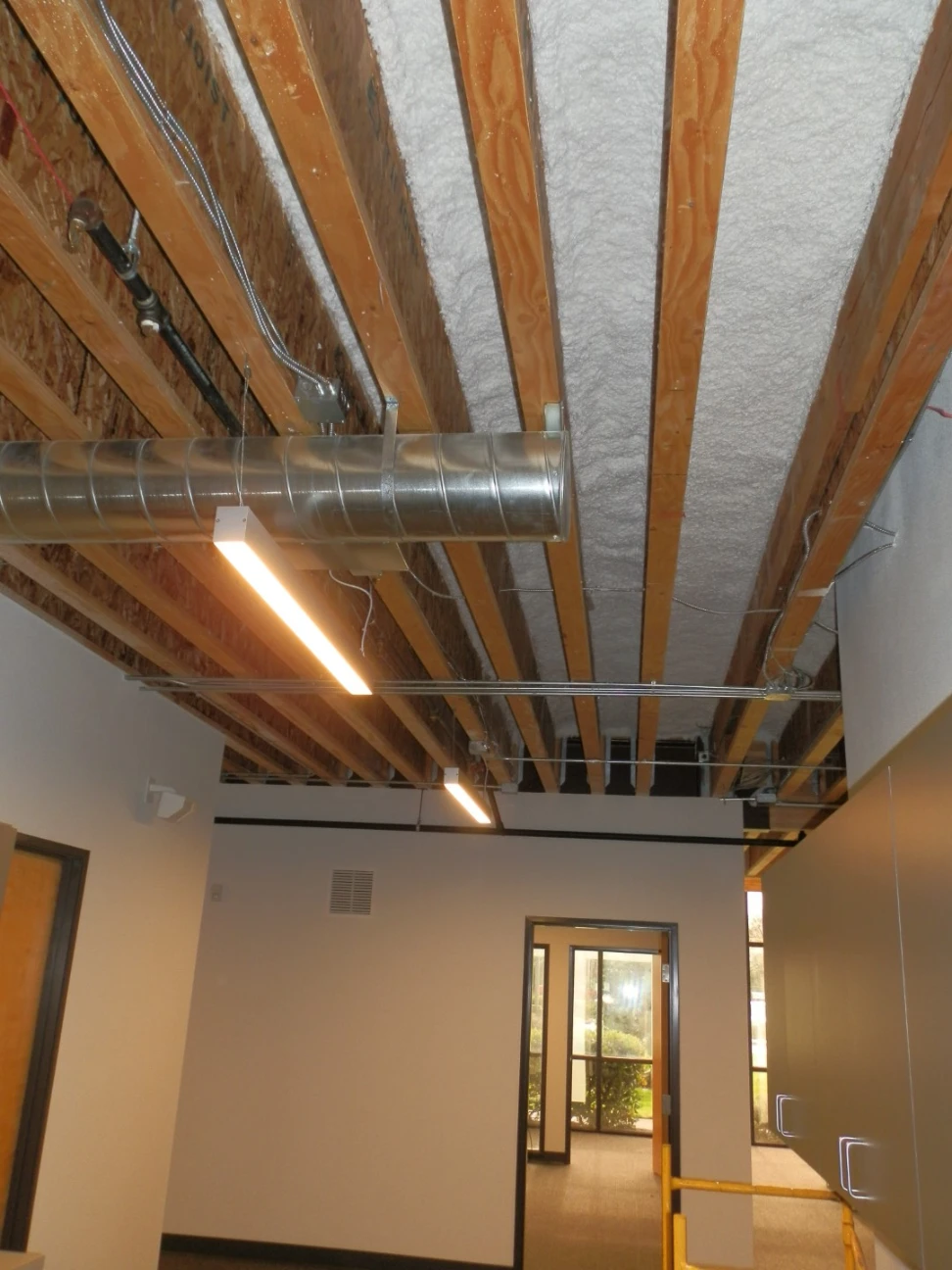
Closed-cell spray foam in Battle Ground, WA, typically costs between $1.20 and $3.00 per board foot, with most projects averaging around $1.50 per board foot. A board foot equals one square foot of surface area covered at one inch of thickness, so a 1,000 square foot wall sprayed two inches deep requires 2,000 board feet. Project size is the single biggest factor that affects pricing: larger jobs generally receive a lower per-board-foot rate. Battle Ground sits in Washington State’s Climate Zone 5, where the 2023 Washington State Energy Code demands R-20+5ci for wood frame walls and R-60 for ceilings, making closed-cell spray foam an effective way to meet or exceed these requirements with less material thickness than alternatives.
A board foot is not the same as a square foot. Square feet measure area (length times width). Board feet add the third dimension of depth. The formula is straightforward:
Square Feet x Inches of Thickness = Board Feet
For example, if you have a 500 square foot crawlspace wall and want two inches of closed cell foam, you need 1,000 board feet of material. At our average rate of $1.50 per board foot, that project runs approximately $1,500 for the foam itself.
This distinction matters because thickness directly drives cost. A project that doubles its foam depth doubles the board footage, and therefore doubles the material and labor required.
| Pricing Tier | Cost Per Board Foot | Typical Project Range | Best For |
|---|---|---|---|
| Low | $1.20 | Large-scale projects, new construction | Builders and commercial jobs with high volume |
| Average | $1.50 | Most residential projects | Homeowners doing retrofit or standard builds |
| High | $3.00 | Small or complex jobs, tight access | Specialized applications, hard-to-reach areas |
These figures reflect our actual pricing at Spray-On Foam & Coatings for the Battle Ground area and surrounding Clark County communities.
| Project Type | Location | Approximate Board Feet | Estimated Cost Range |
|---|---|---|---|
| 2,000 sq ft home, walls only (2″ depth) | Battle Ground, WA | 4,000 bd ft | $4,800 – $6,000 |
| Crawlspace walls, 1,500 sq ft home | Brush Prairie, WA | 1,500 bd ft | $1,800 – $4,500 |
| Pole barn insulation (full project) | Ridgefield, WA | Varies | $3,500 – $50,000 |
| Attic retrofit, 2,500 sq ft (3″ depth) | Vancouver, WA | 7,500 bd ft | $9,000 – $22,500 |
| New construction walls + crawlspace | La Center, WA | 6,000 bd ft | $7,200 – $9,000 |
Closed-cell spray foam costs more per board foot than open-cell because of what it delivers in a single application. According to the U.S. Department of Energy, closed-cell polyurethane foam contains a low-conductivity gas in its cells and provides higher thermal resistance per inch than nearly any other insulation material on the market.
Here is what that higher per-board-foot cost actually buys:
1. Superior R-Value Per Inch
Closed-cell foam delivers R-5.7 to R-7.0 per inch, compared to R-3.2 for fiberglass batts. This means you can achieve code-compliant insulation levels in thinner applications, which matters in walls with limited cavity depth.
2. Built-In Air Barrier
Spray foam adheres directly to framing, sheathing, and studs, creating a continuous seal that eliminates the gaps and voids common with batt insulation. The Spray Foam Coalition confirms that both open-cell and closed-cell spray foam function as effective air barriers without requiring additional materials.
3. Moisture and Vapor Protection
Closed-cell spray foam qualifies as a Class II vapor retarder as defined by the International Residential Code. In Battle Ground’s damp Pacific Northwest climate, this built-in moisture resistance helps prevent condensation, mold growth, and wood rot inside wall cavities.
4. Flood Damage Resistance
FEMA rates sprayed polyurethane foam (closed cell) as an “Acceptable” flood-damage-resistant material in their Technical Bulletin 2. It is the only cavity insulation to receive this rating, meaning it can withstand at least 72 hours of direct floodwater contact without sustaining significant damage requiring more than cosmetic repair.
5. Structural Reinforcement
Because of its dense, rigid cell structure, closed-cell foam adds rigidity to walls and roof decks, improving the building’s structural performance under wind and seismic loads.
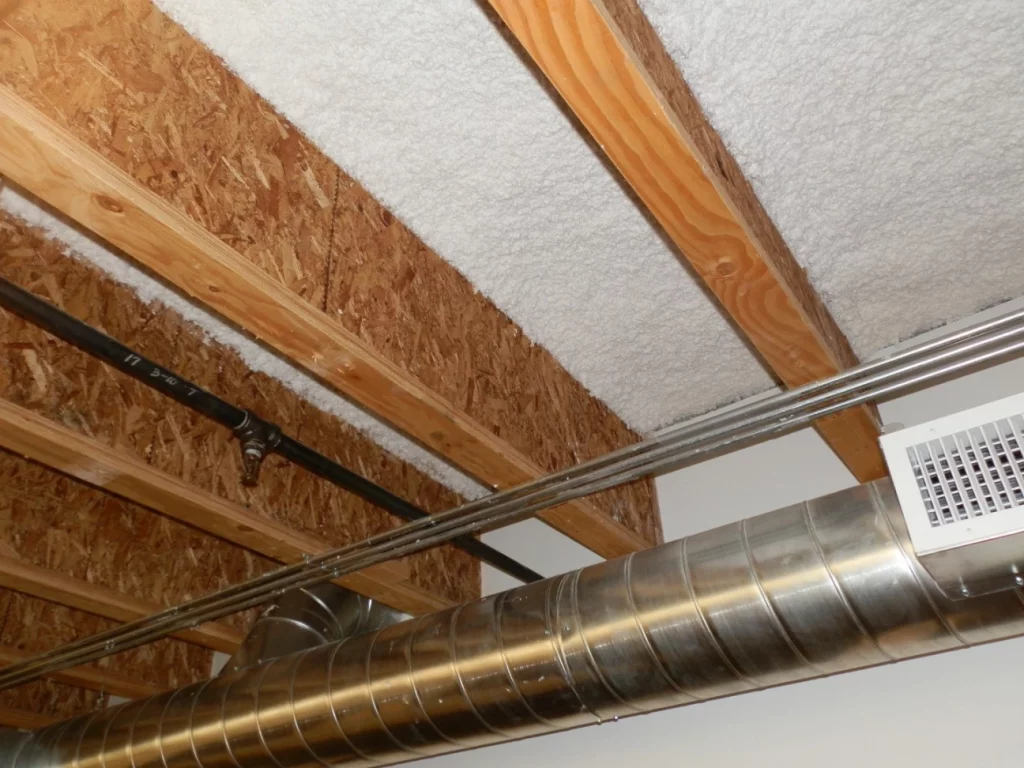
Clark County, where Battle Ground is located, falls within IECC Climate Zone 5. The Insulation Institute’s Washington State energy code guide confirms Clark County’s classification and the corresponding insulation requirements.
The 2023 Washington State Energy Code Summary (based on the 2021 IECC) raised the bar for residential insulation requirements in Zone 5:
| Building Assembly | 2023 WSEC Requirement |
|---|---|
| Wood Frame Walls | R-20 + 5ci or R-13 + 10ci |
| Ceilings | R-60 |
| Basement Walls | R-10/R-15/R-21 + 5TB |
| Slab on Grade | R-10, 4 ft depth |
| Crawl Space Walls | R-10/R-13 |
With closed-cell foam at R-6 to R-7 per inch, you can hit R-20 in roughly three inches of cavity fill, compared to over six inches of fiberglass. This is especially relevant for retrofit projects in older Battle Ground homes where wall cavity depth is limited.
| Feature | Closed Cell | Open Cell |
|---|---|---|
| Cost per board foot | $1.20 – $3.00 | $0.28 – $0.75 |
| R-value per inch | R-5.7 to R-7.0 | R-3.6 |
| Moisture barrier | Yes (Class II vapor retarder) | No |
| Air barrier | Yes | Yes |
| Flood damage resistance | Acceptable (FEMA) | Not rated |
| Best applications | Crawlspaces, exterior walls, basements, pole barns | Interior walls, attic floors, sound-dampening |
The conversation about cost per board foot often misses the bigger picture. What happens when you choose the cheapest insulation option for your Battle Ground home, and it falls short?
Air leakage accounts for a significant portion of energy loss in typical homes. The U.S. Department of Energy notes that foam-in-place insulation can fill even the smallest cavities and create an effective air barrier, something fiberglass and cellulose simply cannot do on their own.
Under-insulating means higher monthly energy bills for the entire life of the building. It means potential moisture problems in crawlspaces and walls that lead to mold, rot, and expensive remediation. It means struggling to meet the Washington State Energy Code on inspections, causing construction delays and rework.
The real cost question is not “how much does closed-cell spray foam cost per board foot?” It is “how much money and headaches am I saving over the next 20 to 30 years by insulating the first time correctly?”
At Spray-On Foam & Coatings, we have been insulating homes, pole barns, crawlspaces, and commercial buildings across Clark County and the greater Portland-Vancouver metro area for years. Our team understands the local building codes, the Pacific Northwest climate challenges, and how to deliver maximum value per board foot. We price every project based on your actual needs, not a one-size-fits-all formula, and larger projects receive our most competitive per-board-foot rates.
Request a Free Quote or Schedule a Site Assessment
Reach us at (360) 667-1993 or [email protected] to get a free quote. Let us show you exactly what your project will cost and what you will gain.
Multiply the total square footage of the area to be insulated by the number of inches of foam thickness you want. For example, 800 square feet of wall at 2 inches of foam equals 1,600 board feet.
In most Battle Ground applications, yes. Closed-cell foam provides roughly double the R-value per inch, acts as an air barrier and vapor retarder, and adds structural rigidity. It also meets FEMA’s standards for flood damage resistance, which fiberglass does not.
Pricing can vary slightly by location due to travel and mobilization costs. However, our primary and secondary service areas throughout Clark County and the Portland metro region are all within our standard coverage zone, so most Battle Ground area projects are priced at our standard rates.
Closed-cell spray foam typically cures within 24 hours. The area should be well-ventilated during and immediately after application. Our team provides specific occupancy guidelines for each project based on the materials used and the scope of work.
Professional installation is strongly recommended. Spray foam requires specialized equipment, precise temperature control, proper mixing ratios, and safety gear. Improper installation can lead to off-gassing issues, poor adhesion, and failure to achieve the rated R-value.