

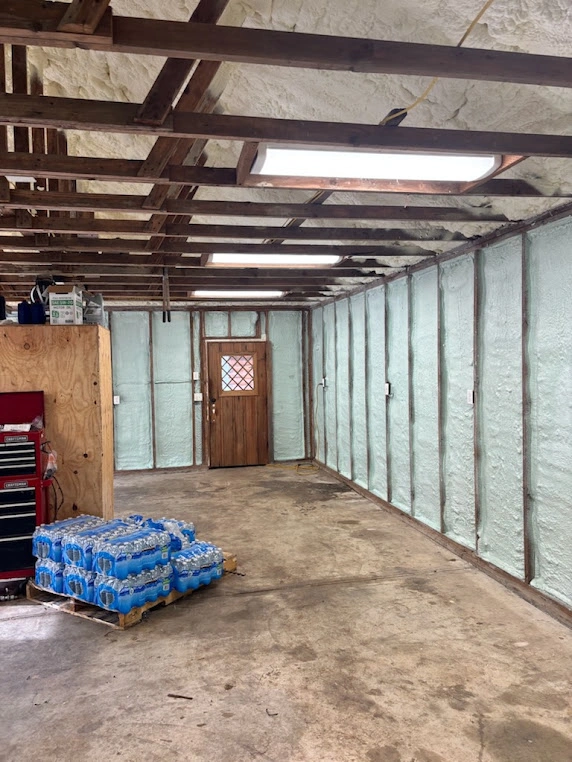
Builders in Seattle, WA are turning to spray foam insulation for new construction because it simultaneously delivers superior air sealing, high R-value per inch, and moisture control in a single application. Seattle sits in IECC Climate Zone 4C, a marine climate with moderate temperatures but persistent moisture exposure. Meeting Washington’s increasingly strict energy code requirements while protecting framing assemblies from condensation and water intrusion makes spray foam a practical choice for builders who want to avoid callback problems and pass inspections on the first attempt. Whether they choose open cell or closed cell formulations, the material’s ability to expand into gaps, cracks, and voids sets it apart from batt or blown-in alternatives.
Per the Seattle Energy Code, Seattle is classified as Climate Zone 4C, a marine designation that reflects the region’s relatively narrow temperature swings combined with elevated humidity levels year-round. The 2023 Washington State Energy Code, which took effect July 1, 2023 and is based on the 2021 IECC, raised the bar for residential envelope performance in Zone 5 and Marine Zone 4. Builders now face prescriptive requirements of R-60 ceiling insulation, wood frame walls at R-20 plus R-5 continuous insulation or R-13 plus R-10 continuous insulation, and a maximum air leakage rate of 5 ACH50.
These requirements make modern insulation approaches more difficult to implement efficiently. Fiberglass batts rated at R-15 in a standard 2×4 cavity fall short of the wall requirement without continuous insulation added to the exterior. Spray foam installation in Seattle, WA helps builders meet these targets with fewer assembly layers and less coordination between trades.
The DOE Building America spray foam guide identifies two distinct product categories that perform differently and serve different purposes in new construction:
| Property | Open Cell Spray Foam | Closed Cell Spray Foam |
|---|---|---|
| R-value per inch | ~3.6 | ~6.1 (aged) |
| Density | 0.5 lb/cu ft | 2.0 lb/cu ft |
| Air permeance | Air-impermeable | Air-impermeable |
| Vapor permeance | ~5-10 perms at 5″ (vapor permeable) | Less than 1 perm at 2″ (vapor retarder) |
| Water absorption | Can absorb and hold water | Hydrophobic, does not absorb water |
| Structural benefit | Minimal | Adds wall racking strength |
| Common wall cavity fill | Full cavity depth (up to 5.5″) | Full or partial cavity (typically 2-3″ per pass) |
For Seattle’s Marine Zone 4C climate, Building Science Corporation recommends high density closed cell spray foam as the preferred choice because it meets code requirements for both condensation control and Class II vapor retarder performance per IRC Section R702.7 for Climate Zones 5 through 8 and Marine 4. This means closed cell foam at adequate thickness keeps interior surfaces above the dew point, preventing hidden condensation within wall and roof assemblies, a common failure mode in marine climates where moisture drive can come from both interior and exterior directions.
Open cell foam works well in wall cavities in mixed climates like Seattle, but builders must account for its vapor-permeable nature. Interior vapor retarder paint or kraft-faced materials may be needed to prevent moisture accumulation within the assembly. Many Seattle builders use a hybrid approach: a thin layer of closed cell foam against the exterior sheathing for its vapor control and air sealing properties, then fill the remaining cavity with open cell foam or fiberglass batts.
Both spray foam types expand upon application, filling gaps around framing members, penetrations, and irregular surfaces that batt insulation cannot reach. The DOE guide notes that this liquid-to-expanding foam process makes spray foam performance “superior to other typical insulations such as fiberglass or cellulose which are far less able to block air flow.” For new construction, this means fewer separate detailing steps for caulking, gasketing, and sealant application at transitions between walls, roofs, foundations, and penetrations.
Air leakage accounts for a significant portion of energy loss in residential buildings. The DOE’s 2024 IECC Energy Savings Analysis projects that updated code requirements for Climate Zone 4 will deliver approximately 7.43 percent site energy use intensity reductions compared to the 2021 baseline. Builders who use spray foam to exceed the minimum air sealing requirements can achieve better-than-code performance, which translates to lower heating and cooling loads and smaller, less expensive mechanical systems.
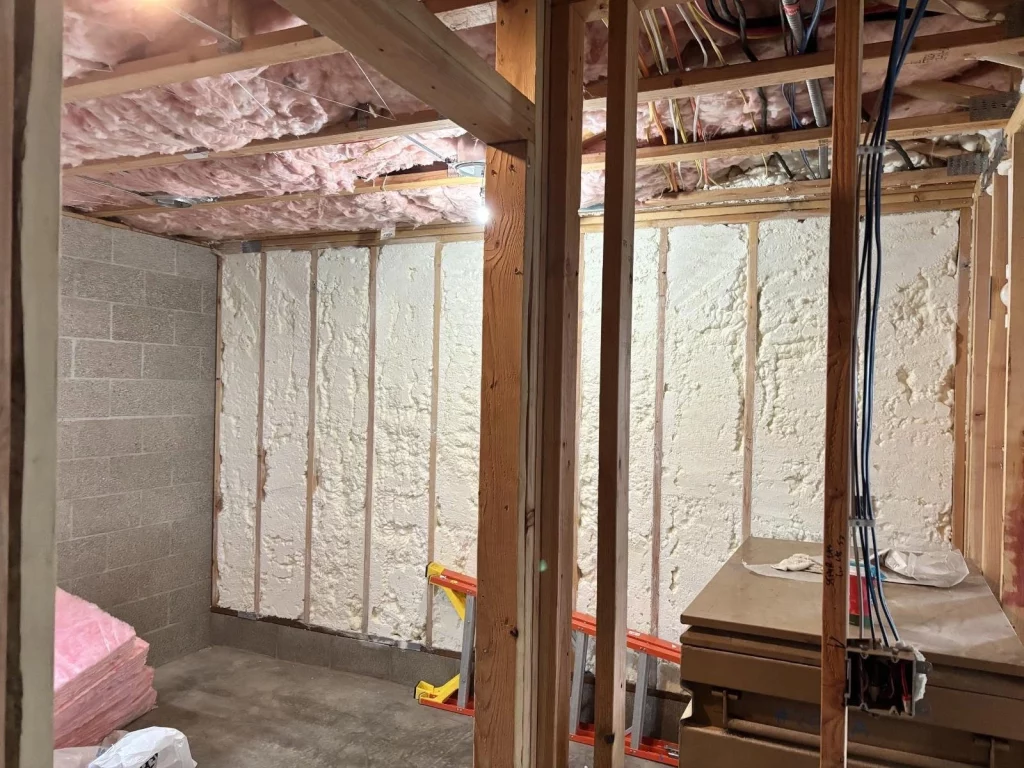
Spray foam fits into multiple areas of a new build envelope:
Wall cavities: Closed cell foam applied to full cavity depth delivers R-30 or more in a 2×6 wall, exceeding prescriptive code without exterior continuous insulation. The hybrid flash-and-batt approach uses 1 to 2 inches of closed cell foam against the sheathing, then fills the remaining cavity with a less expensive material.
Unvented attics and cathedral ceilings: Spray foam applied directly to the underside of the roof deck eliminates the need for venting and allows HVAC ducts to be located within conditioned space, avoiding the thermal penalties associated with ducts in vented attics. Building Science Corporation recommends unvented conditioned attics using spray foam as the preferred approach when mechanical systems must be located in attic spaces.
Band joists and rim areas: These transitions between floors and the exterior are notoriously difficult to insulate and air seal with batts. Spray foam fills irregular voids completely in a single application.
Foundations and crawlspaces: Closed cell spray foam applied to interior foundation walls provides both thermal insulation and moisture resistance. For vented crawlspaces, Building Science Corporation recommends only closed cell foam to keep moisture out of floor assemblies.
| Builder Profile | Recommended Strategy | Why |
|---|---|---|
| Custom home builders seeking high performance | Full cavity closed cell in walls and roof deck | Maximum R-value, vapor control, and structural benefit in one application |
| Production builders managing cost | Hybrid flash-and-batt with 1-2″ closed cell flash | Meets code with lower material cost while maintaining air sealing |
| Builders with vented attic designs | Closed cell at ceiling plane and band joists | Superior air barrier at critical transition points |
| Builders with unvented conditioned attics | Full depth spray foam to roof deck | Moves ducts into conditioned space, eliminates venting complexity |
A qualified spray foam installer for new construction should be able to explain the differences between open cell and closed cell foam in the context of Seattle’s Marine Zone 4C climate, including where each product is appropriate and where it is not. They should provide documentation showing installed thickness and R-value for each spray polyurethane foam area, as required by the Seattle Energy Code Section C303.1.1. Look for installers who coordinate with framing and mechanical trades to ensure penetrations are properly detailed before foam application, and who understand fire barrier requirements including the need for 15-minute thermal barriers per IRC Section R314 in habitable spaces.
Spray-On Foam & Coatings brings certified spray foam installation to builders across the Pacific Northwest, with expanding coverage into the Seattle market. Whether your project calls for closed cell foam in wall cavities and crawlspaces, open cell foam for interior partitions, or a hybrid system designed to meet Washington’s stringent energy code, our experienced team evaluates each envelope assembly and recommends the right product for the application. We handle everything from residential new construction to commercial builds, and we work with builders to coordinate insulation schedules around framing and mechanical milestones. Reach out today to discuss your project scope and get a detailed plan in place before framing begins.
📞 Request a Free Quote | 📋 Schedule a New Construction Insulation Consultation | (360) 667-1993 | [email protected]
Yes. Both closed cell and open cell spray foam meet the prescriptive and performance path requirements when installed at the correct thickness to achieve the required R-values for Climate Zone 4C.
Closed cell spray foam is generally preferred for Seattle’s Marine Zone 4C because it provides both air impermeability and vapor retarder properties in a single layer, offering condensation control without additional detailing.
Yes. The superior air sealing and thermal performance of spray foam can reduce overall heating and cooling loads, which may allow for smaller, less expensive mechanical equipment.
Yes. Per the IRC, spray foam in habitable spaces must be covered by a 15-minute thermal barrier such as half-inch gypsum board, and specific fire protection requirements apply to attics and crawlspaces.
Spray foam provides air sealing and vapor control that fiberglass batts cannot achieve on their own. Fiberglass relies on separate air barrier detailing, while spray foam creates a continuous seal as part of the insulation application.