

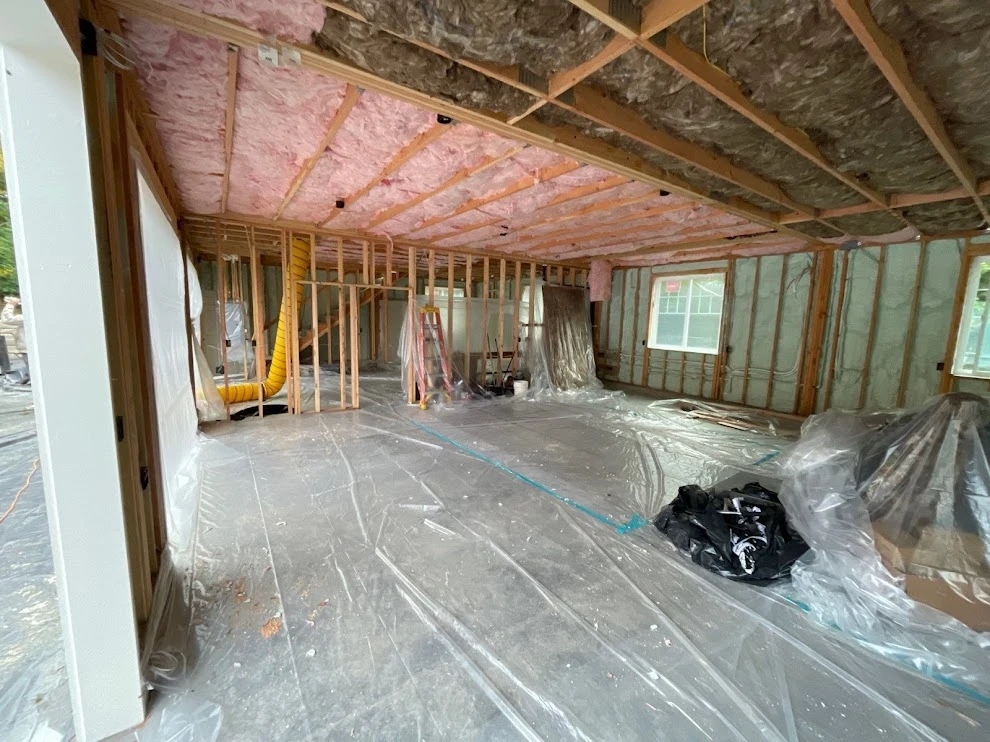
Rockwool insulation (mineral wool) outperforms fiberglass insulation for soundproofing in most residential and commercial applications, including homes and buildings in Olympia, WA. Its higher density and non-directional fiber structure give it a measurable advantage in both sound absorption and sound transmission loss. Fiberglass still works well for general noise reduction and costs less per square foot, but if sound control is a primary goal, mineral wool is the stronger choice. That said, the right material depends on your project type, budget, and whether you need to meet specific building code requirements for airborne or impact sound isolation.
Rockwool, technically called stone wool or mineral wool, is manufactured by spinning molten basalt and other minerals into fine fibers at temperatures around 1,600 degrees Celsius. The result is a product with a fibrous, non-directional structure that traps and dissipates sound energy through friction as sound waves try to pass through.
The key acoustic advantage comes down to density. Standard rockwool insulation in Olympia, WA used in wall cavities and soundproofing assemblies weighs roughly 8 lb/ft³, compared to fiberglass at 0.5 to 1.8 lb/ft³. That threefold density difference means rockwool adds more mass to an assembly and absorbs more sound energy within the wall cavity itself.
Per Wikipedia’s mineral wool entry, the material’s ability to partition air makes it an excellent sound absorber, and its applications explicitly include soundproofing alongside thermal insulation. The non-directional fiber orientation also means sound waves encounter resistance regardless of the angle at which they enter the material.
Rockwool also offers secondary benefits that matter in the Pacific Northwest climate:
These properties make rockwool particularly well suited for Olympia’s wet climate, where moisture in wall cavities can degrade other insulation types and reduce their acoustic performance.
Fiberglass insulation, also known as glass wool, is made from recycled glass and sand heated to approximately 1,450 degrees Celsius and then spun into fibers. It traps air pockets between fibers, and those air pockets provide both thermal resistance and some level of sound absorption.
The InterNACHI noise control reference notes that fiberglass insulation is “very absorptive and can be used where sound control is a concern,” particularly for absorbing sound within a room rather than blocking sound between rooms. Its strength lies in reducing mid-to-high frequency sounds like voices and television audio.
However, fiberglass has limitations for soundproofing applications:
Fiberglass performs best in applications where basic sound absorption is needed at a lower material cost. It works well in interior walls where moderate noise reduction is the goal, and it remains the most common choice for attic insulation where thermal performance outweighs acoustic needs.
| Property | Rockwool (Mineral Wool) | Fiberglass (Glass Wool) |
|---|---|---|
| Density | ~8 lb/ft³ | 0.5 to 1.8 lb/ft³ |
| Primary acoustic role | Sound absorption and transmission blocking | Sound absorption |
| Best frequency range | Wide spectrum, including low frequencies | Mid to high frequencies |
| Fire resistance | Up to 2,150°F | Up to 500°F |
| Moisture resistance | Hydrophobic, drains and dries | Absorbs water, can degrade |
| Structural rigidity | Holds shape, friction-fits cavities | Can sag and settle over time |
| Carcinogenicity (IARC) | Group 3, not classifiable | Group 3, not classifiable |
| Installation comfort | Denser, slightly more rigid to handle | Lighter, can be itchy |
The density advantage is the primary differentiator. When sound waves hit a denser material, more energy is converted to heat through friction within the fiber structure. This is why mineral wool is the standard choice in recording studios, home theaters, and multi-family wall assemblies where maximum sound isolation is the goal.
Washington State adopts the International Building Code (IBC) with state-specific amendments. For residential construction, the International Residential Code (IRC) applies. According to the WoodWorks acoustical design guide, these codes establish clear minimums:
These ratings apply to the entire assembly (drywall, framing, insulation, sealing), not the insulation material alone. A standard uninsulated single-stud wall with one layer of drywall on each side might achieve only STC 33 to 38. Adding fiberglass batts in the cavity can raise that to around STC 42 to 45. Switching to mineral wool in the same cavity, combined with proper sealing, can push the assembly closer to STC 50, meeting or exceeding code requirements without changing the framing.
The same WoodWorks resource emphasizes that the most cost-effective acoustic improvement to any assembly is adding batt insulation to the stud or joist cavity. Both materials accomplish this, but mineral wool delivers more improvement per inch due to its density.
The right choice depends on what you are trying to achieve:
Home offices and bedrooms in shared walls: Rockwool is the better pick here. The higher density provides more transmission loss through the wall assembly, and the fire resistance adds a safety layer in occupied spaces. If your home office shares a wall with a living room or bedroom, rockwool will do more to block conversational noise and HVAC sounds.
Interior partition walls in single-family homes: Fiberglass can work if you only need moderate noise reduction between rooms. For a wall between a bedroom and a bathroom or closet, the cost savings of fiberglass may be justified.
Multi-family construction in Olympia: For townhouses, duplexes, or apartments, code compliance for STC ratings is non-negotiable. Rockwool gives you more margin to meet STC 50 without resorting to expensive double-stud or staggered-stud framing. The WoodWorks guide notes that a double-stud wall with batt insulation and two layers of gypsum board can reach STC 63, but that same assembly with mineral wool in the cavities performs better than with fiberglass.
Recording studios and home theaters: Rockwool is the clear winner. Its density and wide-spectrum absorption make it the preferred material for acoustic treatment panels and bass traps in critical listening environments.
Attics and floors where thermal performance dominates: Fiberglass remains practical and cost-effective when soundproofing is a secondary concern. In Olympia’s climate, adequate attic insulation matters for year-round comfort, and fiberglass delivers strong thermal performance at a lower material cost.
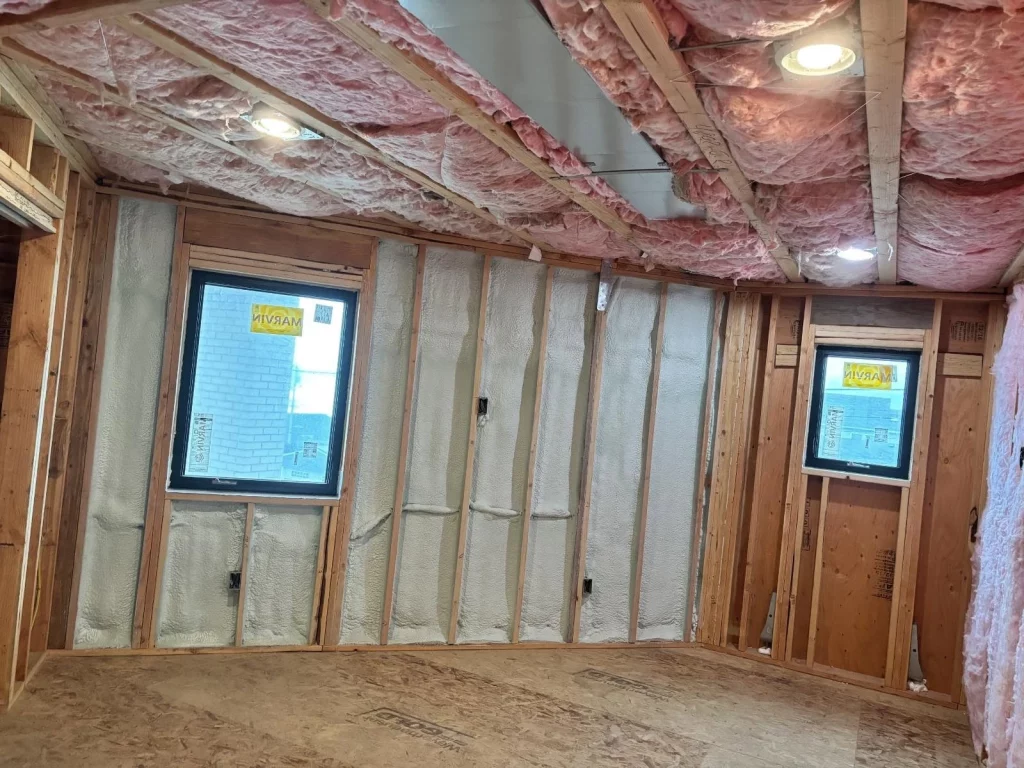
No insulation material, including rockwool, soundproofs a wall on its own. Sound control is a system-level outcome. Several factors matter as much as or more than the insulation choice:
Rockwool gives you a stronger insulation component within that system, but the assembly design and installation quality determine the final result.
How do you know your insulation strategy is on track? Look for these indicators:
Soundproofing is one area where material quality and installation precision both matter. Cutting corners on either one shows up as audible noise between rooms, and fixing it after drywall is installed is far more expensive than getting it right during construction.
Choosing between rockwool and fiberglass is just one part of a soundproofing strategy. The assembly design, sealing, and installation quality determine whether your walls and ceilings actually block the noise you are targeting. Our team at Spray-On Foam & Coatings evaluates your specific project, recommends the right materials and methods for your acoustic goals, and handles the installation from start to finish.
Request a Free Quote | Schedule a Soundproofing Assessment
Call us at (360) 667-1993 or email [email protected] to discuss your project. We serve homeowners and contractors throughout the Olympia area and surrounding communities.
There is no acoustic benefit to layering both materials in a single cavity. Pick the one that matches your sound control goals and fill the cavity properly.
Rockwool does both. Its density absorbs sound within the wall cavity and adds mass that helps block sound transmission through the entire assembly.
Both rockwool and fiberglass are classified as IARC Group 3, meaning they are not classifiable as to carcinogenicity in humans. Proper protective equipment during installation handles temporary skin and respiratory irritation.
The improvement depends on the full assembly, but mineral wool typically adds 3 to 5 STC points over fiberglass in the same cavity, which can mean the difference between meeting code and falling short.
Closed cell spray foam seals air leaks and provides thermal performance but offers less sound attenuation than batt insulation because closed cells do not allow air molecule interaction. Open cell foam performs better acoustically but still generally trails mineral wool for sound control.