
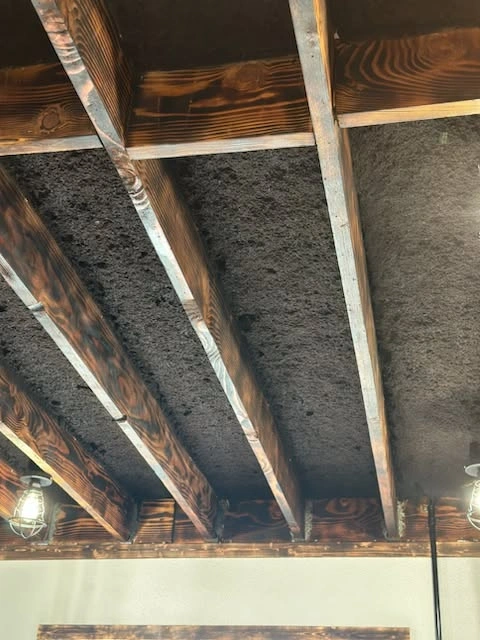
K-13 spray foam insulation is one of the most effective acoustical treatments for reducing ceiling echo in large commercial and industrial buildings. It works by absorbing sound energy rather than reflecting it, directly lowering the reverberation time in spaces with hard, reflective surfaces like metal decks, concrete, and exposed steel. Whether you manage a gymnasium, warehouse, manufacturing facility, or worship space, the right thickness and application of K-13 can turn an acoustically hostile environment into one where speech is intelligible, noise buildup is controlled, and OSHA workplace noise standards become easier to meet.
Large commercial and industrial spaces are built with hard, durable materials: metal roof decking, concrete floors, steel framing, glass, and masonry walls. These materials are excellent at reflecting sound, which means that any noise generated inside the building bounces repeatedly off these surfaces, creating what acousticians call reverberation.
Reverberation time is the number of seconds it takes for sound to decay by 60 decibels after the source stops. In a large warehouse or gymnasium with all hard surfaces, reverberation times can exceed 4 to 6 seconds. For reference, the target for a multi-purpose gym that also serves as an auditorium or classroom is 1.5 seconds or less across the speech frequency range. When reverberation times are too high, speech becomes garbled, instructions go unheard, and overall noise levels escalate as sounds pile on top of each other.
According to OSHA’s noise exposure guidelines, engineering controls that reduce sound exposure levels are the preferred first line of defense in the workplace. That includes modifying the acoustic properties of the building itself, not just handing out earplugs. Applying absorptive material to the ceiling, which is typically the largest single reflective surface in any building, is one of the most efficient ways to shorten reverberation time and bring noise levels down.
K-13 is a spray-applied cellulosic acoustical insulation made primarily from recycled newsprint treated with fire retardant chemicals. It is mixed with a water-based adhesive at the nozzle and sprayed directly onto ceiling substrates, including metal roof decks, concrete, wood, gypsum, and steel panels. The material bonds to the surface and cures into a self-supporting, monolithic layer.
The acoustical performance of K-13 is measured using the room reverberation method per ASTM C423, which calculates a Noise Reduction Coefficient (NRC). NRC is a single-number rating from 0.0 to 1.0 that describes the average sound absorption of a material across four key frequencies: 250, 500, 1,000, and 2,000 Hz. The higher the NRC, the more sound the material absorbs rather than reflects. Even a modest NRC improvement of 0.20 or more produces a “considerable” audible difference in most real-world spaces.
K-13 achieves high NRC ratings because the open, fibrous structure of cellulose converts sound energy into small amounts of heat through friction as air molecules move through the material. This is fundamentally different from trying to block sound, which is measured by Sound Transmission Class (STC). NRC relates to sound absorbed within a room, while STC relates to sound passing through a wall or ceiling. K-13 is designed for absorption, making it the right tool for echo and reverberation control.
Not every K-13 application delivers the same results. The effectiveness of the treatment depends on several variables that should be evaluated during the planning phase.
| Factor | How It Affects Performance | What to Consider |
|---|---|---|
| Thickness | Thicker material absorbs lower frequencies. A 100 mm application extends effective absorption down to roughly 250 Hz versus 500 Hz at 50 mm. | Match thickness to the frequency range that needs control. Low-frequency noise from machinery needs thicker application. |
| Surface Area Covered | More coverage means lower reverberation. Partial coverage helps, but full ceiling coverage delivers the best results. | Budget constraints may limit coverage, but prioritize the largest uninterrupted ceiling sections first. |
| Substrate Type | Different mounting conditions affect NRC. Material applied directly to a solid deck performs differently than material on an open framework. | Corrugated metal decks, flat concrete, and exposed bar joists each require slightly different approaches. |
| Ceiling Height | Taller spaces have longer initial reverberation times and need more absorption to achieve the same decay rate. | High-bay warehouses (30+ feet) may need thicker applications or supplemental wall treatments. |
| Room Volume and Shape | Volume directly affects reverberation time. Irregular shapes may create flutter echo in specific areas. | Large open-floor plans benefit from full ceiling coverage. Complex geometries may need targeted treatment. |
Building managers and architects have several options for treating ceiling surfaces acoustically. Each approach has trade-offs in terms of coverage, installation complexity, and long-term performance.
| Treatment Method | Best For | Installation Considerations | Acoustic Limitations |
|---|---|---|---|
| K-13 Spray-Applied Cellulose | Large open ceilings, corrugated decks, complex geometries | Requires spray equipment and trained crew; fast application on large areas | Limited color options; requires minimum ceiling height for spray access |
| Acoustic Ceiling Tiles (Drop Ceiling) | Office spaces, classrooms, areas with plenums | Adds suspended framework; individual panel replacement possible | Gap between tiles and deck reduces effective absorption; limited in exposed-ceiling designs |
| Acoustic Baffles and Clouds | Gymnasiums, pools, spaces where full coverage isn’t feasible | Suspended from structure above; less substrate prep needed | Coverage gaps between baffles reduce total absorption compared to monolithic spray |
| Acoustic Wall Panels | Supplementing ceiling treatment; rooms with lower ceilings | Mount directly to walls; limited floor-to-ceiling coverage | Cannot compensate for an untreated reflective ceiling alone |
The main advantage of K-13 is its ability to form a continuous, seamless acoustical surface across an entire ceiling, including around structural steel, ductwork, piping, and other obstructions. Rigid panels and tiles leave gaps, especially around irregular geometry, that reflect sound and reduce overall effectiveness.
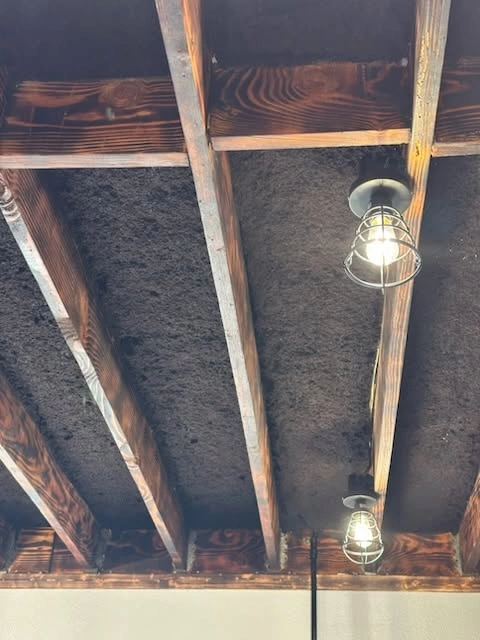
One of the most important considerations for any exposed ceiling treatment in a commercial or public building is fire performance. Cellulose insulation treated with fire retardants carries a Class 1 / Class A fire rating per ASTM E84, meaning it has a flame spread index of 25 or less (with many applications achieving a zero flame spread index, compared to red oak at 100). K-13 also meets UL 723, NFPA 255, and UBC 42 fire testing standards.
This fire rating means K-13 can serve as an exposed finish without requiring an additional thermal barrier, which is a significant advantage in retrofit applications where installing drywall or other coverings over existing roof decks would be impractical or costly. The National Institute of Environmental Health Sciences (NIEHS) has documented that spray-applied cellulosic insulation covered by ASTM C1149 addresses surface burning characteristics, adhesive/cohesive strength, flame resistance, and air erosion, among other properties.
Different types of large buildings have different acoustic priorities. Here is how K-13 application should be approached based on the use of the space.
Gymnasiums and Multi-Purpose Rooms: These spaces need a reverberation time of 1.5 seconds or less to maintain speech intelligibility for instruction, announcements, and events. Full ceiling coverage at a thickness of 1.5 inches or more is typically recommended. Basketball courts, volleyball courts, and indoor turf spaces all benefit from ceiling-only treatment because the floor must remain hard for the sport.
Warehouses and Distribution Centers: Noise from forklifts, conveyors, and loading operations builds up quickly in large-volume spaces with metal roofs. The priority is reducing overall ambient noise levels to comply with OSHA hearing conservation thresholds. Ceiling treatment at standard commercial thickness (1 to 1.5 inches) across the main work areas can reduce noise buildup significantly.
Manufacturing and Industrial Facilities: Machinery noise in these settings often includes low-frequency components that require thicker applications. Facilities with heavy equipment, stamping presses, or air compressors may need 2 inches or more of K-13 to address the full noise spectrum. Wall treatments may also be needed in addition to ceiling coverage.
Worship Spaces and Assembly Halls: Speech intelligibility is the primary concern for sermons, presentations, and performances. These spaces also need reverberation times under 2 seconds for speech-focused use. K-13 provides an attractive natural texture that works well as an exposed finish, eliminating the need for an additional suspended ceiling.
Agricultural Buildings and Pole Barns: Metal-roofed post-frame buildings are among the worst offenders for ceiling echo. Rain on a metal roof inside an untreated building can exceed safe hearing levels. K-13 sprayed to the underside of the metal roof deck dramatically reduces both rain noise and general reverberation.
Choosing the right contractor for a K-13 acoustical project matters as much as choosing the right material. Here are the indicators that you are working with a qualified team:
Spray-On Foam & Coatings provides expert K-13 spray foam installation for large commercial and industrial buildings across the Pacific Northwest. Our team evaluates your building’s unique acoustic challenges, recommends the right thickness and coverage plan, and delivers professional installation backed by certified fire-rated materials. Whether you need to bring a gymnasium up to speech intelligibility standards or reduce ambient noise in a manufacturing facility, we can help.
Request a Free Quote | Schedule an Acoustical Assessment
Reach us at (360) 667-1993 or [email protected] to discuss your project.
K-13 is a spray-applied cellulose insulation made primarily from recycled newsprint treated with fire retardant chemicals. Despite the common name, it is a cellulose-based product, not a polyurethane foam.
K-13 is spray-applied as a continuous monolithic layer, covering the entire ceiling surface including around obstructions. Rigid acoustic panels leave gaps between units that allow sound reflection, reducing overall absorption effectiveness.
Yes. K-13 bonds directly to metal roof decks, concrete, wood, and other common ceiling substrates. It serves as both an acoustical treatment and an exposed finish without requiring additional thermal barriers in most commercial applications.
Yes. OSHA identifies engineering controls like acoustical treatments as the preferred method for reducing noise exposure before relying on hearing protection devices. By lowering reverberation time, K-13 reduces the overall ambient noise level in the workspace.
Thickness depends on the acoustic goals, ceiling height, and noise sources in the building. Typical commercial applications range from 1 to 2 inches. Lower-frequency noise from machinery may require thicker application, while general echo control in gymnasiums and assembly spaces often needs 1 to 1.5 inches.