
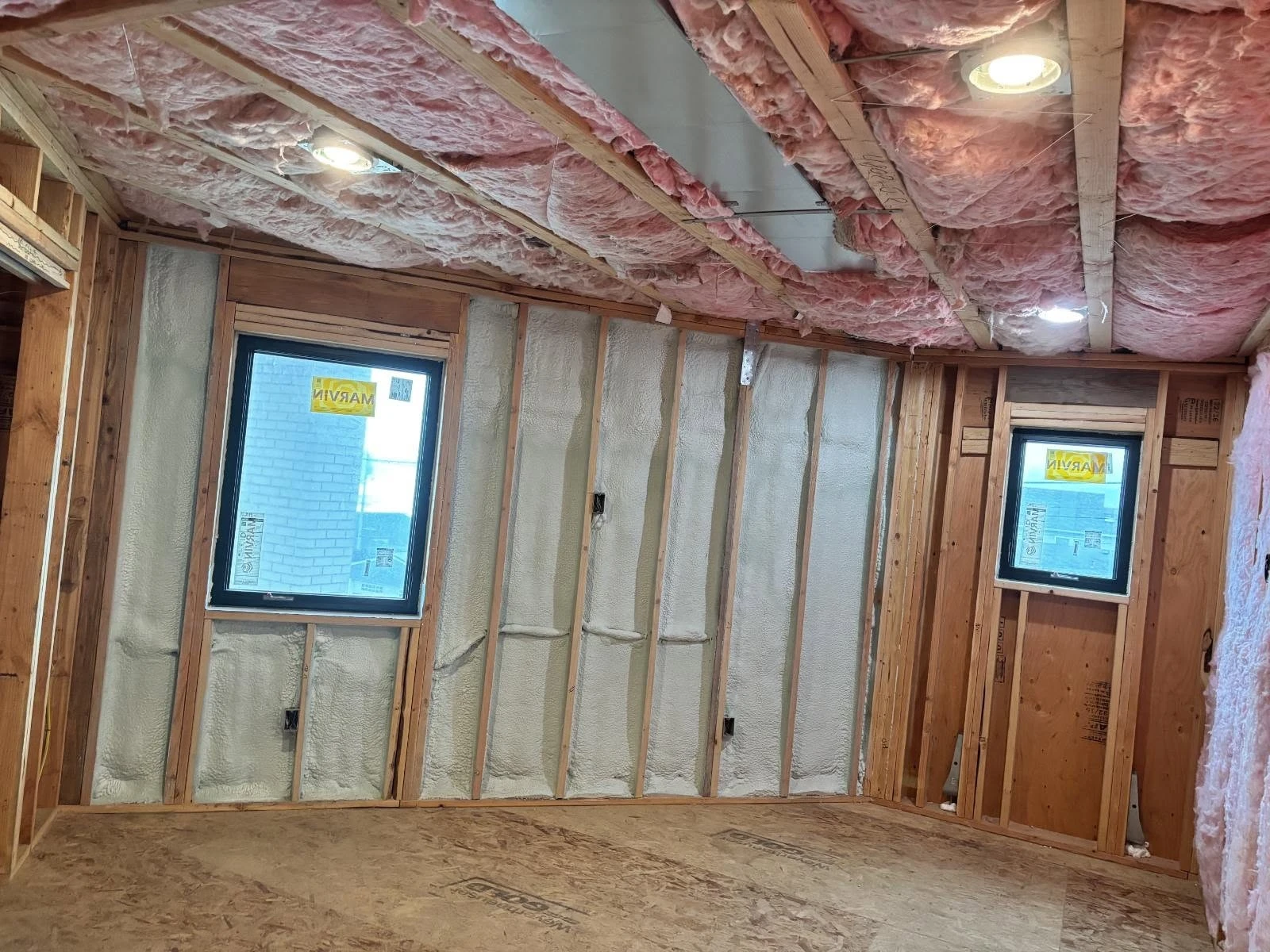
Open-cell spray foam beats fiberglass on air sealing in nearly every Seattle, WA wall, ceiling, and crawl space application. When you compare open-cell spray foam vs. fiberglass, the difference comes down to physics: open-cell foam expands up to 30 to 60 times its liquid volume to fill cracks, gaps, and irregular cavities, forming a continuous insulation-and-air-barrier layer in a single pass. Fiberglass batts deliver a similar R-value per inch, but they only slow heat flow. They do not stop air from moving through and around them, and gaps between batts become sites of air infiltration and condensation. That matters in a wet, windy marine climate where Department of Energy research attributes roughly 40 percent of a home’s energy loss to air infiltration through walls, windows, and doorways. Foam costs more upfront, typically $0.28 to $0.75 per board foot for our open-cell material, yet it eliminates the need for a separate air sealing pass and holds open-cell spray foam performance for the life of the installation. Fiberglass remains a smart pick for open attic floors and tight budgets, especially when paired with a dedicated air sealing project.
Air sealing and insulation are two different jobs. Insulation resists conductive heat flow. Air sealing stops the convective heat transfer that happens when heated air physically leaks out of the building and outside air pushes in. Both matter in Seattle, where as much as half of all household energy use goes toward heating and cooling, according to ENERGY STAR’s seal and insulate program, which also notes that air sealing plus insulation can cut up to 10% from annual energy bills.
Open-cell spray foam does both jobs at once. Applied as a liquid, it expands into cracks, crevices, and voids, adheres to irregular framing, and cures into a semi-rigid, sponge-like layer that forms an air sealing insulation. Once it reaches about 5.5 inches of depth, it functions as an air barrier. Fiberglass batts do none of this. Per Wikipedia’s technical overview of building insulation materials, even batts installed carefully leave gaps that become sites of air infiltration or condensation, and cutting batts to fit around electrical boxes and other obstructions gives air a free path straight through the cavity.
| Factor | Open-Cell Spray Foam | Fiberglass Batts |
|---|---|---|
| R-value per inch | About R-3.8 | R-3 to R-4 |
| Air barrier | Yes, at 5.5 in. installed depth or more | No, air passes through and around batts |
| Irregular cavities | Expands 30-60x to seal cracks and voids | Must be cut to fit, gaps become leak paths |
| Vapor behavior | Permeable, allows timber to dry | Paper-faced batts are retarders, must face the warm side |
| Sound control | About twice the sound resistance of closed-cell foam at normal frequencies | Modest |
| Performance over time | No settling, maintains efficiency for the life of the install | Compression or sagging reduces effectiveness |
| One-pass installation | Insulation and air sealing together | Insulation only, air sealing is a separate scope |
Buildings insulated with spray foam can insulate as much as 50% better than traditional insulation products, according to Department of Energy studies referenced by Wikipedia’s spray foam entry, precisely because foam blocks the convective losses that fiber insulations ignore.
| Cost Item | Open-Cell Spray Foam (Our Pricing) | Fiberglass Batts |
|---|---|---|
| Typical low | $0.28 per board foot | Lowest material cost of the two options |
| Typical average | $0.32 per board foot | Varies by supplier and installer |
| Typical high | $0.75 per board foot on thick, high-R-value jobs | Varies by supplier and installer |
| Dedicated air sealing project | $1,500 low, $4,500 average, $10,000 high | Requires a separate caulking and sealing scope |
| What moves the price | Bigger projects lower the per-board-foot rate, greater thickness raises it | Wasted material from compression and poor fit |
A board foot is one square foot at one inch thick. The average home we work on runs 1,500 to 2,500 square feet, and most Seattle walls call for 5.5 inches of open-cell foam in a 2×6 cavity. Fiberglass is the budget material, but Wikipedia’s building insulation research notes that foam’s higher cost buys air sealing performance batts cannot match, and any savings on batts disappears if a separate air sealing crew has to follow behind them.
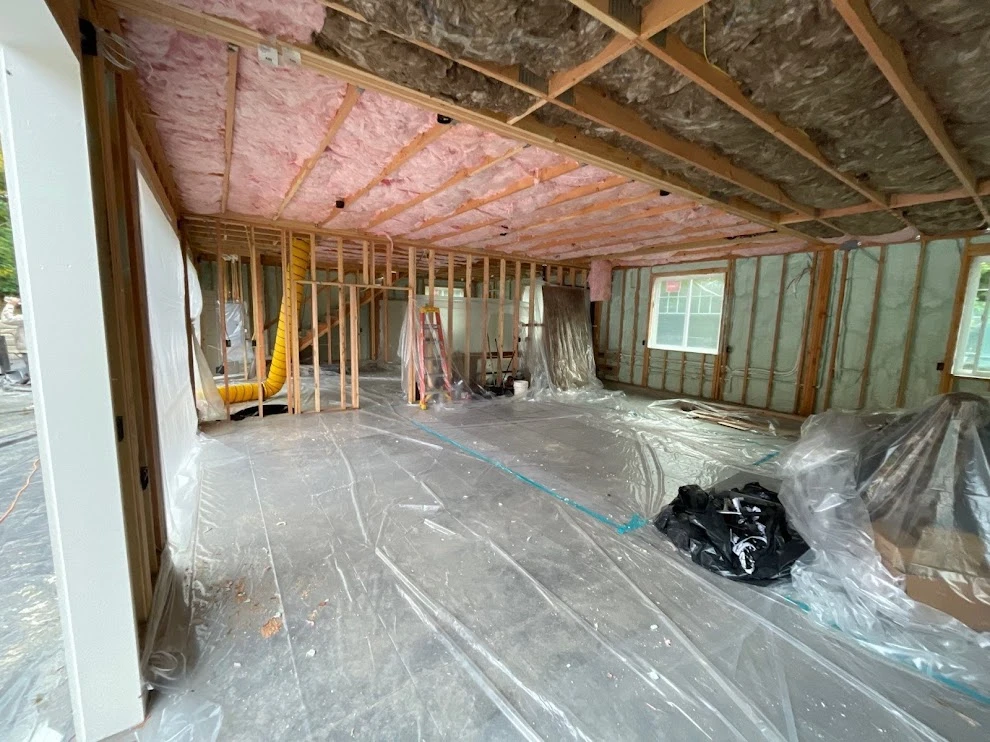
Seattle’s building environment makes air sealing a bigger deal than in milder regions. Wind-driven rain, long heating seasons, and strong stack effect in multi-story homes push moist air through wall assemblies all winter. Air that moves through wet fiberglass carries moisture into cold cavities, which is how batts end up as the wet, sagging material we regularly remove from Seattle crawl spaces.
The Seattle Energy Code explicitly regulates the building envelope, including requirements for roofs, walls, and windows to control heat loss, solar heat gain, and air leakage. The adopted 2021 Seattle Energy Code largely matches the Washington State Energy Code, so open-cell spray foam contractor in Seattle, WA pulling permits need envelope assemblies that actually control air movement, not just assemblies with the right number on the label. Open-cell foam at 5.5 inches in walls simplifies that compliance path because the insulation itself is the air barrier.
| Scenario | Property Type | Recommended Option | Estimated Cost |
|---|---|---|---|
| Drafty 1960s ranch in Ravenna with leaky exterior walls | Single-family retrofit | Open-cell foam at 5.5 in. in wall cavities | About $0.32 per board foot on average, less on larger jobs |
| New 2×6 spec home in Ballard | New construction | Open-cell foam, one-pass insulation and air barrier | $0.28 to $0.75 per board foot depending on specs |
| Cathedral ceiling in a West Seattle craftsman | Open-rafter retrofit | Full-depth open-cell foam between rafters | Higher end of the range as thickness and R-value increase |
| Wet, sagging batts under a Beacon Hill bungalow | Crawl space insulation | Sealed crawl space with foam insulation | $1,500 low, $5,500 average, up to $35,000 for large or complex spaces |
| Rental turnover in the University District on a tight budget | Multi-unit rental | Fiberglass in open attic floors plus dedicated air sealing | Air sealing from $1,500 to a $4,500 average |
Open-cell spray foam is the right call when:
Fiberglass is the better fit when:
If you are weighing open-cell spray foam vs. fiberglass for a Seattle, WA project, our team at Spray-On Foam & Coatings will assess your walls, ceilings, and crawl spaces and tell you honestly which material earns its place. We install open-cell and closed-cell spray foam, crawl space insulation, and dedicated air sealing across Seattle and the surrounding region. Call us at (360) 667-1993 or email [email protected] to talk through your building with our crew.
Schedule an Air Sealing Assessment
Stop paying to heat the outdoors. Let our team seal it right the first time.
Yes. Open-cell foam expands to fill cracks and voids and acts as an air barrier at 5.5 inches or more of installed depth. Fiberglass slows heat flow but allows air to pass through and around the batts, which is where most energy loss happens.
Our open-cell spray foam typically runs $0.28 to $0.75 per board foot, with an average around $0.32. Larger projects lower the per-board-foot rate, while greater thickness and higher R-value targets raise it.
The exposure concerns are limited to application time, when isocyanates in the liquid chemicals can irritate skin, eyes, and lungs, which is why EPA guidance on spray polyurethane foam stresses professional handling and proper protective equipment. Once the foam cures, it is inert and occupants can return.
Absolutely. A common hybrid uses open-cell foam in walls and cathedral ceilings where air sealing matters most, and fiberglass batts on open attic floors where the air barrier comes from sealing penetrations below. Dedicated air sealing projects start at $1,500 and average $4,500.
Seattle’s wind-driven rain and long heating season drive air and moisture through wall cavities for much of the year. Air moving through wet fiberglass carries moisture into cold assemblies, and wet batts lose effectiveness, sag, and stop sealing anything.