

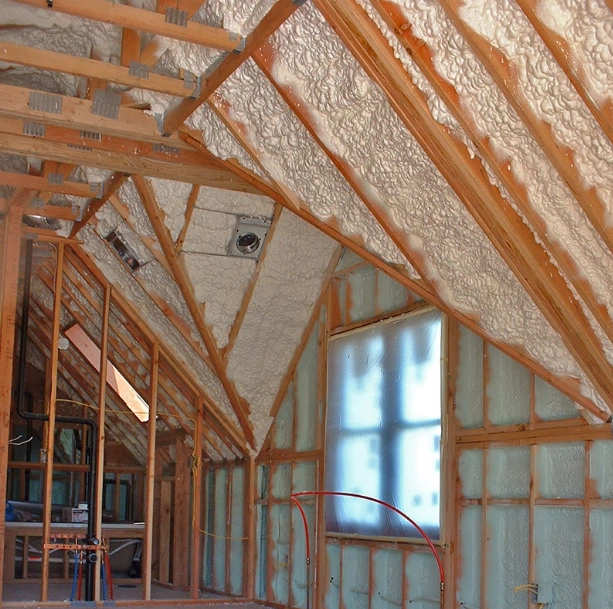
Thickness is the single biggest variable in open-cell spray foam pricing, and it has a compounding effect: more inches mean more material measured in board feet, and greater thickness to reach higher R-values pushes the per-board-foot rate upward as well. For homeowners in Battle Ground, WA, where the marine climate of Climate Zone 4C demands meaningful insulation levels, understanding how thickness translates into board footage and final project cost is essential before requesting a quote.
Before discussing thickness, it is important to understand the unit of measurement that drives every spray foam estimate. A board foot equals one square foot of area at one inch of thickness. This means thickness is multiplied directly into the volume calculation, and even a small increase in depth has an outsized effect on the total board footage.
For example, insulating a 1,000 square foot attic ceiling at 3 inches requires 3,000 board feet. Increasing that depth to 5.5 inches to achieve R-20 pushes the total to 5,500 board feet, an 83% increase in material, not a proportional increase. As noted in the DOE Building America spray foam guide, open-cell foam typically achieves R-3.6 per inch, so every additional inch directly raises the thermal resistance while also adding material volume.
Open-cell spray foam in Battle Ground, WA is a low-density, semi-rigid material with an R-value of approximately R-3.6 per inch. This is lower than closed-cell foam (which ranges from R-5.1 to R-6 per inch), but open-cell compensates with strong air-sealing properties and lower material cost per board foot. According to the Wikipedia entry on spray foam, most open-cell products deliver around R-3.8 per inch and act as an effective air barrier when installed at 5.5 inches or more.
The challenge in Battle Ground’s Climate Zone 4C is that recommended R-values for attics and cathedral ceilings typically call for R-38 to R-49, which translates to roughly 10 to 14 inches of open-cell foam. Walls generally require R-20 to R-21, or approximately 5.5 to 6 inches in a standard 2×6 cavity. Each additional inch of thickness adds another full board foot per square foot of coverage area.
The table below shows how different application depths multiply your total board footage for every square foot of coverage area:
| Application Depth | R-Value Achieved | Board Feet Per Sq Ft | Common Application |
|---|---|---|---|
| 3 inches | R-11 | 3.0 | Band joists, flash-and-batt hybrid |
| 5.5 inches | R-20 | 5.5 | Standard 2×6 wall cavities |
| 7 inches | R-25 | 7.0 | Cathedral ceilings (moderate) |
| 10 inches | R-36 | 10.0 | Unvented attics, cathedral ceilings |
| 13.5 inches | R-49 | 13.5 | Attic floors, full code compliance |
As depth increases, the board foot multiplier grows linearly, but pricing often rises at a faster rate because thicker applications require more material, more time on site, and more careful temperature control during installation. Our data confirms that greater thickness and higher target R-values are the primary factor that increases pricing, while ease of access and timeline flexibility are the factors that reduce it.
Our open-cell spray foam pricing typically falls within the following range:
| Thickness Range | Typical Per-Board-Foot Rate | Why It Falls Here |
|---|---|---|
| 3 to 5.5 inches (wall cavities) | $0.28 to $0.32 | Lower total depth, easier access, standard residential cavity fills |
| 7 to 10 inches (cathedral ceilings) | $0.32 to $0.50 | Higher material volume, ceiling applications require more setup |
| 10+ inches (unvented attics) | $0.50 to $0.75 | Maximum depth, large roof deck area, code compliance requirements |
Project size also plays a significant role. The biggest factor affecting our pricing is the size of the project itself. Larger projects receive a lower per-board-foot rate because equipment mobilization and setup costs are spread across more material. A 4,000+ square foot home will have a lower cost per board foot than a 1,500 square foot home with the same target thickness.
Battle Ground falls within IECC Climate Zone 4C, a marine climate with cool, wet winters and mild, dry summers. According to the ENERGY STAR methodology for energy savings estimates, homeowners in Zone 4C can expect approximately 13% savings on total utility bills and 20% savings on heating and cooling costs from proper air sealing and insulation upgrades.
For this climate zone, the following thickness targets are common for open-cell spray foam:
As noted in the DOE/ENERGY STAR Insulation Fact Sheet, heating and cooling account for 50 to 70% of energy use in the average American home. Inadequate insulation and air leakage are the leading causes of energy waste. Open-cell spray foam addresses both simultaneously because it expands to fill gaps, cracks, and voids that traditional batt insulation cannot reach.
One of the most common questions we hear from homeowners in Battle Ground is whether to choose open-cell or closed-cell foam. Thickness is often the deciding factor. Open-cell foam is less expensive per board foot, but because it delivers a lower R-value per inch, it requires roughly twice the depth to match the thermal resistance of closed-cell.
For a wall cavity needing R-20, open-cell at 5.5 inches is the natural fit. For an attic needing R-49, open-cell would require approximately 13.5 inches of depth, which may not be practical in every framing scenario. In those cases, closed-cell foam at roughly 7 to 8 inches (R-42 to R-49) or a hybrid system combining both products may be the better approach.
The HUD USER guide on insulation and air sealing notes that the EPA estimates proper insulation and air sealing can save homeowners up to 20% on heating and cooling costs. The right thickness and product choice determines how close you get to that benchmark.
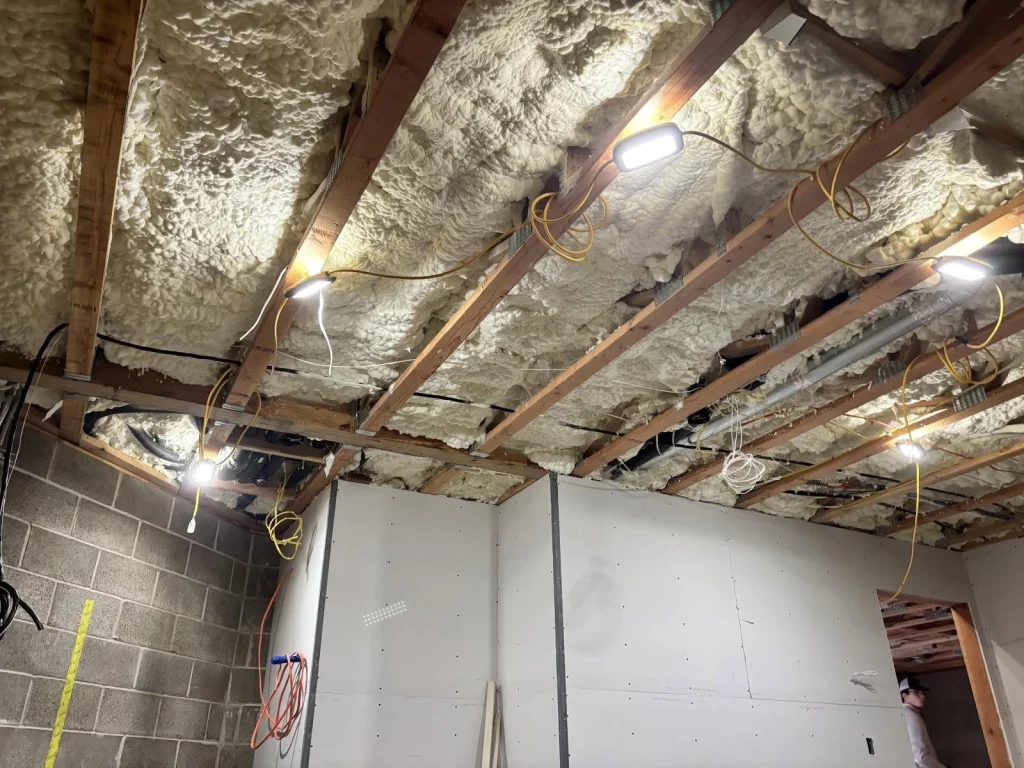
| Project Type | Recommended Thickness | R-Value Target | Open-Cell Suitability |
|---|---|---|---|
| Existing retrofit walls | 3.5 to 5.5 inches | R-13 to R-20 | Well suited, full cavity fill |
| New construction walls | 5.5 inches | R-20 | Ideal application |
| Cathedral ceilings | 7 to 10 inches | R-25 to R-36 | Suitable with adequate rafter depth |
| Unvented attics | 10+ inches | R-36+ | May require hybrid or closed-cell |
| Band joists and rim areas | 3 to 4 inches | R-11 to R-14 | Well suited, small area |
While thickness is the primary cost driver, several other variables can reduce your final project price:
Choosing an installer who understands how thickness, climate zone, and building assembly interact is as important as the foam product itself. Look for these indicators:
At Spray-On Foam & Coatings, we evaluate every project individually, calculating the exact board footage based on your home’s unique dimensions, framing depth, and target R-value. Our team serves homeowners throughout Battle Ground and the surrounding Clark County area, and we will walk you through exactly how thickness affects your open-cell spray foam pricing before any work begins. Call us at (360) 667-1993 or email [email protected] to discuss your project.
Request a Free Quote | Schedule an On-Site Assessment
For standard 2×6 wall cavities in Battle Ground’s Climate Zone 4C, a full cavity fill of 5.5 inches delivers approximately R-20, which meets prescriptive code requirements for cavity insulation.
Yes. Greater thickness and higher R-value targets are the primary factor that increases per-board-foot pricing, because deeper applications require more material, more installation time, and more careful temperature control.
Open-cell foam works well in vented attics at the ceiling plane, but for unvented attics requiring R-38 or higher, the required thickness may make closed-cell or a hybrid system more practical.
Larger projects receive a lower per-board-foot rate because mobilization and equipment setup costs are distributed across more material volume.
Scheduling flexibility and easy job site access are the two most effective ways to reduce pricing. Combining multiple areas into a single project scope also lowers the per-board-foot rate.