

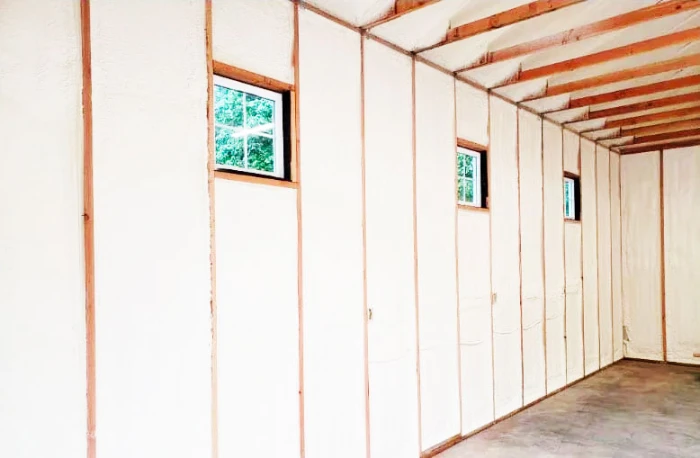
Drafts in commercial buildings are caused by uncontrolled air infiltration through gaps, cracks, and penetrations in the building envelope. When outside air forces its way in through these leaks, it creates uncomfortable temperature fluctuations, drives up HVAC energy costs, and introduces moisture and pollutants into conditioned spaces. Spray foam insulation for homes and businesses and professional air sealing address drafts by closing those leakage paths and creating a continuous thermal and air barrier that keeps conditioned air where it belongs.
Drafts are not just an annoyance. They represent a measurable failure of the building envelope to separate conditioned and unconditioned spaces. Three forces work together to push unconditioned air through any available opening:
Wind pressure. When wind strikes a commercial building, it creates positive pressure on the windward side and negative pressure on the leeward and parallel walls. The infiltration modeling research published by Pacific Northwest National Laboratory confirms that wind-driven pressure on the windward face of a building is the primary driver of infiltration, and the magnitude of that pressure varies significantly with building height and terrain.
Stack effect. In taller commercial buildings, warm indoor air rises and escapes through openings at the top, pulling cold outside air in through openings at lower levels. This temperature-driven pressure differential is especially pronounced during winter months in northern climates and can overwhelm a building’s mechanical pressurization strategy.
Mechanical systems. Exhaust fans, ventilation systems, and HVAC operation create pressure imbalances. Many commercial buildings are designed with positive pressurization to resist infiltration, but NIST research using CONTAM multizone airflow modeling showed that pressurization only reduces system-on infiltration by an average of 44 percent, not the 75 percent commonly assumed in energy models.
An article in Building Enclosure Online notes that uncontrolled air leakage accounts for anywhere between 30 and 60 percent of yearly HVAC-related energy costs fpr commercial buildings insulation, aligning with estimates from ENERGY STAR guidelines. The leakage paths are consistent across building types:
| Leak Source | Typical Location | Why It Leaks |
|---|---|---|
| Construction joints | Wall-to-roof, wall-to-floor, panel seams | Gaps from thermal movement, settling, or incomplete sealing |
| Window and door perimeters | Framing connections, weatherstripping failures | Degraded seals, thermal expansion cycles |
| Penetrations | Plumbing, electrical, HVAC ducts, conduit | Openings drilled through assemblies and never sealed |
| Loading docks and roll-up doors | Ground-level service entrances | Large gaps, worn gaskets, frequent use damage |
| Roof edges and parapets | Flashing transitions, coping caps | Failed or missing sealant at transition points |
| Wall penetrations for utilities | Any wall with pipes, vents, or wires | Often left unsealed during original construction |
Traditional insulation materials like fiberglass batts and loose-fill cellulose slow heat transfer through conduction, but they do not stop air movement. Air can pass through or around these materials freely. This is why a building can have thick insulation in its walls and still suffer from significant drafts.
Spray foam insulation works differently. It expands into cavities, fills gaps, and adheres to surrounding surfaces, creating a monolithic seal that addresses both thermal resistance and air infiltration simultaneously.
| Insulation Type | R-Value per Inch | Air Barrier | Moisture Barrier | Draft Control Effectiveness |
|---|---|---|---|---|
| Closed-cell spray foam | 6.0 to 7.0 | Yes | Yes (Class II vapor retarder) | Excellent: seals gaps, blocks air and moisture |
| Open-cell spray foam | 3.5 to 4.0 | Yes | No (vapor permeable) | Very good: seals gaps and stops air movement |
| Fiberglass batts | 2.9 to 3.8 | No | No | Poor: air moves through and around insulation |
| Loose-fill cellulose | 3.1 to 3.8 | Partial (when densely packed) | No | Moderate: some air blocking but not a true seal |
| Rigid board insulation | 3.8 to 6.5 | No (seams leak unless taped) | Varies | Moderate to good: depends entirely on seam sealing |
Closed-cell spray foam delivers the highest performance for draft elimination because it acts as a thermal insulator, air barrier, and vapor retarder in a single application. Open-cell spray foam provides strong air sealing at a lower material density, making it suitable for wall cavities and attics where vapor permeability is desired.
Our team has encountered these draft-related problems across a range of commercial building types in the Vancouver and Portland metro areas. Each scenario illustrates how targeted insulation work eliminates the root cause.
| Scenario | Building Type | Problem Identified | Solution Applied | Outcome |
|---|---|---|---|---|
| Warehouse office wing | Distribution facility, 15,000 sq ft | Cold drafts at the wall-roof joint and around the loading dock door frame. Employees in offices reported 10-degree temperature swings. | Closed-cell spray foam applied to rim joist and wall-to-roof transition; air sealing around door perimeter | Drafts eliminated; temperature variance reduced to 2 degrees; measurable drop in heating run time |
| Retail strip mall | Multi-tenant retail, 8,000 sq ft total | Drafts in tenant spaces caused by unsealed parapet transitions and gap between drywall and masonry block walls. Merchandise near exterior walls showed cold spots. | Open-cell spray foam in wall cavities; closed-cell at parapet and roof-edge transitions | Uniform temperatures across all suites; reduced tenant complaints about comfort |
| Professional office | Two-story office, 6,000 sq ft | Upper floors are cold in winter despite functioning HVAC. Stack effect pulling cold air through unsealed penetrations at ground level. | Closed-cell spray foam at rim joists, around plumbing penetrations, and at staircase wall assemblies | Eliminated cold-air infiltration; reduced heating demand on upper floors |
| Church fellowship hall | Pole building, 5,000 sq ft | Significant drafts at eave lines and at wall-to-floor connection. Buildings are difficult to heat during winter services. | Closed-cell spray foam applied to eave details and sill plate areas; comprehensive air sealing of all penetrations | Maintainable temperatures during winter occupancy; reduced heating fuel consumption |
Before specifying any insulation, perform a blower door test or infrared thermography scan to identify the exact locations and severity of air leakage. Research from the Center for Energy and Environment found that systematic diagnostic testing is the most reliable way to quantify potential energy savings from air sealing in large commercial buildings. Without testing, insulation work becomes guesswork.
Focus on areas with the largest and most common leakage paths:
Apply closed-cell spray foam at transitions, rim joists, and any location where both air sealing and moisture control are required. The high density and closed-cell structure of this foam makes it an effective vapor retarder, preventing condensation-driven moisture damage in wall and roof assemblies.
In commercial wall cavities, ceiling assemblies, and other large enclosed spaces, open-cell spray foam provides excellent air sealing at a lower installed weight and with faster coverage. Its vapor-permeable nature allows assemblies to dry if any moisture does enter.
Tightening the building envelope reduces uncontrolled air changes, which means the HVAC system must handle ventilation intentionally rather than accidentally. Ensure the building’s mechanical ventilation meets ASHRAE Standard 62.1 requirements after air sealing work is complete.
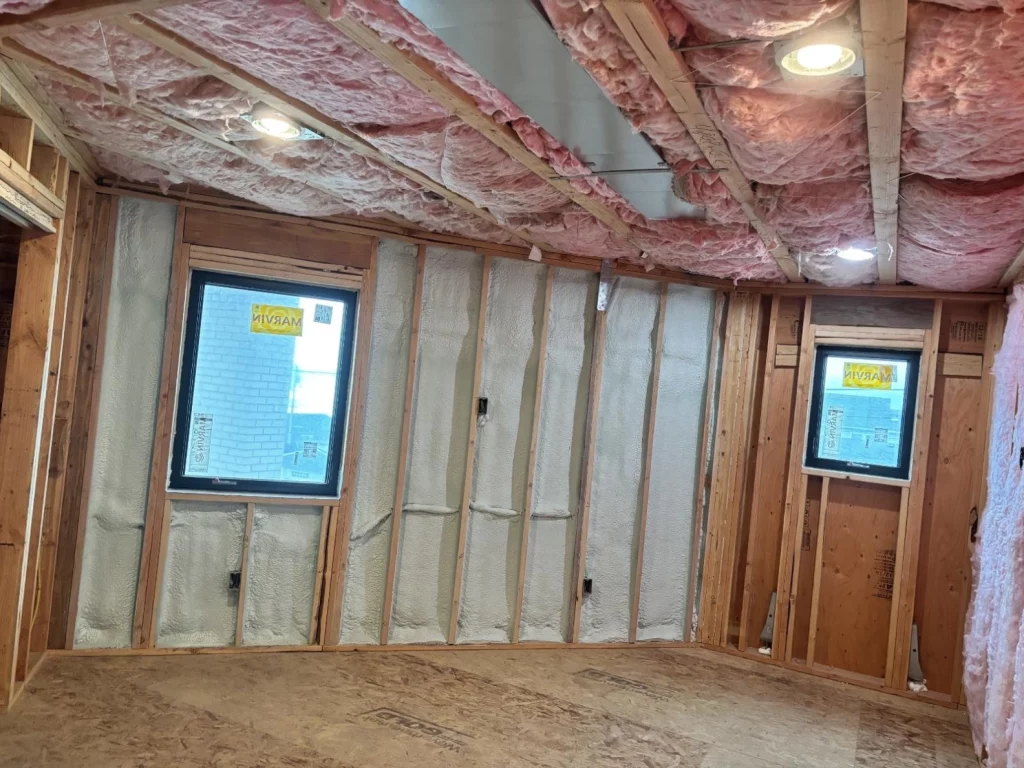
Several variables determine how well insulation resolves draft problems in any given commercial building:
Building height and stack effect potential. Taller buildings experience stronger stack-driven infiltration. The NIST CONTAM modeling data shows that infiltration rates and energy impacts vary meaningfully with building height and climate zone, with colder climates producing the largest energy penalties from envelope leakage.
Climate zone. Buildings in Climate Zones 4 through 8 (which include the Pacific Northwest and Portland metro areas we serve) experience larger indoor-outdoor temperature differentials, making draft control more impactful on heating energy use. The NIST study found that HVAC energy savings from airtightening ranged from minimal savings in warm climates to nearly 4 kBtu/ft² in Fairbanks, Alaska (CZ8).
Existing construction quality. The ASHRAE 90.1 Envelope Subcommittee established a baseline commercial building infiltration rate of 1.8 cfm/ft² at 0.30 inches of water column (75 Pa). Buildings with construction quality above this baseline will see smaller improvements from additional sealing. Buildings below it, which includes many older commercial structures, have the most to gain.
HVAC system pressurization. Buildings designed with positive pressurization still experience infiltration. The NIST modeling demonstrated that even “pressurized” commercial buildings only reduce system-on infiltration by about 44 percent on average, not the 75 percent assumed in many energy models. This means the building envelope itself must be tight, regardless of mechanical pressurization strategy.
Insulation thickness and R-value target. Greater foam thickness delivers higher thermal resistance, which is the primary factor that affects spray foam project pricing. Our pricing ranges reflect this: closed-cell spray foam projects are priced by board foot, with thicker applications needed to meet higher R-value targets.
Drafts are not something any commercial building should have to tolerate. They waste energy, reduce occupant comfort, and accelerate wear on HVAC equipment. At Spray-On Foam & Coatings, our team specializes in identifying and eliminating the air leakage paths that cause drafts in commercial buildings throughout the Vancouver and Portland metro areas. We provide closed-cell spray foam, open-cell spray foam, pole barn insulation, crawl space insulation, and comprehensive air sealing services for commercial properties of all types.
Request a Free Quote | Schedule a Building Assessment
Contact us at [email protected] or call (360) 667-1993 to discuss your building’s draft problems. We will walk through exactly where air is getting in and recommend the most effective insulation strategy to fix it for good.
Spray foam insulation handles both thermal resistance and air sealing in a single step, because it expands to fill gaps and adheres to surfaces. With other insulation types, separate air sealing work with caulks, gaskets, and sealants is required.
We use blower door testing combined with infrared thermography to locate air leakage paths precisely. These diagnostic tools reveal problem areas that are invisible during a visual inspection.
When done correctly with proper mechanical ventilation maintained per ASHRAE 62.1, air sealing improves indoor air quality by eliminating uncontrolled pathways for pollutants, dust, and moisture to enter the building.
Closed-cell spray foam is one of the most effective insulation solutions for metal buildings and pole barns because it adheres directly to metal surfaces, seals the many gaps inherent in metal construction, and provides both insulation and condensation control.
Given that uncontrolled air leakage drives 30 to 60 percent of HVAC energy costs in commercial buildings, spray foam insulation and air sealing typically deliver measurable energy savings that offset the investment over time, in addition to immediately improving occupant comfort.