

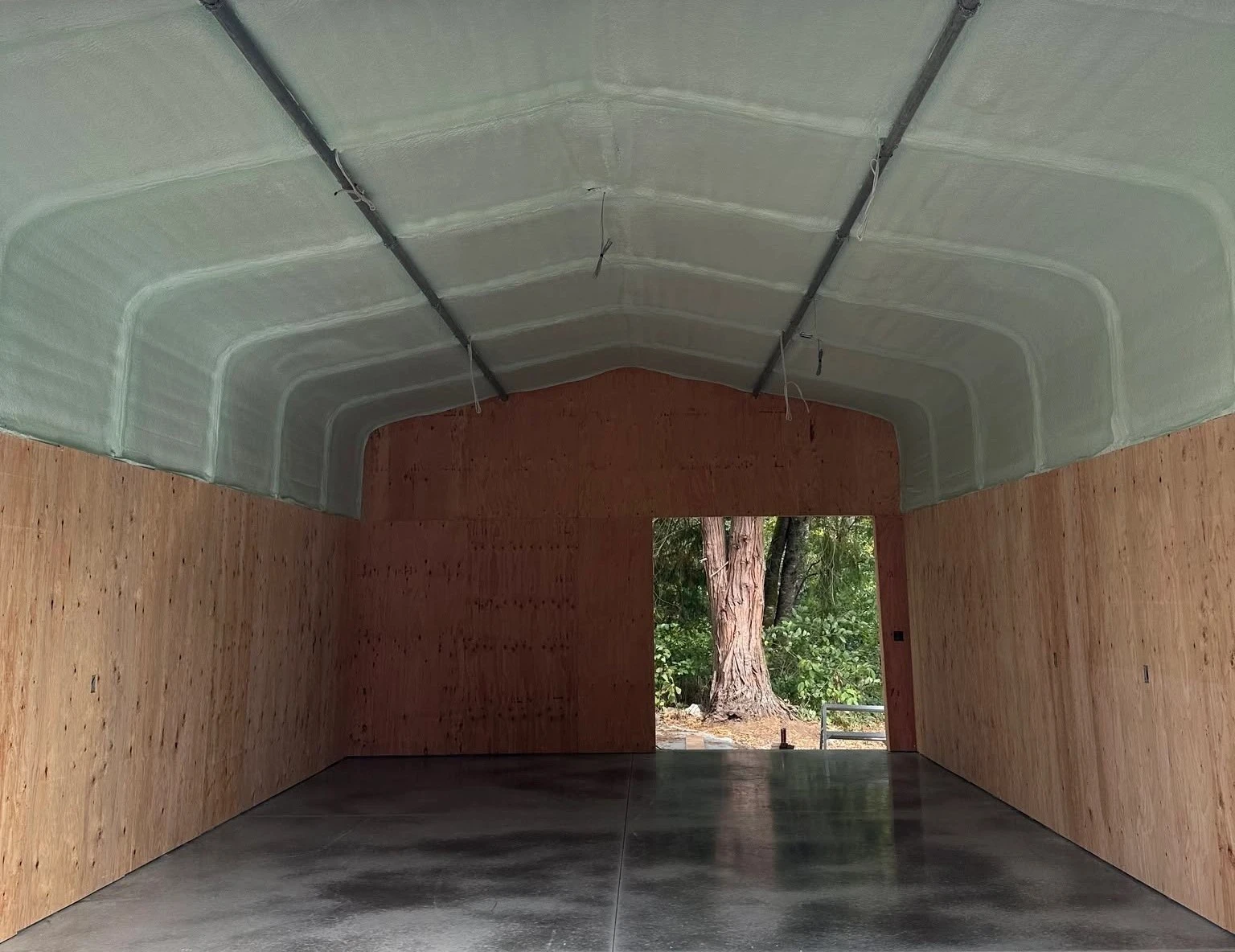
Vapor permeance measures how much water vapor passes through a building material, rated in perms, where a lower perm rating means less vapor gets through. For closed-cell spray foam in Vancouver, WA, permeance works like a performance dial: the perm rating falls as installed thickness increases, moving the foam from a Class III vapor retarder at about 1 inch to a Class II vapor retarder near 2.5 inches, based on ASHRAE data published by the ICC. That number matters here because Clark County sits in IECC Climate Zone 4C, a marine zone with wet winters, so permeance determines whether your wall, crawl space, or roof assembly meets code, resists condensation, and still has a drying path. The right specification depends on the assembly, the cladding, and the moisture load, which is exactly what the sections below sort out.
Permeance is tested under ASTM E96 and reported as the rate of water vapor diffusion through a material. Building codes group the results into three classes, plus a fully permeable category, and each class plays a different role in a wall or crawl space assembly. Understanding closed-cell spray foam performance also requires looking at how air sealing, thermal resistance, and moisture control work together, not just at the perm rating.
| Vapor Class | Permeance (US perms) | Common Examples | Practical Role in Vancouver, WA |
|---|---|---|---|
| Class I (impermeable) | 0.1 or less | Polyethylene sheet, unperforated foil | Reserved for special cases, easy to overdo in a wet marine climate |
| Class II (semi-impermeable) | 0.1 to 1.0 | Kraft-faced batts, closed-cell foam at 2.5 inches | The workhorse rating for 4C walls with non-vented cladding |
| Class III (semi-permeable) | 1.0 to 10 | Latex paint, 1-inch closed-cell foam, OSB sheathing | Works where vented cladding or exterior insulation provides the drying balance |
| Permeable | Above 10 | Unpainted drywall, open-cell foam, fiberglass | Lets assemblies dry inward, needs a companion layer for vapor control |
Two details from the code guidance deserve attention. Permeance drops as thickness rises, so the same foam serves different roles at different depths. And air leakage usually moves far more moisture than diffusion, which is why foam that seals air while controlling vapor does double duty.
The DOE Building America program defines a marine climate by cool summers (a warmest-month mean under 72°F), mild winters, and a wet cold season followed by a dry summer, and its county-by-county guide places Clark County, home to Vancouver, in Zone 4C marine. In practice that means months of rain-heavy air, cool wall cavities, and outward vapor drive each winter.
In this zone, the IRC requires a Class I or II vapor retarder on the interior side of above-grade frame walls, with a Class III layer allowed where the wall has vented cladding or the code’s minimum continuous exterior insulation (R-2.5 on a 2×4 wall, R-3.75 on a 2×6). ICC guidance for Marine 4 recommends Class II as the general choice and cautions against Class I layers where air conditioning runs in summer, because they block inward drying. DOE EERE sheets for the Seattle and Portland zone make the same point another way: assemblies need a way to dry, and the most common failure mode is stacking vapor-impermeable layers so moisture that gets in cannot get out.
Because permeance decreases with thickness, your installed depth is a moisture decision, not just an R-value decision.
| Installed Thickness | Approx. R-Value | Approx. Permeance | Vapor Class | Best Use Around Vancouver |
|---|---|---|---|---|
| 1 inch | R-6 | About 2 perms | Class III | Flash coats, air sealing, and flash-and-batt builds where vented cladding or exterior insulation covers the code path |
| 2.5 inches | R-15 | About 0.8 perm | Class II | Full vapor-retarder performance for 4C walls and crawl spaces in one product |
| 3 inches and up | R-18+ | Continues to drop, approaching the Class I range | Class I territory | Metal buildings, high-humidity exposures, and unvented assemblies |
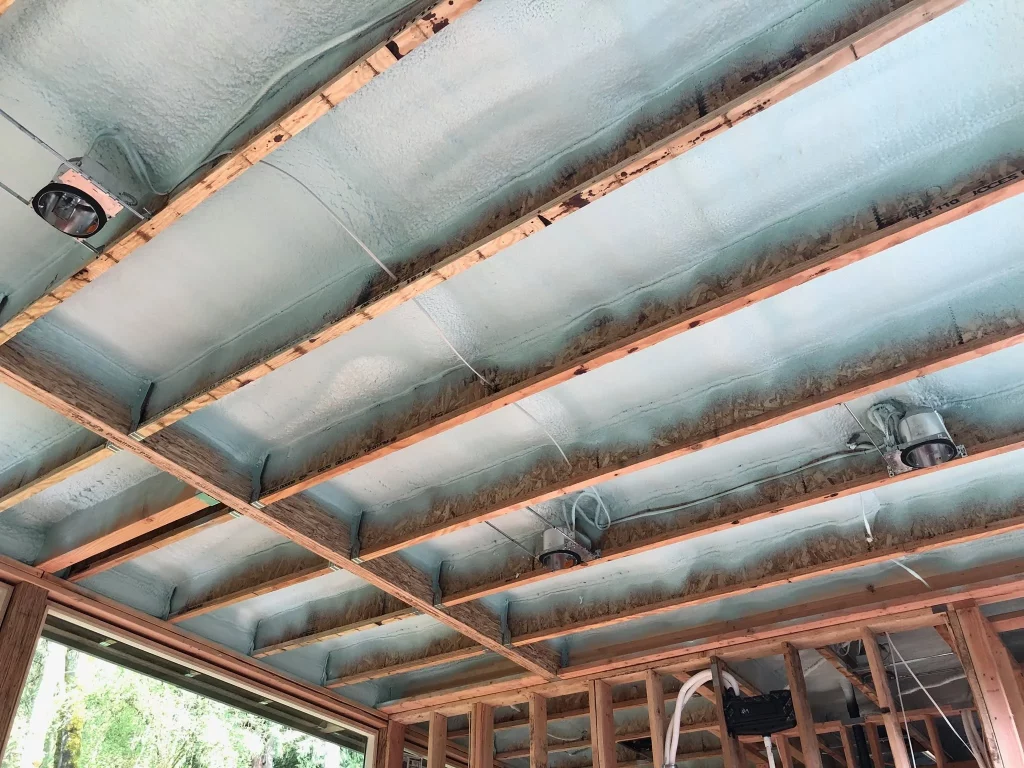
Two notes from the research: high-density closed-cell foam can stand in for insulating sheathing in flash-and-batt walls, and spray foam in Vancouver, WA applied at the interior of exterior sheathing serves the continuous-insulation function when it measures 1.5 perm or less at the specified R-value. Thicker passes add board feet, and our pricing runs $1.20 to $3.00 per board foot with bigger projects at the lower end of that range.
| Property | Closed-Cell (2 lb density) | Open-Cell (0.5 lb density) |
|---|---|---|
| Tested permeance | About 2 perms at 1 inch, 0.8 perm at 2.5 inches | About 25 perms at 3.5 inches |
| Vapor classification | Class II or III, set by thickness | Permeable |
| Moisture behavior | Retards diffusion in proportion to depth | Lets vapor pass through the assembly |
| Fit for a 4C assembly | Can satisfy the vapor retarder requirement on its own | Requires added vapor control at the warm side |
Budget follows the same split: our open-cell installs average $0.32 per board foot ($0.28 to $0.75) while closed-cell averages $1.50 ($1.20 to $3.00). The closed-cell premium buys the built-in vapor retarder, which in a marine climate often eliminates the need for a separate membrane.
Crawl spaces. Ground moisture and humid winter air make this the highest-risk zone in most Clark County homes. We insulate crawl walls with closed-cell foam and seal the rim joist, and because below-grade walls are exempt from the IRC’s interior-retarder rule, air sealing and moisture management carry the load. Our crawl space insulation projects average $5,500, ranging from $1,500 to $35,000.
Above-grade walls. Specify about 2.5 inches of closed-cell foam to reach Class II, or use a thinner Class III layer where the home has vented cladding or exterior insulation. Skip Class I products here, they fight the assembly’s ability to dry.
Attics, rooflines, and pole barns. Condensation forms on cold roof decks and metal panels during damp spells. Closed-cell foam at the deck or added thickness on metal structures controls it, and our pole barn insulation projects range from $3,500 to $50,000 with an $8,500 average.
| Audience / Context | Recommended Approach | Key Notes |
|---|---|---|
| Homeowners with damp crawl spaces | 2 to 3 inches of closed cell on crawl walls plus rim joist air sealing | Air sealing projects run $1,500 to $10,000, averaging $4,500 |
| Builders and remodelers framing in 4C | Class II closed-cell at about 2.5 inches, or Class III with vented cladding | Follows the IRC Marine 4 compliance path |
| Pole barn and shop owners | Added closed-cell thickness on rooflines and girts | Metal panels show condensation first, plan for it |
| Attic and roofline retrofits | Closed cell at the deck with targeted air sealing | Keeps warm indoor air off cold sheathing |
Vapor permeance is where spray foam projects succeed or fail in the Pacific Northwest, and our team at Spray-On Foam & Coatings specs every closed-cell application with Climate Zone 4C, code class, and drying path in mind. Call us at (360) 667-1993 or email [email protected] and we will review your assembly, recommend the thickness that hits the right perm class, and price it plainly by the board foot. Talk with our crew before the next wet season turns small moisture issues into expensive repairs.
Schedule a Vapor and Moisture Assessment
Technically a retarder at common residential thicknesses. At roughly 2.5 inches it measures about 0.8 perm, a Class II retarder, and only reaches Class I barrier territory as thickness increases further Wikipedia.
About 2.5 inches gets you to roughly 0.8 perm, the Class II level the IRC expects in Marine Zone 4. With vented cladding or qualifying exterior insulation, a thinner Class III layer is also code-permitted.
Usually no, and adding poly over thick foam often creates a double vapor barrier that traps moisture. Most Zone 4C assemblies perform better with the foam alone plus a defined drying path.
Closed cell is the safer call here. Open-cell foam measures about 25 perms at 3.5 inches, so ground moisture would diffuse straight through it, while closed cell insulates, air-seals, and retards vapor in one layer.
Not meaningfully. Plastic materials like spray foam hold their permeance steady at high humidity, unlike kraft paper or wood products that become more vapor-open as relative humidity climbs.