

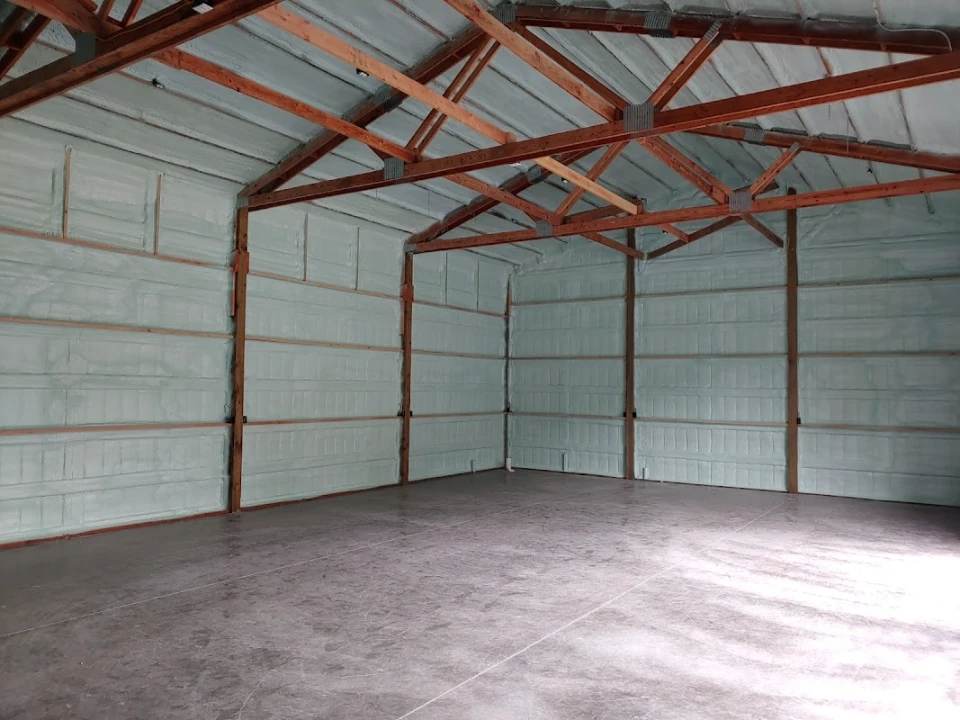
Every winter, we get the same phone call. A homeowner has a room that never seems to warm up, floors that feel like ice, and a furnace that runs nonstop. They may have already added insulation, but the drafts and high bills remain. The missing piece is usually not more fluff in the attic. It is air, moving through the building in ways fiberglass batts cannot stop.
Closed-cell spray foam insulation solves that problem because it does two jobs at once. It insulates against heat flow, and it seals the gaps where air leaks out. According to ENERGY STAR, homeowners who air seal and insulate their attics, crawl space floors, and rim joists save an average of 15% on heating and cooling costs, or 11% on total energy costs. A material that does both jobs in one pass changes the math.
Closed-cell spray foam is a two-part polyurethane. Two liquid chemicals, an isocyanate (the A-side) and a polyol resin blend (the B-side), are heated, pressurized, and mixed at the spray gun. The moment they combine, they react, expand, and cure into rigid foam in seconds.
The name comes from the foam’s structure. As it rises, it forms billions of tiny cells, and in closed-cell foam, each one seals itself off from its neighbors. Those cells trap a gas with a low thermal conductivity, which is where much of the insulation value comes from. The cell walls themselves are plastic, which makes the cured foam stiff, dense, and water-resistant.
A few practical traits follow from that structure:
Contractors measure spray foam in board feet. One board foot equals one square foot of coverage at one inch thick. That unit matters later when we talk about pricing, because foam is almost always quoted by the board foot.
The two foam types share a chemistry family but behave very differently. Here is the honest comparison we walk customers through:
| Property | Closed Cell | Open Cell |
|---|---|---|
| R-value per inch | Starts at R-5.7 or higher | Starts at R-3.6 |
| Texture when cured | Rigid and dense | Soft and sponge-like |
| Air barrier | Yes, even at low thickness | Yes, at full-fill thickness |
| Water vapor | Class II vapor retarder | Vapor-open, needs separate management |
| Water absorption | Sheds water | Can hold water |
| Flood performance | Rated highly flood-resistant | Usually must be removed after flooding |
| Sound dampening | Modest | Better |
| Best uses | Rim joists, crawl spaces, metal buildings, flood zones | Attics, interior sound control |
The R-value figures come from the Spray Foam Coalition, which also notes that closed-cell foam can turn a standard 2×4 wall cavity into R-20 at full fill.
Heat leaves a building three ways: conduction through solid materials, convection through moving air, and radiation. Most insulation products only address conduction. Air leakage, the convective piece, is where many homes bleed energy no matter how much insulation they contain.
Warm air rises, escapes through the top of the house, and pulls cold outside air in through the bottom. This is called stack effect, and it never stops while indoor and outdoor temperatures differ. The worst leak points we find, nearly every time, are:
Fiberglass batts do almost nothing at these locations because air moves straight through them. As the U.S. Department of Energy’s Building Science Education program explains, a complete thermal envelope requires both insulation and air sealing working together across floors, walls, and ceilings. R-value without air sealing is a sweater with the zipper open.
An air barrier stops bulk airflow. A vapor retarder slows water vapor diffusion, which is a slower, invisible process. Closed-cell foam earns both titles. It adheres to framing and sheathing, filling gaps as it expands, and it qualifies as a Class II vapor retarder under the International Residential Code, per the Spray Foam Coalition.
Think about your refrigerator. The walls do not change when you leave the door open, but airflow wrecks its performance instantly. Your house works the same way. Air sealing the envelope is what lets the insulation you already paid for actually work.
Key Takeaways
R-value measures resistance to heat flow. Higher numbers resist heat better, and values are usually listed per inch of thickness. The Department of Energy notes that materials are selected based on the R-values required by code or your energy goals, and closed-cell foam delivers more R per inch than nearly anything else you can spray.
Closed-cell foam starts at R-5.7 per inch, per the Spray Foam Coalition’s product data. Thickness simply multiplies that number:
| Applied Thickness | Minimum Listed R-Value |
|---|---|
| 1 inch | R-5.7 |
| 2 inches | R-11.4 |
| 3 inches | R-17.1 |
| 4 inches | R-22.8 |
Individual products vary, and the manufacturer’s data sheet for the specific foam being sprayed is the number that counts. Most closed-cell products perform slightly better than these minimums once fully cured.
Here is something most product comparisons miss. Wood framing conducts heat far faster than insulation does. A wall filled with batts between studs still has a wooden highway every 16 inches, letting heat bypass the insulation entirely. Builders call this thermal bridging.
Closed-cell foam attacks the problem two ways. Sprayed full-fill into a 2×4 cavity, it reaches about R-20, nearly double what a batt achieves in the same space. Applied as a continuous layer over framing or paired with batts in a hybrid approach, it blankets the studs too. Both strategies raise the whole-assembly performance well beyond what the cavity number suggests.
One honest caveat: foam’s R-value can drift slightly downward over many years as the blowing agent slowly diffuses out. Modern blowing agents hold their values much better than older formulations, but any contractor quoting a permanent R-value is overselling.
Expert Tip: When we inspect a job, we probe cured foam thickness at a dozen points, not just the easy ones. Thin spots behind obstructions are where cold rooms and callback complaints come from. Ask any installer how they verify thickness before you sign anything.
Comfort claims are easy to make. Hard data is better, so let’s look at what the EPA’s own modeling shows.
According to ENERGY STAR, air sealing plus adding insulation in attics, floors over crawl spaces, and accessible basement rim joists saves the average homeowner 15% on heating and cooling costs and 11% on total energy costs. Their model assumed a 25% reduction in air infiltration, which a properly scoped foam job on the leakiest areas of a home meets or exceeds.
The numbers get better in our region. EPA’s climate zone table projects 20% heating and cooling savings for climate zone 4C, the marine zone covering much of Western Washington and Oregon. Our long, wet heating season gives air sealing more months per year to pay off.
Beyond the bill, sealed envelopes deliver benefits you feel daily:
That last point deserves emphasis. When a home stops leaking air, the furnace or heat pump cycles less, and ducts running through unconditioned crawl spaces stop leaking conditioned air into the dirt. If you want a professional measurement of your home’s leakage before spending a dollar, start with home energy audit guide.
Not every project needs this material, and part of honest advice is saying so. These are the applications where closed-cell foam consistently outperforms everything else:
1. Rim joists. This is the single worst leak site in most homes, and it is nearly impossible to seal well with anything but foam. Two inches delivers R-11 or better plus a permanent air and vapor seal. More detail in.
2. Crawl spaces. Closed-cell foam on crawl space walls and the rim joist turns a damp, cold void into a semi-conditioned buffer. It insulates, manages vapor, and protects pipes in one step, which is why it anchors most encapsulation projects.
3. Cathedral ceilings and rooflines. Rafters offer limited depth, so high R-per-inch matters. Foam makes unvented, conditioned roof assemblies practical where batts would fall short. Codes generally require a thermal barrier, such as drywall, over foam in occupied spaces.
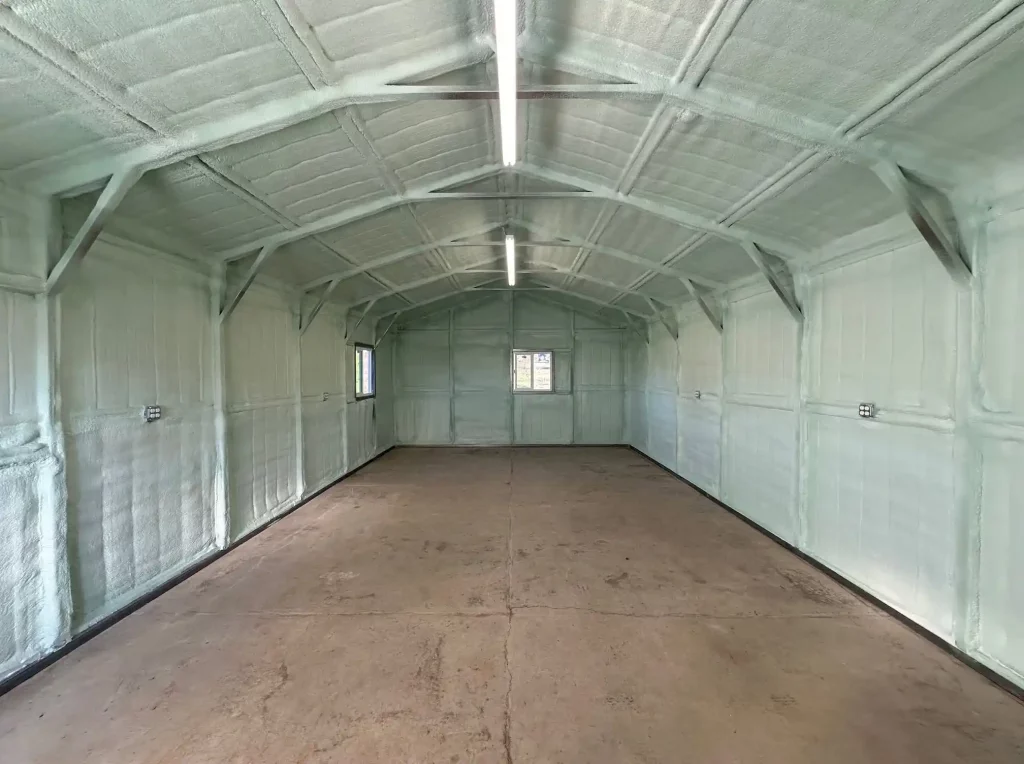
4. Metal buildings and pole barns. Steel conducts heat and condenses moisture, and batts sag out of the framing. Foam bonds directly to the steel, insulates, and controls condensation in one pass.
5. Flood-prone lower levels. The National Flood Insurance Program defines a flood-resistant material as one that survives at least 72 hours of direct contact with floodwaters without significant damage, and it lists closed-cell foam insulation among highly flood-resistant materials, per the Association of State Floodplain Managers. After a flood, wet batts get demolished and hauled away. Foam rinses, dries, and stays.
Expert Tip: If your property sits in a mapped flood zone, talk to your local floodplain administrator before any remodel below the base flood elevation. Materials rules are stricter there, and foam is usually the easy compliance choice.
Understanding the process helps you judge whether a crew knows what it is doing. Here is how a proper job runs from first visit to final walkthrough.
We start by walking the building and identifying where air and moisture enter, what exists in the cavities, and what the goal is: comfort, code compliance, moisture control with closed-cell, or all three. Thickness targets come from the building code and your goals, and the total board footage from that math drives the quote.
Spray foam is not a DIY material. The A-side contains isocyanates, which the NIOSH describes as powerful irritants that can sensitize workers and cause severe asthma attacks on re-exposure. NIOSH recommends ventilation and engineering controls as the primary defense, supported by respirators and protective clothing. Our crews wear supplied-air respirators and full coveralls, seal off the work zone, and keep occupants and pets out of the space until the job is done and the area is ventilated.
Prep also means masking windows and surfaces, confirming the substrate is dry and warm enough, and verifying the equipment is metering both chemicals at the correct ratio.
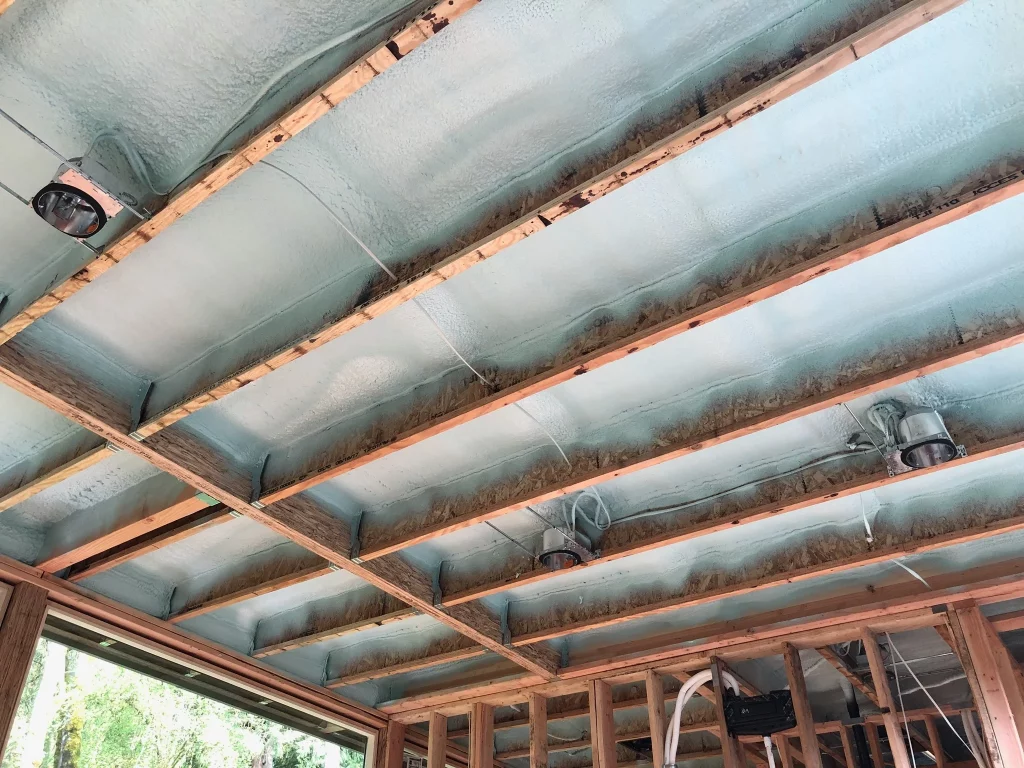
The foam goes on in lifts, or passes, typically around two inches each, with a short cooling pause between passes. Thick single pours trap heat as the chemicals react, which can scorch the foam and cause shrinkage cracks. Lifts also let the applicator watch the rise, color, and adhesion, and catch a ratio problem before it covers a wall.
The foam is tack-free within seconds and cures fully in hours. We probe for thickness, trim overfill at framing, and verify the substrate coverage. Where code requires a thermal barrier, drywall goes over the foam before the space is used as living area.
Expert Tip: Projects go smoother and cheaper when the work area is cleared and access is easy. In our experience, tight crawl hatches and packed storage are the two things that slow a foam crew down most.
Homeowners ask about smell and off-gassing more than almost anything else, so here is the unvarnished version.
During application and curing, the chemicals are active and the area must be vacant. That is non-negotiable. Once foam cures properly, it is inert plastic, and the chemical reaction is complete. A properly mixed, correctly cured job has no meaningful odor after ventilation.
A persistent chemical or fishy smell is a red flag. It usually means the foam was sprayed off-ratio or too thick, and it warrants a call back to the installer, not just an air freshener. The same NIOSH guidance that protects our crews during application is the reason we hold the line on vacancy and ventilation: the hazard window is real, but it is bounded, and professional practice closes it.
Foam is priced by the board foot, meaning one square foot at one inch of thickness. Here is our current typical pricing:
| Service | Typical Low | Typical Average | Typical High |
|---|---|---|---|
| Closed-cell spray foam (per board foot) | $1.20 | $1.50 | $3.00 |
| Open-cell spray foam (per board foot) | $0.28 | $0.32 | $0.75 |
| Crawl space insulation (full project) | $1,500 | $5,500 | $35,000 |
| Air sealing (standalone project) | $1,500 | $4,500 | $10,000 |
Several factors move a quote within and beyond those ranges:
Closed-cell foam carries a higher price per board foot than open cell, and the difference is real. What the comparison leaves out is that closed cell delivers roughly double the R-value per inch, acts as its own vapor retarder, and often removes the need for separate air sealing work. Judged per delivered R and per sealed leak, the gap narrows considerably.
Key Takeaways
A quick decision guide for the most common situations we see:
Insulation and air sealing upgrades frequently qualify for federal tax credits and utility rebates, but program rules change often, so confirm current eligibility with your tax preparer or utility before counting on them.
Most spray foam failures trace back to a handful of causes, and all of them are preventable:
Expert Tip: Before hiring anyone, ask which foam product they spray, request its data sheet, and ask how they verify thickness and ratio on the job. Good crews answer easily and show you in-process photos without being asked twice.
Two to three inches is typical for walls, delivering roughly R-11 to R-17 plus full air sealing. Crawl spaces and rim joists often use two inches, while unvented rooflines may need more. The right number depends on your code requirements and goals.
No. Plan for everyone, including pets, to be out during application and until the foam has cured and the space has been ventilated. For most residential projects, that means the workday plus a drying window.
It adds genuine rigidity and stiffness to wall and roof assemblies because it bonds surfaces together. Treat that as a bonus, not a substitute for structural sheathing or engineering.
Closed cell for moisture exposure, limited depth, flood zones, and metal buildings. Open cell for attics and sound control where vapor is already managed. When in doubt, match the foam to the assembly, not the brochure.
Some. Its density dampens sound better than empty cavities, but open cell foam remains the better acoustic choice because it absorbs vibration rather than transmitting it.
Insulation and air sealing upgrades often qualify for federal tax credits and local utility rebates, but eligibility rules change regularly. Verify current requirements with your utility or tax professional before filing.
Here is the short version of everything above. Air leakage and conduction are separate problems, and closed-cell foam is one of the few materials that solves both in a single application. Its R-value starts at 5.7 per inch, it seals as it insulates, and it manages vapor at the same time. The EPA’s own numbers show air sealing and insulation cutting heating and cooling costs by 15% on average, and more in our marine climate.
Your next steps are simple. Walk your home on a cold, windy day and feel the rim joists and floors over crawl spaces. Get your leakage measured if the drafts are obvious. Then compare quotes based on thickness, verified application practice, and cost per delivered R, not price alone. Bookmark this guide and use it as a checklist when you do.
When you are ready for a straight assessment of your building, we are here to help.
If you would like a professional evaluation of your home, crawl space, or metal building, reach out to us at Spray-On Foam & Coatings. We will walk the space with you, explain where air and moisture are getting in, and give you an honest recommendation, including when foam is not the right answer. Every quote is scoped to your building, not a formula. Call us at (360) 667-1993 or email [email protected] to schedule a free consultation.