

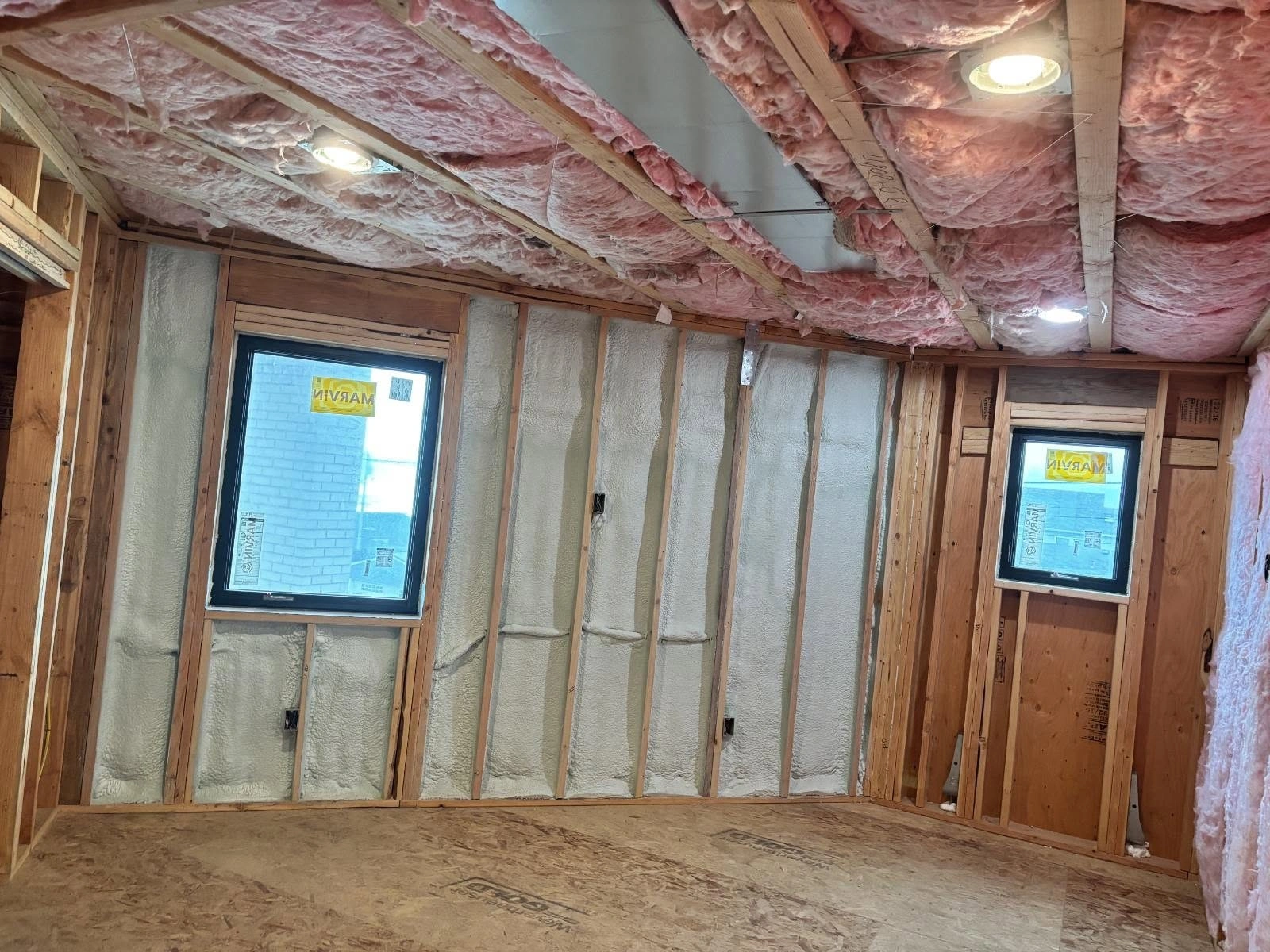
Closed-cell spray foam stands apart from other insulation materials because it handles four building science functions at once: thermal resistance, air control, vapor control, and moisture resistance. For exterior walls specifically, those combined properties matter more than anywhere else in a building envelope. The right insulation choice depends on your climate zone, construction type, and moisture exposure, but closed-cell spray foam consistently earns a “preferred” rating from building scientists across cold, hot-humid, and hot-dry climates when applied to wall cavities. According to the Building Science Corporation’s residential spray foam guide, spray foam’s ability to provide continuity across all four control layers makes it uniquely suited for exterior wall applications where failure in any single layer leads to costly moisture damage, air leakage, and energy loss.
Spray polyurethane foam is created by mixing two liquid chemicals on-site. The “A” side contains methylene diphenyl diisocyanate (MDI) and the “B” side blends polyols, catalysts, blowing agents, flame retardants, and surfactants. When combined, these chemicals react and expand rapidly, filling wall cavities and bonding to framing, sheathing, and other substrates. According to the Spray Polyurethane Foam Alliance, closed-cell SPF forms a continuous barrier on walls, around corners, and across contoured surfaces that resists heat transfer and blocks unwanted air infiltration through cracks, seams, and joints.
What separates closed-cell from open-cell foam is the cell structure. Closed-cell foam maintains over 90% of its cells as closed, with insulating gases trapped inside. Air and moisture cannot move from one cell to the next, which gives closed-cell foam its high R-value, low vapor permeance, and water resistance. Open-cell foam, by contrast, has interconnected voids that allow vapor and air to pass through.
Exterior walls face the full range of environmental stresses: temperature extremes, wind-driven rain, vapor pressure from both inside and outside the building, and structural loads. Insulation in exterior walls must do more than slow heat transfer. It needs to work as part of a system that manages water, air, vapor, and heat simultaneously.
The Building Science Corporation notes that spray foam insulation has significant advantages over other systems specifically because of its ability to provide continuity across the water control, air control, vapor control, and thermal control layers. In a standard wall assembly with fiberglass batts, each of those four functions requires a separate material and a separate installation step, creating opportunities for gaps, misalignment, and errors. Closed-cell spray foam handles all four in one continuous application.
This is especially important in wall assemblies because walls have more penetrations than any other part of the building envelope. Plumbing vents, electrical runs, windows, doors, and structural connections all create potential pathways for air and moisture. Spray foam expands to seal around each one.
Both closed-cell and open-cell foam types have their place, but when it comes to exterior walls, the physical properties of closed-cell foam make it the stronger candidate in most scenarios.
| Property | Closed-Cell Foam | Open-Cell Foam |
|---|---|---|
| R-Value per Inch | R-6.0 to R-7.0 | R-3.5 to R-3.6 |
| Density | 1.75 to 2.25 lbs./ft3 | 0.4 to 1.2 lbs./ft3 |
| Vapor Permeance | Less than 1 perm at 2 inches (Class II vapor retarder) | 5 to 10 perms at 5 inches (vapor permeable) |
| Water Absorption | Hydrophobic, will not absorb water | Can absorb and hold significant liquid water |
| Air Barrier | Yes, at minimum classified thickness | Yes, at full wall thickness |
| Structural Strength | High rigidity, adds wall racking strength | Low, soft and flexible |
| Cold Climate Wall Rating | Preferred | Preferred (with vapor retarder) |
| Hot-Humid Wall Rating | Preferred | Acceptable |
The InterNACHI polyurethane spray-foam guide reports that closed-cell foam achieves an R-value of approximately R-7 to R-8 per inch according to the U.S. Department of Energy, and it acts as a vapor barrier, making it the recommended choice when insulation will be exposed to high moisture levels. It also notes that over time, the R-value of closed-cell foam can decrease slightly due to thermal drift as the insulating gas is gradually replaced by air, but most of this drift occurs within the first two years and the foam then remains stable.
Moisture is the single most common cause of premature building failure, and exterior walls are ground zero. Whether you are building in the Pacific Northwest’s wet climate or a humid southern region, water infiltration through walls leads to mold growth, wood rot, reduced insulation performance, and structural damage.
Closed-cell spray foam offers three layers of moisture defense. First, it acts as a vapor retarder, limiting the amount of water vapor that can diffuse through the wall assembly. At typical application thicknesses, closed-cell foam falls below 1 perm, qualifying as a Class II vapor retarder under the International Residential Code. Second, it serves as an air barrier, preventing moist air from leaking through cracks and penetrations where vapor can condense on cooler surfaces. Third, closed-cell foam is hydrophobic, meaning it will not absorb liquid water even in the event of a leak.
The DOE Building America spray foam guide rates closed-cell SPF as “preferred” for frame-wall cavities in hot-humid climates specifically because it provides air-sealing and redundant moisture control at the exterior of the wall assembly. In those climates, the vapor drive pushes from outside to inside, and closed-cell foam keeps that humid exterior air out of the wall cavity.
Unlike any other insulation material, closed-cell spray foam adds measurable structural strength to the wall assembly. The foam bonds directly to framing members and sheathing, creating a rigid composite that resists racking forces. Research documented by the Building America program found that closed-cell SPF substantially increases the racking strength of frame walls, which is a notable advantage for construction in hurricane-prone and seismic zones.
The University of Florida and other institutions have confirmed that closed-cell foam used to bond roof decking to trusses improves wind uplift resistance. The same principle applies in walls: when closed-cell foam fills cavities and adheres to framing, the wall acts more like a structural insulated panel (SIP) than a conventional stick-framed assembly.
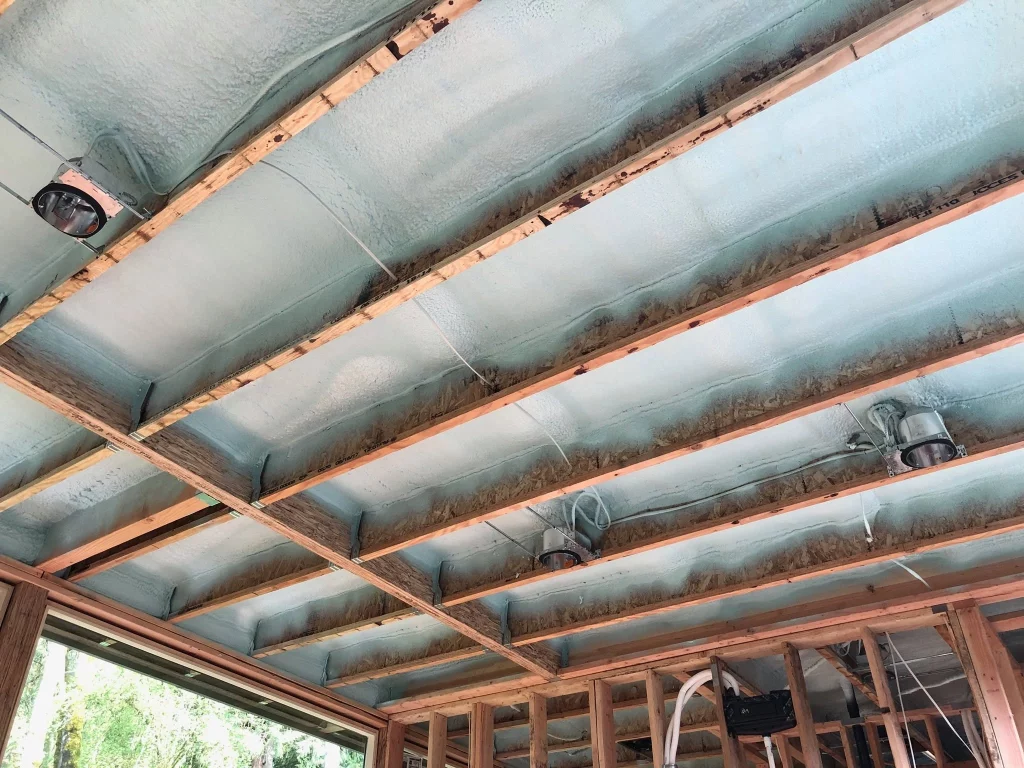
Air leakage accounts for a significant portion of energy waste in residential and commercial buildings. The Spray Foam Coalition reports that as much as 40% of a building’s energy is lost due to air infiltration, and the EPA’s Energy Star program estimates that adding insulation and sealing air leaks could save up to 20% on monthly energy bills. The U.S. Department of Energy further estimates that 56% of energy used in a home goes to heating and cooling.
Closed-cell spray foam addresses both problems simultaneously. Its high R-value per inch means thinner applications achieve the same thermal resistance as much thicker layers of fiberglass or cellulose. And because it seals gaps and cracks as it’s applied, it eliminates the air leakage pathways that traditional insulation materials cannot block.
With spray foam’s ability to tighten the building envelope, HVAC sizing can be reduced in some cases, since the heating and cooling system does not need to work as hard to maintain consistent indoor temperatures.
The performance of any wall insulation depends on the climate zone. Here is how closed-cell spray foam performs across different conditions:
Cold climates (IECC Climate Zones 5 and higher): Closed-cell spray foam is preferred for frame-wall cavities. At 1.5 inches thick, it meets code requirements for condensation control and functions as a Class II vapor retarder. For climates above 6,000 heating degree days, a minimum of 2 inches is recommended. Interior vapor-retarder primers or latex-painted drywall complement the foam’s vapor control.
Hot-humid climates: Closed-cell is the preferred choice because it provides a moisture control layer on the exterior side of the wall cavity, blocking humid outdoor air from entering. Interior vapor retarders should be avoided with closed-cell foam in these climates to prevent trapping moisture between two impermeable layers.
Hot-dry climates: Closed-cell performs well and is rated preferred, though the climate is generally more forgiving. Exterior drainage planes remain critical since periodic heavy rain events can still drive moisture into wall assemblies.
Choosing the right insulation contractor matters as much as choosing the right material. Look for these indicators:
Spray-On Foam & Coatings specializes in closed-cell spray foam insulation for exterior walls in residential and commercial buildings across the Vancouver, WA and Portland, OR areas. Our team evaluates each project’s unique requirements, from climate zone and wall assembly type to access conditions and R-value targets, and recommends the right approach for lasting performance. Whether you are building new construction or retrofitting an existing structure, we bring the experience and equipment needed to deliver a continuous, airtight, and moisture-resistant insulation layer.
Request a Free Quote | Schedule a Consultation
Call us at (360) 667-1993 or email [email protected] to discuss your project with our team.
Yes, closed-cell spray foam can be applied to the interior surface of wood-based sheathing or rigid foam exterior sheathings such as foil-faced isocyanurates and XPS. In these assemblies, the water control layer is typically the taped joints of the exterior rigid insulation.
No. At typical application thicknesses of 1.5 inches or more, closed-cell spray foam functions as a Class II vapor retarder on its own, eliminating the need for an additional polyethylene vapor barrier in most wall assemblies.
Closed-cell spray foam contains flame retardants and meets ASTM E 84 flame spread requirements, but it must be covered by an approved thermal barrier, such as half-inch gypsum board, in habitable spaces per the International Residential Code Section R316.
Closed-cell spray foam typically costs $1.20 to $3.00 per board foot, which is higher per inch than fiberglass batts. However, closed-cell foam delivers higher R-value per inch, air sealing, vapor control, and moisture resistance that fiberglass cannot provide, often eliminating the need for separate air and vapor barrier materials.
Closed-cell spray foam provides some sound attenuation due to its density and ability to seal air pathways that transmit noise. However, open-cell foam is generally more effective at absorbing sound in normal-frequency ranges because of its softer, more flexible cell structure.