

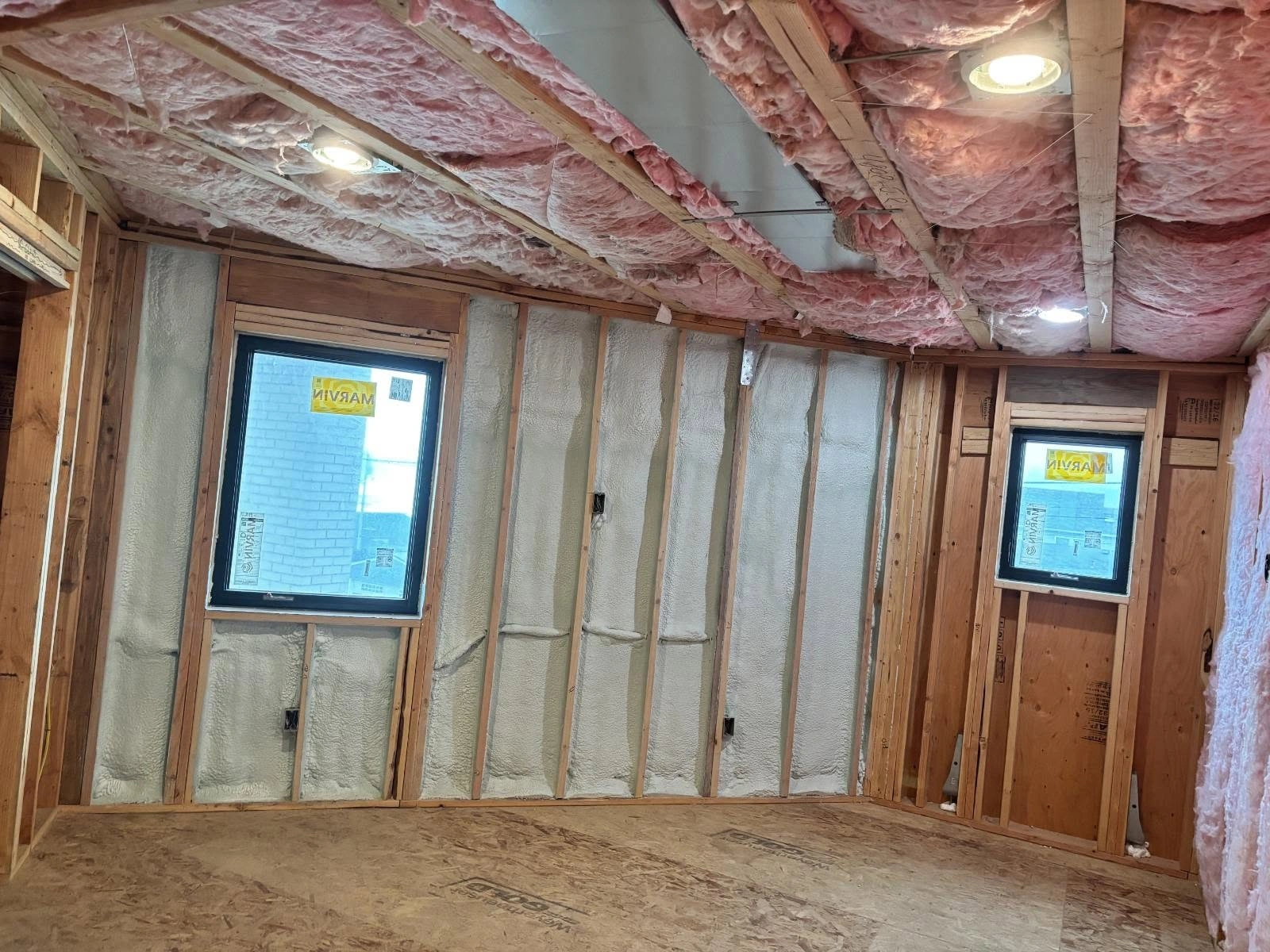
Closed-cell spray foam insulation in Battle Ground, WA typically runs between $1.20 and $3.00 per board foot installed, with most homeowners in our area paying around $1.50 per board foot. For a typical 1,500 to 2,500 square foot home in Clark County, total project costs generally fall between $3,500 and $10,000, depending on the scope of work, thickness required, and areas being insulated. Battle Ground sits in IECC Climate Zone 5B, which means winters hit a design heating temperature of 19°F, and the 2021 Washington State Energy Code requires walls to meet a minimum of R-20 cavity plus R-5 continuous insulation. Closed-cell spray foam delivers approximately R-6 to R-7 per inch, making it one of the most effective ways to meet and exceed those code requirements in a single application.
Spray foam insulation is measured and priced by the board foot, not by the square foot. One board foot equals 1 square foot of coverage at 1 inch of thickness. So if we spray a 1,000 square foot wall cavity at 3 inches deep, that equals 3,000 board feet of material.
Here is how our closed-cell spray foam pricing breaks down in Battle Ground and the surrounding areas:
| Pricing Level | Cost Per Board Foot | Typical Scenario |
|---|---|---|
| Low | $1.20/bf | Larger projects with easy access and flexible scheduling |
| Average | $1.50/bf | Standard residential retrofit, 1,500-2,500 sq ft home |
| High | $3.00/bf | Complex jobs requiring thicker applications, difficult access, or high R-values |
To put board foot pricing into real-world terms for a Battle Ground home, here are several common project scenarios:
| Project Type | Location | Project Size | Estimated Total Cost |
|---|---|---|---|
| Full wall cavity retrofit | Battle Ground, WA | 1,800 sq ft home, 2×6 walls at 3 inches | $3,500 – $10,000 |
| Crawlspace rim joist sealing | Battle Ground, WA | 1,500 sq ft footprint, 1 inch average | $1,500 – $4,500 |
| New construction full envelope | Battle Ground, WA | 2,200 sq ft home, walls and band joists | $4,000 – $12,000 |
| Vaulted ceiling / cathedral ceiling | Battle Ground, WA | 800 sq ft roof deck, 4 inches | $3,500 – $8,000 |
| Combined crawlspace + walls | Battle Ground, WA | 2,000 sq ft home, full encapsulation | $5,000 – $15,000 |
Every insulation project is different, and pricing shifts based on several site-specific factors. The single biggest factor affecting our pricing is the size of the project. Larger projects allow us to mobilize equipment once and work efficiently, which lowers the per-board-foot rate.
Factors that increase pricing:
Factors that reduce pricing:
Battle Ground’s climate demands serious insulation performance. According to the Department of Energy’s Insulation Fact Sheet from Oak Ridge National Laboratory, heating and cooling account for 50 to 70% of the energy used in the average American home. Inadequate insulation and air leakage are the leading causes of energy waste. Closed-cell spray foam directly addresses both issues in a single step.
Here is how closed-cell spray foam compares against common alternatives:
| Insulation Type | R-Value Per Inch | Air Barrier | Moisture Barrier | Structural Support |
|---|---|---|---|---|
| Closed-Cell Spray Foam | 6.0 – 7.0 | Yes | Yes (Class II vapor retarder) | Yes |
| Open-Cell Spray Foam | 3.5 – 3.7 | Yes | No | No |
| Fiberglass Batt | 2.9 – 3.8 | No | No | No |
| Blown-In Cellulose | 3.1 – 3.8 | No | No | No |
| Rigid Foam Board | 3.8 – 6.5 | Varies | Varies | No |
Closed-cell foam is the only option in this list that simultaneously delivers high R-value per inch, a continuous air seal, a built-in moisture barrier, and added structural strength. For Climate Zone 5B homes in Clark County, that combination is hard to beat.
The Washington State Energy Code has some of the most demanding insulation requirements in the country. For Climate Zone 5, Table R402.1.3 of the 2021 code specifies:
Closed-cell spray foam can meet the cavity component of wall requirements in as little as 3 inches of application in a 2×6 wall, reaching R-18 to R-21. When paired with R-5 continuous rigid foam on the exterior, the assembly comfortably exceeds code. In vaulted or cathedral ceilings, closed-cell foam applied directly to the underside of the roof deck eliminates the need for venting and provides both the thermal envelope and the air barrier in one layer.
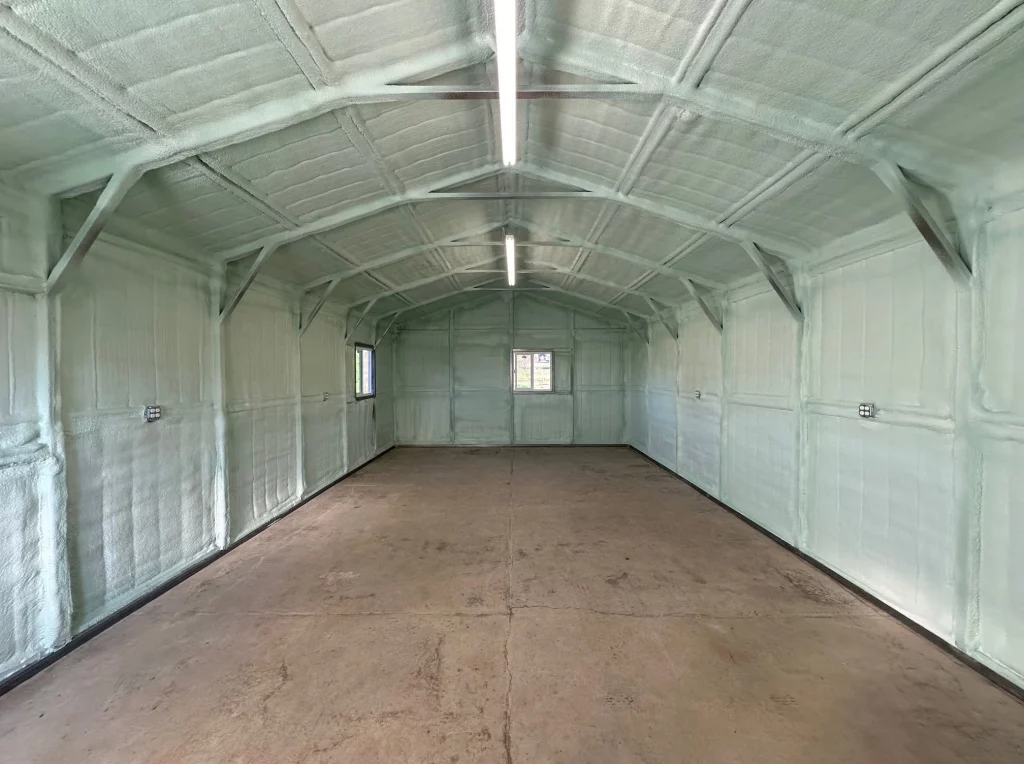
According to ENERGY STAR, the EPA estimates that homeowners can save an average of 15% on heating and cooling costs, or about 11% on total energy costs, by sealing their homes and adding insulation. Nine out of ten homes in the United States are under-insulated, meaning most Battle Ground homeowners have room for meaningful improvement.
Closed-cell spray foam delivers savings beyond what standard insulation achieves because it creates a monolithic air seal. Traditional fiberglass or cellulose can leave gaps around framing members, electrical boxes, pipes, and other obstructions. The DOE Insulation Fact Sheet notes that air leaks through these gaps and penetrations often account for significantly more energy loss than the obvious leaks around windows and doors. Spray foam expands into every void and crack, eliminating those leakage paths entirely.
For a typical Battle Ground home, the return on investment comes from three sources:
Closed-cell spray foam is the right choice if:
Closed-cell spray foam may not be the best fit if:
What happens to your heating bills when Battle Ground temperatures drop to 19°F and your walls are still insulated with compressed, gap-filled fiberglass from the 1980s? Every winter you delay upgrading your insulation, you are paying for energy that escapes through air leaks your current insulation cannot seal. The 2024 IECC Determination from the Department of Energy continues to push for tighter building envelopes and higher efficiency standards, which means homes with outdated insulation will fall further behind code requirements and lose more resale value over time. Closed-cell spray foam is a permanent upgrade that pays for itself in energy savings and never needs replacement.
Spray-On Foam & Coatings has been serving Battle Ground and the greater Clark County area with professional closed-cell spray foam installation for years. We handle everything from new construction full-envelope insulation to retrofit crawlspace encapsulation, pole barn insulation, and targeted air sealing projects. Our team understands the specific demands of Climate Zone 5B and the Washington State Energy Code, and we price every job fairly based on the actual scope of work.
Request a Free Quote: [email protected] or call us at (360) 667-1993 to get a detailed estimate for your project.
Schedule an On-Site Assessment: Not sure whether closed-cell spray foam is right for your home? Reach out and we will evaluate your building envelope, identify problem areas, and recommend the best approach for your budget and goals.
We answer every call, show up on time, and stand behind our work. Let us show you what proper insulation does for a Battle Ground home.
A board foot is one square foot of foam at one inch of thickness. Pricing is based on board feet because the thickness of the application directly determines both material volume and R-value performance. A 2-inch application over 500 square feet equals 1,000 board feet.
For standard 2×6 wall cavities, a 3-inch application of closed-cell foam achieves approximately R-18 to R-21, which covers the cavity insulation requirement for Climate Zone 5B when paired with R-5 continuous exterior insulation. Exact thickness depends on your specific assembly and code compliance path.
No. Closed-cell spray foam has a permeance rating that qualifies as a Class II vapor retarder, meaning it acts as both insulation and a vapor barrier in a single application. This eliminates the need for an additional polyethylene sheet in most wall and ceiling assemblies.
Most single-family home projects take one to two days depending on scope. A full wall cavity insulation job on a 2,000 square foot home typically completes in a single day. Projects involving crawlspaces, attics, and walls together may require a second day.
For homeowners in Battle Ground’s Climate Zone 5B, closed-cell foam offers advantages that fiberglass cannot match: higher R-value per inch, built-in air sealing, moisture resistance, and structural reinforcement. When you factor in energy savings and the fact that spray foam never settles or degrades, the long-term value often outweighs the higher upfront cost.