

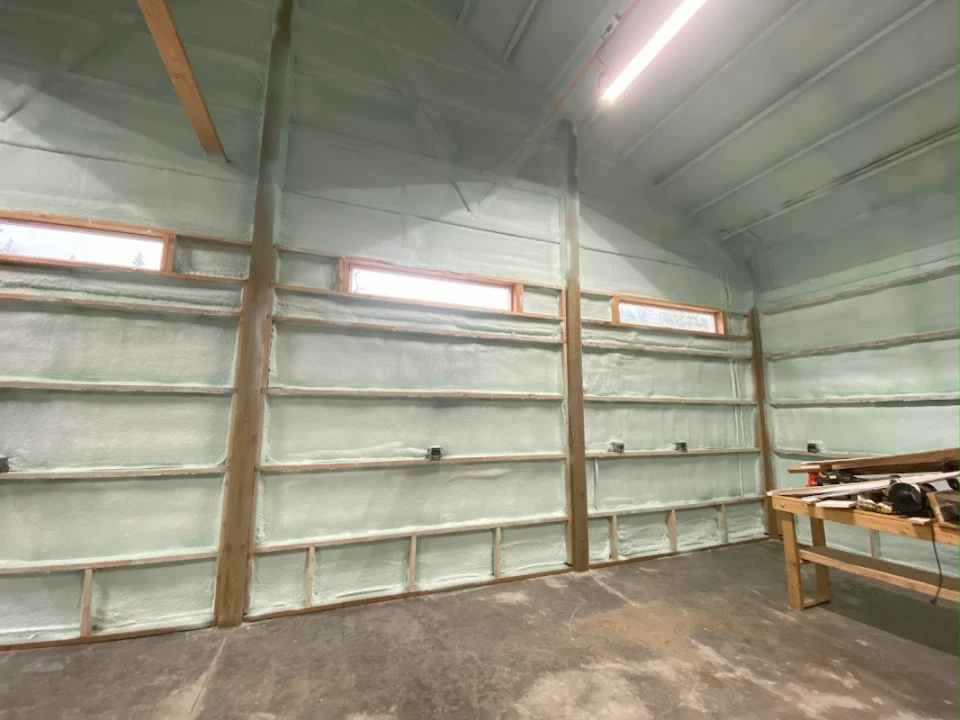
Spray foam insulation works for soundproofing by expanding to fill every gap, crack, and void in wall and ceiling cavities, creating an airtight seal that blocks airborne sound transmission. It accomplishes this through two mechanisms: absorbing sound energy within its cellular structure and eliminating the air pathways that sound waves travel through. Open-cell spray foam is generally the preferred choice for soundproofing because its interconnected cell structure absorbs more mid and high-frequency sound, while closed-cell spray foam provides a denser barrier that excels at air sealing and thermal performance. Neither type eliminates all sound on its own, but when properly installed as part of a complete wall or ceiling assembly, spray foam can meaningfully improve the Sound Transmission Class (STC) rating of a partition. The right approach depends on the type of noise you need to control, the construction of your walls and ceilings, and whether the project is new construction or a retrofit.
Sound travels through buildings in two primary ways: airborne transmission (voices, television, traffic noise) and structure-borne transmission (footsteps, machinery vibrations through framing). Spray foam insulation primarily addresses airborne sound by filling the cavities within walls and ceilings.
When sound waves hit a wall assembly, they cause the drywall on one side to vibrate. Those vibrations transfer into the wall cavity, where they would normally travel through empty air spaces and exit through the drywall on the other side. According to research compiled by NIST in their noise criteria review for buildings, the presence of absorptive material inside wall cavities converts acoustic energy into heat, reducing the amount of sound that passes through the assembly.
Spray foam works through three mechanisms:
The gap-sealing function may be spray foam’s greatest contribution to soundproofing. As documented in the Wikipedia STC reference, even a 1% open area in a partition can reduce transmission loss from 40 dB down to 20 dB. Caulking and sealing gaps has been a standard practice for improving sound isolation since the 1930s, and spray foam essentially performs this function on a comprehensive scale throughout an entire wall or ceiling cavity.
The two types of spray foam behave differently when it comes to sound control. Understanding these differences helps determine which product suits your project.
| Characteristic | Open-Cell Spray Foam | Closed-Cell Spray Foam |
|---|---|---|
| Cell Structure | Interconnected, porous cells | Fully closed, dense cells |
| Density | Lower (approximately 0.5 lb/ft3) | Higher (approximately 2.0 lb/ft3) |
| Sound Absorption | Higher, absorbs mid and high frequencies well | Lower, reflects more sound |
| Air Sealing | Excellent airtight seal | Superior airtight seal and vapor barrier |
| Sound Transmission Blocking | Moderate improvement to STC | Slight improvement to STC |
| Best Application for Sound | Interior walls, ceilings between rooms, and home theaters | Exterior walls, where thermal and air sealing also matter |
| R-Value per Inch | Approximately R-3.7 | Approximately R-6.0 to R-7.0 |
Open-cell spray foam is typically the better choice when soundproofing is the primary goal. Its sponge-like structure allows sound waves to enter the material and dissipate within the interconnected cells. Closed-cell foam, while denser, tends to reflect sound rather than absorb it, making it less effective as a sound absorber. However, closed-cell foam’s superior air sealing capability can still contribute to noise reduction by eliminating air leakage paths.
The Sound Transmission Class rating is the industry standard for measuring how well a building partition blocks airborne sound. As defined by ASTM E413, STC is an integer rating derived from transmission loss values tested at sixteen standard frequencies from 125 Hz to 4000 Hz. A higher STC number indicates better sound isolation.
| STC Rating | What You Can Hear Through the Partition |
|---|---|
| 25 | Normal speech is fully understood |
| 30 | Loud speech is understood |
| 35 | Loud speech is audible but not intelligible |
| 40 | Loud speech heard as a murmur |
| 45 | Loud speech heard but not audible |
| 50 | Loud sounds are only faintly heard |
| 60+ | Most sounds do not disturb neighboring occupants |
A standard interior wall with half-inch drywall on each side of 2×4 wood studs and no insulation has an STC of about 33. Adding fiberglass batt insulation to the same wall brings it to roughly STC 39. Installing spray foam in that same cavity produces a similar improvement to the STC rating because the foam fills the cavity more completely than batts, especially around framing members and penetrations.
The National Research Council Canada developed the soundPATHS prediction tool to help builders and designers calculate both direct and flanking sound transmission between rooms. Their research confirms that the perceived sound insulation by occupants correlates well with the Apparent Sound Transmission Class (ASTC), which accounts for flanking paths through floors, ceilings, and structural junctions, not just the partition itself.
Setting realistic expectations is important when planning a soundproofing project.
What spray foam does well:
What spray foam alone cannot do:
For the best results, spray foam should be one element of a comprehensive approach that includes multiple layers of drywall, proper framing techniques like staggered studs or resilient channels, and attention to every potential sound leak.
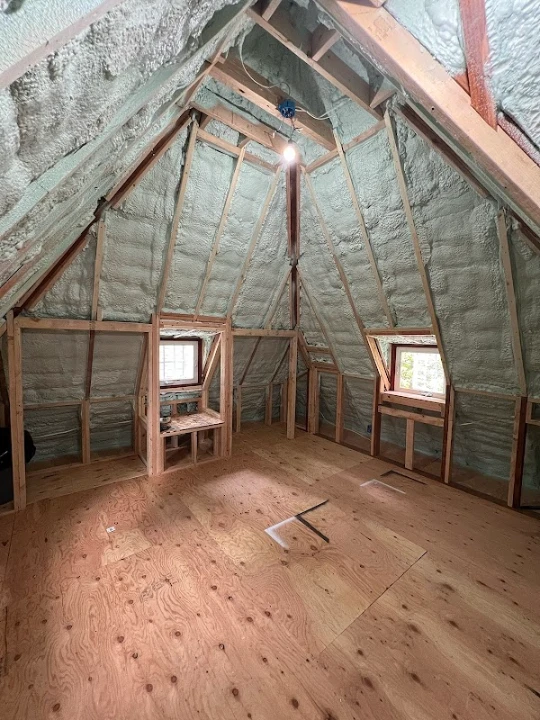
Different building scenarios call for different soundproofing strategies. Here is a guide to matching spray foam type with common noise control needs.
| Application | Recommended Foam Type | Why It Works Here |
|---|---|---|
| Interior partition walls | Open-cell | Absorbs conversational noise between rooms; fills stud cavities completely |
| Ceilings between floors | Open-cell or closed-cell | Open-cell absorbs airborne sound; closed-cell adds structural rigidity if needed |
| Home theater rooms | Open-cell | High sound absorption at mid and high frequencies for better room acoustics |
| Exterior walls near traffic | Closed-cell | A denser barrier combined with air sealing helps block exterior noise and provides a high R-value |
| Office partition walls | Open-cell | Reduces speech privacy concerns between offices and conference rooms |
| Basement ceilings | Open-cell | Fills irregular joist cavities and seals around ductwork and plumbing |
| Nursery or bedroom walls | Open-cell | Quiets household noise for sleeping areas without requiring major reconstruction |
Several variables influence how much noise reduction you will actually get from spray foam insulation in walls and ceilings.
Cavity depth: Deeper wall and ceiling cavities allow for thicker foam application, which provides more material for sound waves to travel through. A 2×6 wall cavity will accommodate more foam and perform better acoustically than a 2×4 cavity.
Framing type: Steel stud framing generally provides better sound isolation than wood stud framing at the same stud spacing because steel studs are less rigid and transmit less vibration. Double-stud or staggered-stud walls dramatically outperform single-stud walls.
Drywall layers: Adding a second layer of drywall to one or both sides of a partition increases mass, which is one of the two most basic principles for improving STC ratings. On light-gauge steel stud partitions, a second drywall layer can add approximately 5 STC points.
Completeness of seal: The effectiveness of spray foam for sound control depends heavily on complete coverage. Any gaps, missed penetrations, or areas with insufficient foam create flanking paths that undermine the overall performance.
Flanking paths: Sound travels through structural connections, ductwork, and shared floor assemblies. As the NRC Canada research on ASTC demonstrates, the overall sound insulation that occupants experience depends on all transmission paths, not just the separating wall alone. Addressing flanking is essential for meaningful noise reduction.
Not every soundproofing strategy delivers what it promises. Here are indicators that your approach is on the right track.
Spray-On Foam & Coatings has the experience and equipment to evaluate your walls and ceilings for sound control, recommend the right foam type and thickness for your noise concerns, and deliver a complete installation that seals every gap and cavity. Whether you are building a new home theater, reducing noise between units in a multifamily property, or simply want a quieter living space, our team can help you understand your options and get the job done right.
Request a Quote | Schedule a Soundproofing Consultation
Call us at (360) 667-1993 or email [email protected] to discuss your project. We serve homeowners and contractors across the Vancouver, WA, and Portland, OR, metro areas, and we are ready to help you build a quieter space.
Pricing depends on the type of foam, the thickness required, and the total square footage of the project. Open-cell foam is priced lower per board foot than closed-cell foam, and larger projects typically receive a reduced rate per board foot. Contact us for a project-specific quote.
No single insulation material makes a room completely soundproof. Spray foam significantly reduces airborne sound transmission by sealing gaps and absorbing sound energy within cavities, but achieving very high STC ratings requires additional measures like double drywall layers, decoupled framing, or resilient channels.
Yes, spray foam can be retrofit into existing walls through access points such as electrical box openings, removed drywall sections, or exterior drill-and-fill methods. The feasibility depends on the construction type and cavity accessibility. Our team can assess whether your walls are candidates for retrofit application.
Open-cell spray foam is generally better for sound absorption because its interconnected cell structure allows sound waves to enter and dissipate. Closed-cell foam is denser and reflects more sound, but it provides superior air sealing and moisture control. The best choice depends on whether sound absorption or thermal performance is your higher priority.
Spray foam can help reduce airborne noise between shared walls, but the results depend on the existing wall assembly and whether there are flanking paths through shared floor structures, ductwork, or framing connections. A comprehensive assessment of the shared assembly is needed to determine how much improvement spray foam alone can deliver.