

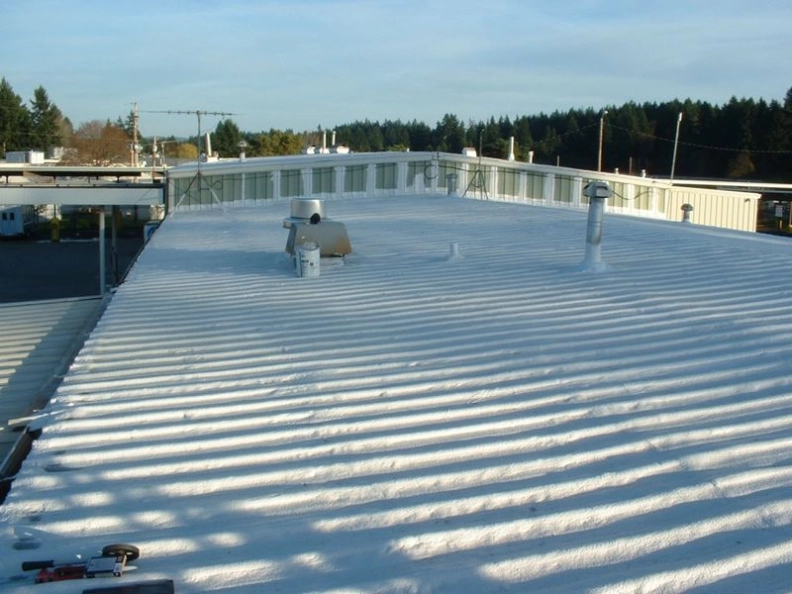
Spray foam roofing services prevents moisture damage by covering the roof with one seamless layer of closed-cell foam that has no seams or fasteners for water to slip through. The foam sheds water, seals itself around vents and curbs, can be shaped to drain low spots, and is topped with a protective coating. In Battle Ground’s long wet season, that keeps rain on top of the roof and out of the deck below.
Before looking at moisture, it helps to know what goes on your roof. Spray foam roofing isn’t a sheet that gets rolled out and glued down. It’s built in place, right on top of your existing deck or roof.
Spray polyurethane foam (SPF) starts as two liquids that mix at the spray gun and expand into a rigid foam that bonds tightly to the surface below. Roofs use closed-cell foam, not the soft open-cell spray foam type used inside walls. According to the U.S. Department of Energy’s spray foam guide, closed-cell foam is roughly four times denser than open-cell foam and is hydrophobic, meaning it won’t absorb water. A weather coating, usually silicone or acrylic, goes on top to protect the foam from sun and wear.
Our climate is the reason moisture protection roofing matters so much here. Rain doesn’t just fall hard in Battle Ground. It falls often, for months at a time.
Based on NOAA data from 1991 to 2020, Battle Ground averages a little over 52 inches of precipitation a year, with November and December each bringing close to 8 inches and rain falling on about 70% of days in those months. Extreme Weather Watch shows July as the driest month at well under an inch.
That pattern is hard on flat and low-slope roofs. Water can sit on the surface for days. A small gap at a seam that might go unnoticed in a dry climate keeps leaking here all winter, soaking decking, staining ceilings and giving mold a steady water supply.
Most roof leaks start in the same few places: seams, fasteners, flashings and low spots. Spray foam roof works because it deals with each of these directly.
Most roof leaks happen when water gets in through an open joint or seam, and on multi-ply roofs it can travel sideways between layers and show up somewhere else. Spray foam goes on as one continuous layer, so there are no laps to open up and no screw holes punched through the roof.
Each tiny cell in the foam is sealed off from its neighbors. Water that hits the roof has no open path into the foam, so the layer stays dry and keeps its R-value through a long wet season.
Vents, pipes, HVAC curbs and parapet walls are classic leak points on conventional roofs. SPF is fully adhered and self-flashing, sealing every penetration without joints or fasteners. The foam simply wraps up and around them.
Standing water speeds up wear and finds any flaw. Installers can spray the foam to build slope, which improves drainage and gets rid of ponding. Low areas get extra thickness so water runs toward drains instead of sitting.
Not all moisture comes from rain. Warm, humid indoor air can condense on a cold deck in winter. The Department of Energy notes that spray foam can serve as the thermal, air and vapor control layers in a roof assembly. A continuous insulated layer keeps the deck warmer and cuts the air leaks that feed condensation.
Spray foam isn’t magic, and a bad install can cause the very problem it’s meant to stop. Here are the honest limits.
Wet decks get sealed in. Foam sprayed over damp material locks that moisture in. In its guidance on Building America research, the DOE lists rainwater leaks, condensation and built-in construction moisture as the main risks, and calls for sheathing and framing to be dried below 18% moisture before foam goes on.
Weather during spraying matters. One roofing foam manufacturer warns that rain, fog, frost, dew or humidity above 85% will hurt how the foam forms. Moisture during application can throw off the mix and leave a soft, spongy foam that is weaker and prone to blisters.
Sun breaks down bare foam. A base coat has to go on the same day the foam is sprayed to protect it from UV. A coating that wears thin over the years needs renewing, or the foam underneath starts to degrade.
Damage still needs fixing. Dropped tools, fallen branches and heavy foot traffic can cut the coating. The good news is that a single visible layer makes these spots easy to find and patch.
One common mix-up: closed-cell foam sprayed on the underside of a roof deck can hide a roof leak between the foam and the wood. That’s a different setup from an SPF roof, where the foam is the waterproof layer on top.
Timing is a real part of roof moisture damage prevention in a town this wet. Late spring through early fall gives the best dry windows, with July and August the safest bets.
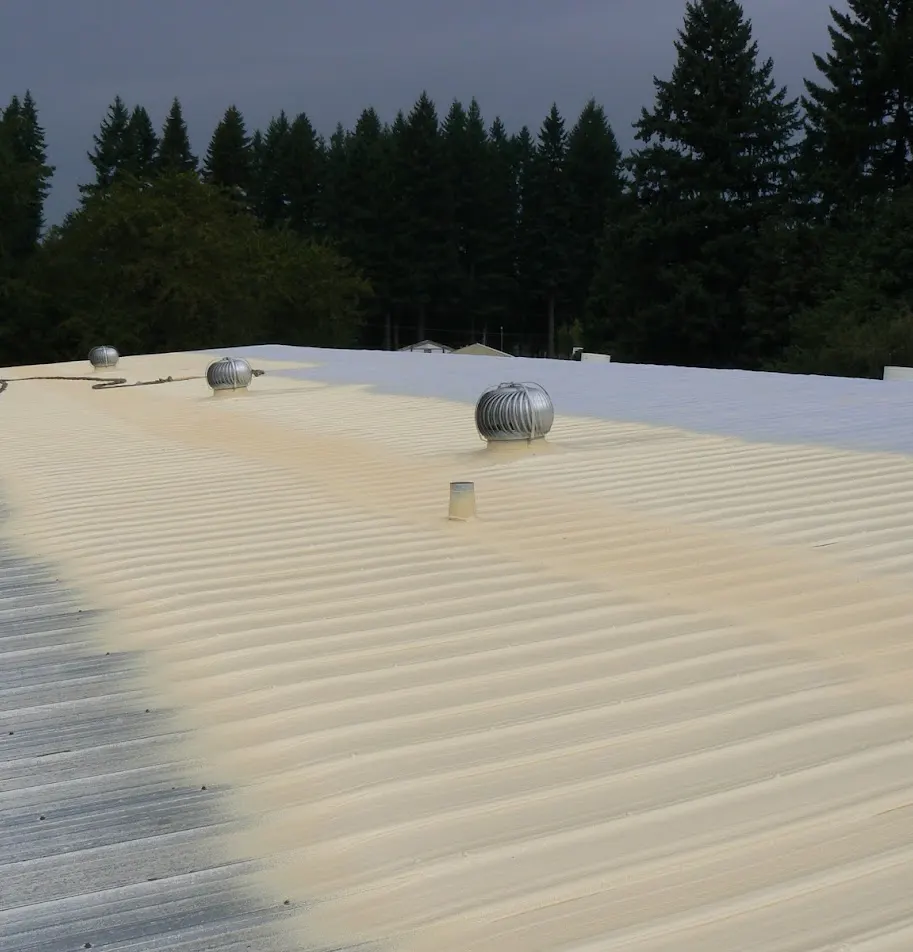
Industry guidance calls for air temperatures above 40°F and for spraying to be avoided when it’s within 5 degrees of the dew point. On an existing roof, a proper moisture analysis should be done first to check for water trapped in the old system. Rushing a job between storms to save a week is how wet decks get sealed in.
Whether you’re planning a new foam roof or caring for one you already have, run through these points:
If water is pooling on your flat roof or you’re tired of chasing leaks every winter, it may be time to look at foam. At Spray-On Foam & Coatings, our team has 50+ years of combined experience with spray foam and coatings, and we start every roofing job by checking that your deck is dry and sound.
We offer free quotes for spray foam roofing in Battle Ground, WA. Call us at (360) 667-1993 or email [email protected] to set up your free quote before the next round of heavy rain.
Often, yes. SPF roofing is commonly applied over existing roof coverings, which saves the cost and mess of a full tear-off. The old roof has to be dry and solid, so any wet insulation or damaged sections come out first.
A survey of more than 300 SPF roofs found an effective service life of over 30 years, with about 15 years on average between recoats. Recoating renews the surface without replacing the foam.
Yes. The cured foam forms a rigid surface you can walk on. For areas with regular traffic, like paths to HVAC units, walkway pads are recommended to protect the roof.
It fits any building with a flat or low-slope roof, including homes, shops and garages. Spray foam is considered a strong choice for low-pitched roofs, while steep shingle roofs usually suit other systems.
It usually costs more upfront but can cost less over time. A life cycle study commissioned by the industry found SPF roofs cost 10% to 50% less on average than comparable systems over 30 years. Keep in mind the study was industry funded, and your numbers will depend on the roof.