
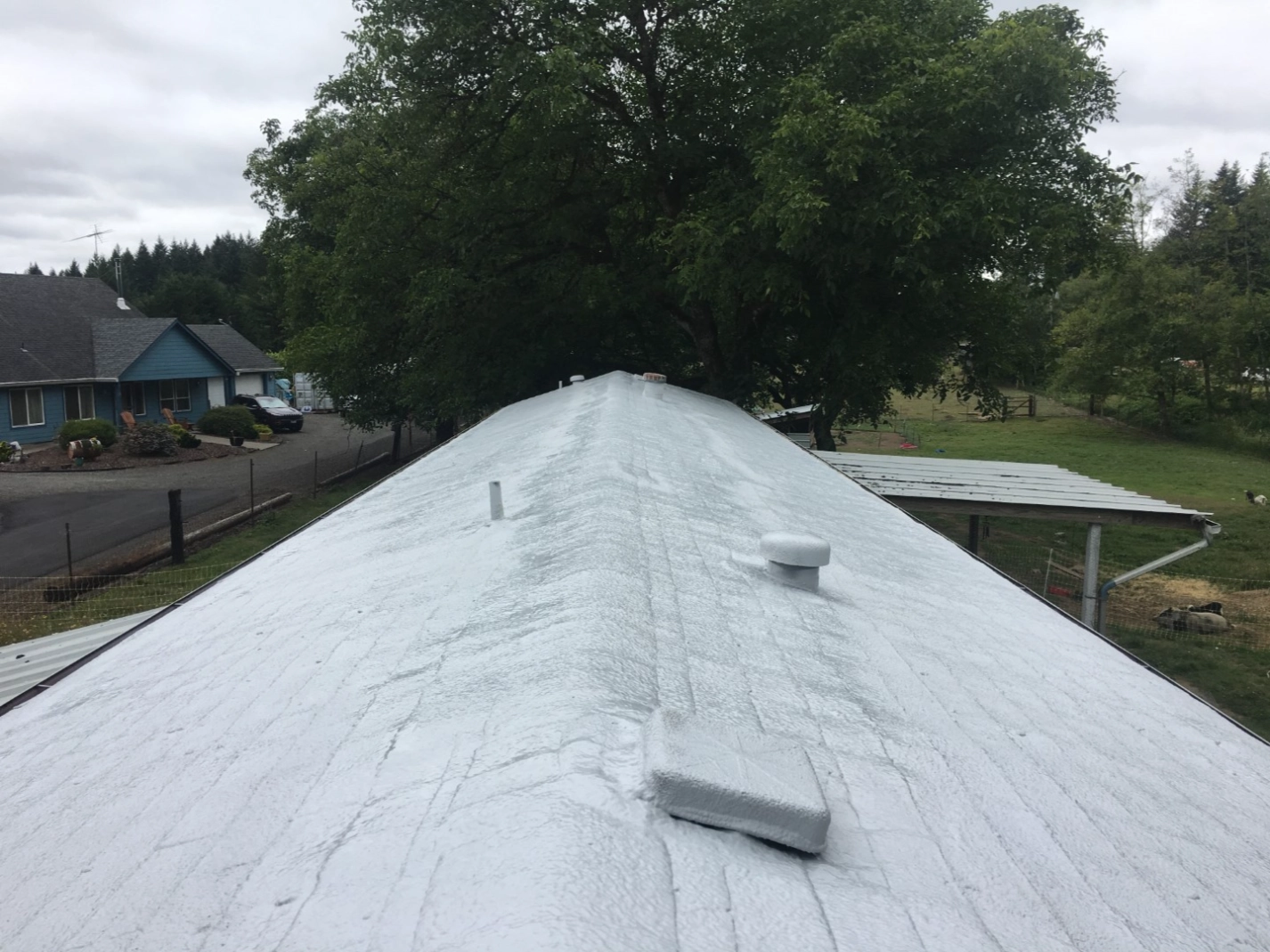
Spray foam roofing works by mixing two liquid chemicals at a spray gun. They react, expand and harden into one solid layer of closed-cell foam that bonds to your roof deck and serves as both the waterproofing and the spray foam roofing insulation for the building. A UV-blocking coating goes on top, and recoating every 10 to 20 years keeps the system working.
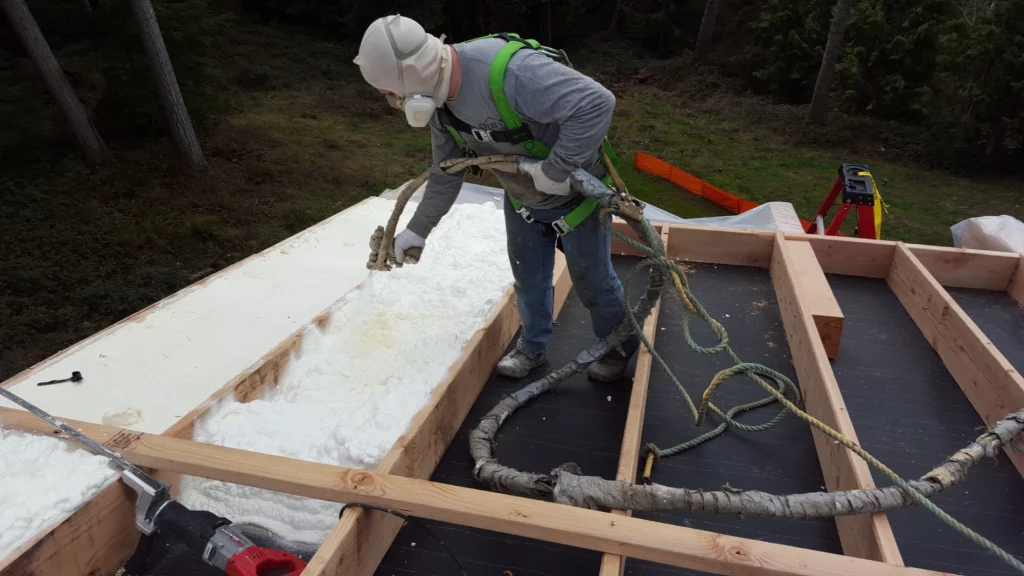
Spray foam roofing, often called SPF roofing, is a roof made on site instead of rolled out from a factory. Two liquids travel through heated hoses to a spray gun, mix at the tip, and land on the roof as a foam that hardens into one continuous piece.
According to the U.S. EPA, Side A contains reactive chemicals called isocyanates, Side B contains a polyol blend, and roofing uses the high-density 3 lb closed-cell type. That’s a different product from the soft open-cell foam sprayed in attics. Roofing foam is stiffer, sheds water and is hard enough to walk on once coated.
Every roof is a little different, but the order of work stays the same. When a crew rushes or skips a step, the roof usually shows it within a couple of years as blisters, soft spots or peeling coating.
The crew walks the roof, probes soft areas and looks for wet insulation using core cuts, moisture meters or an infrared scan. Foam sprayed over wet spray foam roofing material seals that water in, where it can rot the deck or push up blisters. Wet sections get cut out and replaced before any spraying starts.
Next, the surface is power washed or vacuumed to remove dirt, loose gravel and oil. Rusted metal, loose flashing and damaged deck boards get fixed, and primer goes down where the surface needs better grip. Vents, HVAC units, skylights and walls are masked so overspray stays off them.
The applicator sprays the foam in passes, called lifts, until it reaches the specified thickness. It rises and firms up within seconds. Here’s where foam earns its keep: the crew can build up low spots and add thickness toward drains, which fixes ponding water on flat roofs. Foam also wraps around pipes, curbs and parapet walls, so those details are flashed by the foam itself instead of separate pieces that can leak at the joints.
Bare foam can’t take the sun. The U.S. Department of Energy notes that SPF is easily damaged by UV, moisture and wear, and it relies on a protective coating. Manufacturer data sheets we’ve reviewed call for coating the same day or within 24 hours. Crews usually apply a base coat and a top coat, and many broadcast granules into the wet top coat for traction and extra UV protection.
A finished foam roof is a stack of layers, and each one does a specific job. The weakest layer sets how long the whole roof lasts.
| Layer | What It Does | If It’s Done Poorly |
|---|---|---|
| Prepared substrate | Gives foam a dry, solid surface to grip | Blisters, poor bond, trapped water |
| Closed-cell foam | Insulates, seals air leaks, creates slope | Ponding, heat loss |
| Elastomeric coating | Blocks UV, waterproofs, takes foot traffic | Foam turns brittle and powdery |
| Granules (optional) | Adds grip and UV shielding | Faster coating wear |
Your coating choice changes how the roof handles weather. Silicone resists standing water and UV well, and many manufacturers recommend it. Acrylic costs less but handles ponding poorly, so roofers in hot, dry places like Arizona often prefer it. Polyurethane coatings resist scuffs and impact, which suits roofs with regular foot traffic. One detail to know: acrylic generally can’t go over an old silicone coat, so the first choice limits later recoats.
The main draw is that one system handles insulation, air sealing and waterproofing at once. Closed-cell foam rates about R-6.5 per inch, and because it’s sprayed in place there are no board joints or fasteners for heat to slip through.
Other practical upsides include:
That last point has a catch. DOE also warns that cool roofs can raise heating costs in colder climates because the roof absorbs less winter sun. In the cooler, wetter Pacific Northwest, the heating side of your energy bill deserves as much attention as cooling, so ask your contractor to weigh both.
On many flat and low-slope roofs, using spray foam for roof restoration means the old built-up, modified bitumen, metal or single-ply roof stays in place and becomes the base. That skips tear-off labor, disposal fees and days with an open roof.
It only works when the old roof is dry and solid. If the inspection finds soaked insulation, rotted decking or several old layers, those areas, or the whole roof, come off first. Spray foam is also a low-slope system, so it’s not a fit for steep shingle roofs.
Example: a warehouse has a leaky tar-and-gravel roof with soft spots near the drains. The crew removes loose gravel and wet sections, patches the deck, then foams over the rest with extra thickness at the drains. If half the roof were wet, replacement would usually make more sense.
Foam goes on as a liquid that reacts with heat, so install-day weather controls quality. Manufacturer specs we’ve reviewed stop foam work when relative humidity tops roughly 80 to 85 percent, when the surface is within 5°F of the dew point, or when wind exceeds 15 mph without a windscreen. Rain, fog, frost or dew on the deck ruins adhesion.
That matters in western Washington and Oregon, where fall and winter bring long stretches of rain and fog. We schedule foam roofs for drier windows and watch the forecast closely, because foam left uncoated overnight can’t take dew or rain. Reliable data on how many workable days a typical Pacific Northwest year offers was not found, so build some slack into your timeline.
Spray foam isn’t right for every roof or budget. These trade-offs are real, and a fair contractor will talk you through them.
Lifespan claims vary. The Spray Polyurethane Foam Alliance says a well-maintained foam roof should last 40 or more years and recommends inspections twice a year and after severe storms. Many roofers quote 20 to 30 years. The trade group’s figure assumes steady maintenance, so 20-plus years is a safer planning number, and anything beyond that is earned through upkeep.
Recoating every 10 to 20 years is the main ongoing cost, and it typically runs far less than tearing off and replacing a flat roof.
Up-front price depends on foam thickness, prep work, coating type, roof access and region. National cost guides published in 2025 and 2026 range from about $4 to over $13 per square foot installed, with heavy prep and thicker foam at the top end. Verified Pacific Northwest pricing was not found, so a site visit and written quote is the only reliable number.
Before you sign, a qualified Spray Foam Roofing Contractor should be able to give you:
If your flat roof leaks, ponds water or costs too much to heat, a foam roof may be worth a look, but only after someone checks what’s underneath. Spray-On Foam & Coatings provides spray foam roofing services, for property owners across Washington and Oregon. Call (360) 667-1993 or email [email protected] for a roof assessment and a free quote.
The biggest downside is ongoing care. The coating wears and needs recoating every 10 to 20 years, and results depend heavily on the crew and install-day weather.
Often, yes, if the old roof is dry and solid. Wet insulation, rotted decking and loose layers must come out first, or the foam traps the problem.
A properly coated system is waterproof. Punctures, cracks or worn coating can let water in, so twice-yearly inspections matter.
Yes. Coated roofing foam is firm enough for foot traffic, and granules add grip. Roofs with frequent traffic often get a tougher polyurethane coating.
Yes. The mounts must be sealed into the foam and coating correctly, so get the solar installer and roofer talking before work starts.