
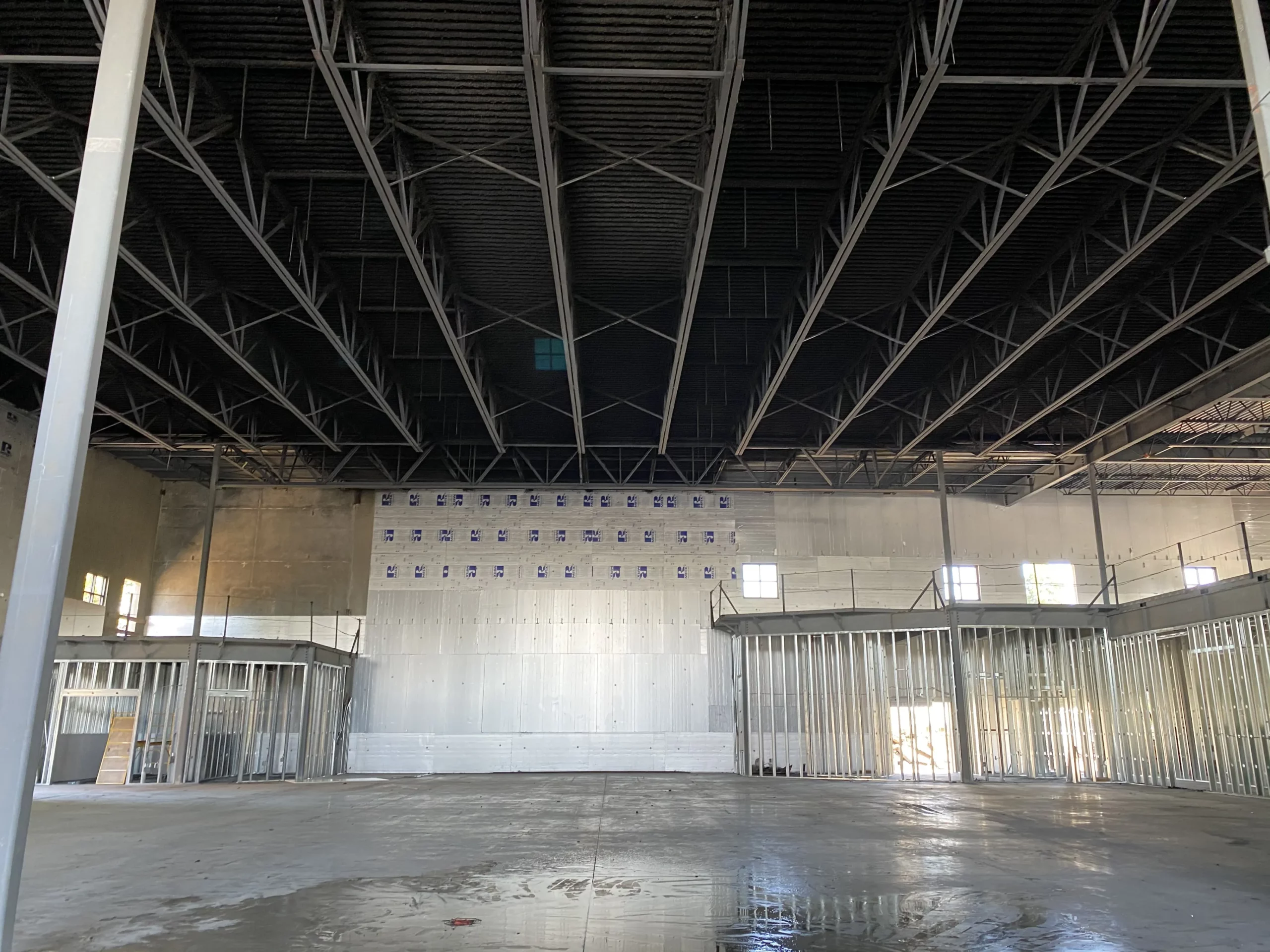
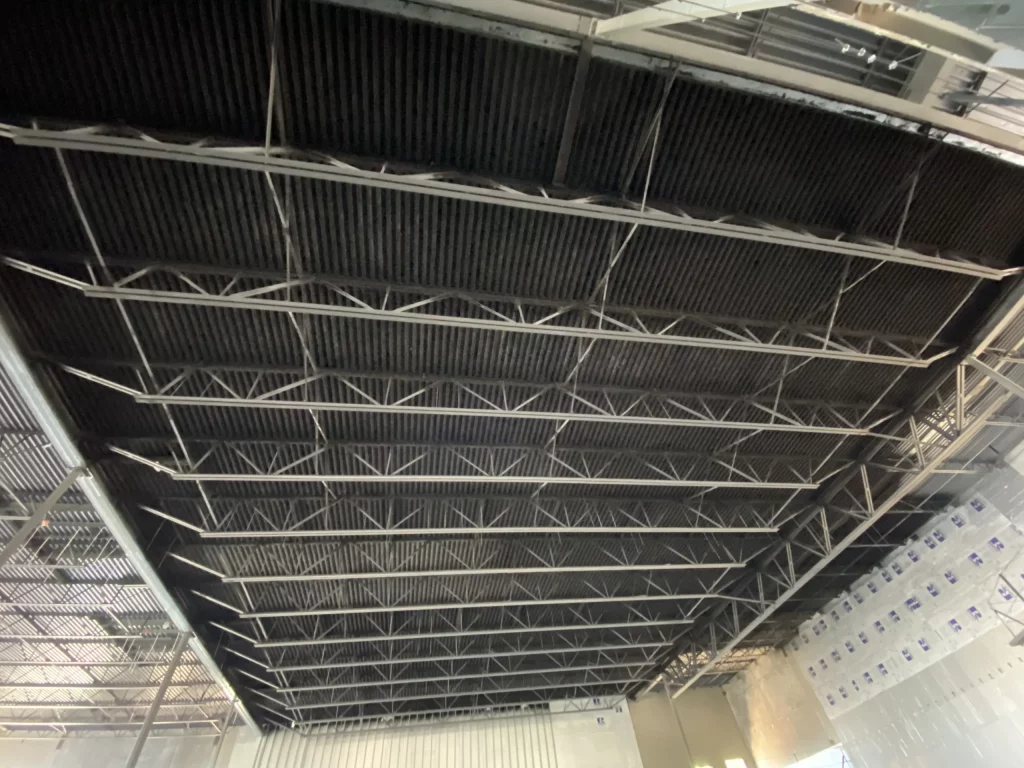
K-13 soundproofing solution is a spray-applied cellulose treatment that absorbs sound energy instead of blocking it, and for most commercial spaces in Battle Ground, WA, it is the fastest way to cut echo, improve speech clarity, and add insulation value in a single installation. We apply it as an exposed finish on ceilings, roof decks, and walls in warehouses, restaurants, gyms, offices, churches, and agricultural buildings. The right acoustic strategy depends on your goals: K-13 excels at controlling reverberation inside a room, while mass and decoupling methods handle sound traveling between rooms. This guide explains how K-13 performs, how it compares with alternatives, which factors shape a project, and how different facility types in Clark County should approach noise control.
K-13 is a spray-applied acoustic treatment made from specially prepared cellulose fibers treated with fire retardants. Using forced air, our crew sprays it directly onto wood, steel, concrete, or metal decking, where it bonds into one continuous layer that fills seams, voids, and penetrations. Because it stays exposed, it acts as both the finished surface and the absorber, which removes an entire finish phase from your construction schedule.
Performance is measured with the Noise Reduction Coefficient, a single number from 0.0 to 1.0 that averages a material’s sound absorption at 250, 500, 1,000, and 2,000 Hz. NRC describes sound absorbed within a room, while STC describes sound blocked through an assembly (Wikipedia – Noise Reduction Coefficient). Cellulose products perform strongly on both measures: NRC ratings range upward of .80, and cellulose in properly built partitions can contribute to STC ratings as high as 70 (Cellulose Insulation Manufacturers Association).
Thickness is the variable we control most on commercial jobs. Porous absorbers work best when built to roughly a quarter wavelength of the target frequency, so a thicker application reaches deeper into low frequencies (Wikipedia – Noise Reduction Coefficient). A useful benchmark: changes in NRC of 0.05 to 0.10 are barely audible in most rooms, while changes of 0.10 to 0.20 are significant. That is why we specify thickness to match your actual noise problem rather than quoting a generic number.
Battle Ground’s commercial building stock blends rural and suburban development, with plenty of metal warehouses, open retail floors, agricultural processing spaces, and high-ceiling gyms. These hard, reflective interiors are exactly where noise builds up and where customers and staff feel it first. Reducing ceiling echo with K-13 spray foam can make these large commercial spaces more comfortable for employees and customers.
The regulatory side is real, not theoretical. OSHA’s permissible exposure limit is 90 dBA averaged over an 8-hour day, and employers must run a hearing conservation program once workers average 85 dBA. When sound levels exceed the limits in Table G-16, feasible administrative or engineering controls are required by law. Absorptive treatments count as engineering controls, and OSHA notes that reducing even a few decibels lowers hearing hazard while improving communication (OSHA – Occupational Noise Exposure). For Battle Ground business owners, that makes acoustic treatment both a comfort upgrade and a compliance tool.
Every sound problem falls into two categories: absorbing noise inside a room, or blocking noise between rooms. Fibrous materials such as cellulose, mineral wool, and fiberglass deaden resonant frequencies, while mass and decoupling stop transmission through assemblies. K-13 spray foam in Battle Ground, WA is an absorption product, so it shines when echo is the complaint.
| Method | Best For | How It Works | Limitations |
|---|---|---|---|
| K-13 spray cellulose | Exposed ceilings, decks, and walls needing echo control plus insulation | Monolithic sprayed absorber, no fasteners | Needs correct thickness for low-frequency noise |
| Acoustic panels and baffles | Spot treatment in finished rooms | Fabric-wrapped absorbers hung individually | Many units needed for large areas, coverage gaps |
| Open-cell spray foam | Wall and ceiling cavities | Absorbs within the cavity | Not an exposed finish |
| Closed-cell spray foam | Thermal barriers and air sealing | Dense, reflective material | Reflects sound rather than absorbing it |
| Added drywall and decoupling | Sound transfer between rooms | Mass law and separation | Adds structure and downtime, does nothing for in-room echo |
We are upfront about that last foam row. Dense closed-cell products can even act as sound conductors, which is why we steer commercial clients toward K-13 when absorption is the goal (Wikipedia – Soundproofing).
| Facility Type | Primary Problem | Where We Apply K-13 | Typical Outcome |
|---|---|---|---|
| Warehouses and manufacturing | Slab-and-steel echo, safety communication | Underside of roof deck | Clearer warnings, shorter echo decay |
| Restaurants and cafes | Clatter, overlapping conversation | Ceiling surfaces | Comfortable dining, longer visits |
| Gyms and recreation | Whistles, ball impact, music | High ceilings over courts | Manageable noise floors |
| Open offices and retail | HVAC and crowd noise | Exposed decks and soffits | Better focus and speech privacy |
| Churches and auditoriums | Long echo, poor intelligibility | Ceilings and rear walls | Clear speech and music |
| Agricultural buildings | Rain roar on metal roofing | Deck underside | Quieter interior plus condensation control |
| Audience / Context | Recommended Approach | Key Notes |
|---|---|---|
| Restaurant and cafe owners | Full-ceiling K-13 at moderate thickness | Treats the whole reflector at once, fastest visible upgrade |
| Warehouse and safety managers | Deck application plus an OSHA noise review | Pairs absorption with required monitoring records |
| Gym, church, and event venues | Thicker application tuned to low frequencies | Big rooms need depth, not just coverage |
| Builders and developers | Spec K-13 during new construction | One trade delivers acoustics, R-value, and fire rating |
| Agricultural building owners | Deck spray for sound and condensation | Dual benefit on metal roofing in Clark County’s wet season |
Spray-On Foam & Coatings installs K-13 soundproofing for commercial spaces in Battle Ground, WA and the surrounding Clark County area, and our team handles everything from thickness recommendations to phased installation around your business hours. Call us at (360) 667-1993 or email [email protected] to talk through your space. Request a free quote or schedule a noise assessment today, and let our crew show you what a quieter building sounds like.
Request a Free Quote | Schedule an Assessment
Cellulose acoustic products reach NRC ratings of .80 or higher in tested assemblies, absorbing most of the sound that contacts the surface. Results vary by room size and thickness, which is why we assess each space before committing to a specification.
Speech-range echo is usually addressed with moderate applications, while low-frequency noise in gyms or mechanical spaces needs greater thickness. A 2-inch porous absorber loses effectiveness below roughly 500 Hz, so we match depth to your measured problem.
Yes. Spray application covers large areas quickly, and our crew can phase work during off hours or section by section. Most clients keep operating throughout the project.
Cellulose insulation is treated with fire retardants to meet federal and local fire safety requirements, with building codes setting a maximum flame spread of 25 and smoke developed index of 450 under ASTM E84.
It doubles as thermal insulation and helps control condensation on metal roof decks. Cellulose also manages moisture through its hygroscopic properties, a useful trait in the Pacific Northwest.