
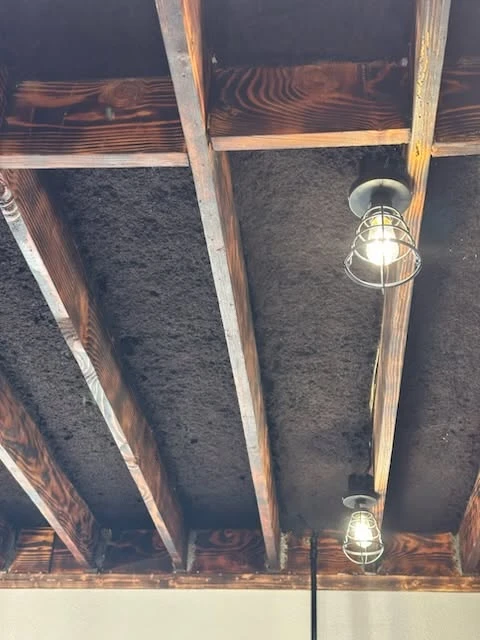
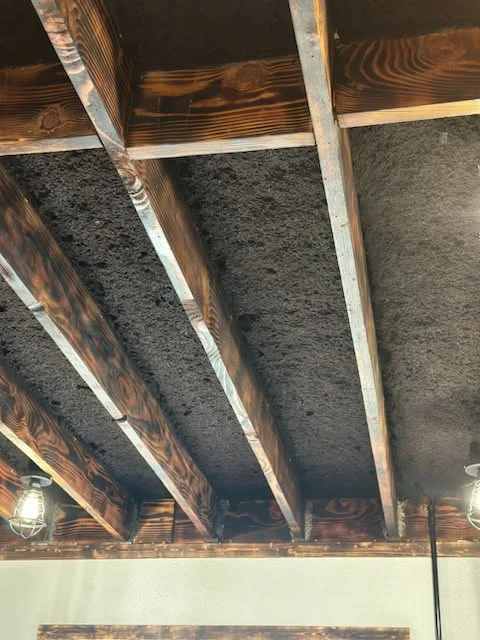
K-13 acoustical spray is a spray-applied cellulose insulation specifically designed to absorb sound within commercial and industrial spaces, reducing reverberation and improving speech intelligibility. It works by converting sound energy that enters its porous, fibrous structure into small amounts of heat, rather than reflecting those sound waves into the room. The material is rated using the Noise Reduction Coefficient (NRC), a standardized metric that averages a material’s sound absorption performance across four key frequencies: 250, 500, 1,000, and 2,000 Hz. For building owners, facility managers, and contractors dealing with noisy warehouses, gymnasiums, manufacturing floors, or open-plan offices, K-13 offers a single-application solution that handles both thermal insulation and acoustic control simultaneously.
K-13 is made from recycled cellulose fibers treated with fire-retardant chemicals, typically borates. When sprayed onto a ceiling or wall surface, it adheres directly and creates a monolithic, textured layer with a high degree of open porosity. Sound waves entering this porous structure cause the air within the fibers to vibrate. Those vibrations generate friction, which converts acoustic energy into a minute amount of thermal energy. Rather than bouncing back into the room as echo or reverberation, the sound is effectively absorbed.
The persistence of sound after the source has stopped due to multiple reflections off room surfaces, known as reverberation, is the primary culprit behind poor acoustics in large, hard-surfaced spaces. Warehouses, gymnasiums, and open office environments with exposed concrete, metal decking, or drywall create environments where sound reflects repeatedly, increasing reverberation time and making conversation difficult. K-13 directly interrupts this reflection cycle by adding an absorptive surface to the largest reflective plane in most rooms: the ceiling.
The material’s effectiveness is measured and reported using the NRC scale. According to the standardized testing methodology, an NRC difference of 0.10 to 0.20 produces a significant audible improvement, while a difference of 0.20 or above is considered considerable for most listening situations. K-13’s ability to reach NRC values above 1.00 at certain thicknesses places it in the top tier of sound-absorbing materials.
The Noise Reduction Coefficient is the most widely used single-number rating for comparing sound absorption materials. It represents the average of absorption coefficients measured at four mid-range frequencies, providing a practical shorthand for general-purpose acoustic planning. The table below shows how K-13 performs at different thicknesses compared to common building surfaces.
| Surface / Material | Approximate NRC | Sound Absorption Level | Typical Application |
|---|---|---|---|
| Bare concrete | 0.05 | Very low | Untreated warehouse floors and ceilings |
| Painted drywall | 0.05 – 0.10 | Very low | Standard office walls |
| Standard acoustic ceiling tile | 0.50 – 0.70 | Moderate | Drop ceiling grid systems |
| K-13 at 1 inch | 0.80 | High | Theatres, offices, data centers |
| K-13 at 1.5 inches | 1.00 – 1.05 | Very high | Gymnasiums, warehouses, manufacturing |
| K-13 at 2 inches | 1.05+ | Exceptional | Industrial facilities, shooting ranges |
A few points to keep in mind when interpreting these numbers. An NRC of 1.00 means the material absorbs 100 percent of sound at the tested frequencies. Values above 1.00 can occur in reverberation room testing due to edge diffraction effects at the sample perimeter, not because the material absorbs more than 100 percent of the sound. For practical purposes, any material rated above 0.85 delivers strong acoustic performance in most commercial settings.
Warehouses, distribution centers, and manufacturing plants often feature exposed steel deck ceilings and concrete floors, which are among the most reflective surfaces possible. Equipment noise, forklift traffic, and conveyor operations compound the problem. K-13 sprayed directly onto the exposed deck transforms the entire ceiling plane into an absorptive surface. This is particularly relevant for OSHA compliance, since the agency requires employers to implement engineering or administrative controls when worker noise exposure reaches 90 dBA as an 8-hour time-weighted average according to OSHA 29 CFR 1910.95. Adding sound-absorbing material to the ceiling is a recognized engineering control that reduces the overall noise level reaching a worker’s ears.
High ceilings with metal decking or exposed structure create severe reverberation problems. Whistles, bouncing balls, and crowd noise reflect off hard surfaces and build up over time, making announcements unintelligible and causing fatigue for occupants. A 1.5 to 2-inch application of K-13 on the ceiling deck can cut reverberation time dramatically, making the space usable for its intended purpose.
Speech privacy and intelligibility are common complaints in open office layouts. Reverberation causes speech from one workstation to carry across the floor, reducing both privacy and concentration. Applying K-13 to the ceiling reduces the overall noise floor and helps contain sound to its area of origin.
The constant hum of servers, cooling systems, and backup generators creates a persistent noise environment. K-13 absorbs a significant portion of this mechanical noise, reducing the overall decibel level in the space and improving conditions for technicians who need to work in these environments for extended periods.
K-13 is not just an acoustic product. As a cellulose-based insulation, it delivers thermal resistance of approximately R-3.7 per inch of thickness. When sprayed on an exposed ceiling deck, it provides a continuous thermal barrier that addresses both heat loss in winter and heat gain in summer. This dual performance, acoustic plus thermal, is what separates K-13 from dedicated acoustic panels or ceiling tiles that offer sound absorption but little to no insulating value.
In retrofit projects where a building owner wants to add insulation to an existing metal deck ceiling without dropping in a suspended ceiling grid, K-13 is one of the few products that can accomplish both goals in a single pass. The spray application also seals minor gaps and irregularities in the substrate, improving the air barrier performance of the building envelope.
K-13 is applied using specialized spray equipment that combines the dry cellulose fibers with a small amount of water and adhesive binder at the nozzle. The material adheres to the substrate on contact and cures to form a durable, monolithic surface. Key installation factors include:
Choosing an experienced applicator matters as much as choosing the right material. Here are indicators that a contractor is qualified to handle your project:
| Building Type | Recommended Thickness | Primary Acoustic Goal | Additional Benefit |
|---|---|---|---|
| Manufacturing/warehouse | 1.5 – 2 inches | Reduce ambient noise, OSHA compliance | Thermal insulation on the exposed deck |
| Gymnasium/sports facility | 1.5 inches | Cut reverberation, improve announcements | Condensation control on metal deck |
| Open-plan office | 1 inch | Reduce speech carry, improve focus | Thermal performance, aesthetic finish |
| Data center | 1 – 1.5 inches | Absorb equipment noise | Condensation control on cold surfaces |
| School auditorium | 1 – 1.5 inches | Improve speech intelligibility | Fire-rated ceiling treatment |
Spray-On Foam & Coatings has the experience and equipment to handle K-13 acoustical spray projects for commercial and industrial buildings throughout the Vancouver and Portland metro areas. Our team assesses your space, recommends the right application thickness for your acoustic and thermal goals, and completes the work with minimal disruption to your operations. Reach out to us at [email protected] or call (360) 667-1993 to discuss your project.
Request a Quote Schedule an Acoustic Assessment
NRC measures how much sound a material absorbs within a room, while STC measures how much sound a building element like a wall blocks from passing through. K-13 is an absorption product rated by NRC, not a soundproofing barrier rated by STC.
Yes, K-13 can be sprayed over many existing ceiling substrates, including drywall, concrete, and metal decking, provided the surface is clean and structurally sound. Our team evaluates your specific conditions before installation.
No, K-13 is available in multiple standard colors and serves as a finished ceiling surface once applied. The textured appearance is the intended aesthetic for exposed ceiling applications.
K-13 provides a continuous, monolithic absorptive surface without the gaps between individual tiles that can reduce overall acoustic effectiveness. It also adds thermal insulation, which standard ceiling tiles do not provide.
Yes, K-13 cellulose fibers are treated with borate-based fire retardants during manufacturing, and the installed product carries a Class 1 fire rating when tested according to applicable ASTM standards.