

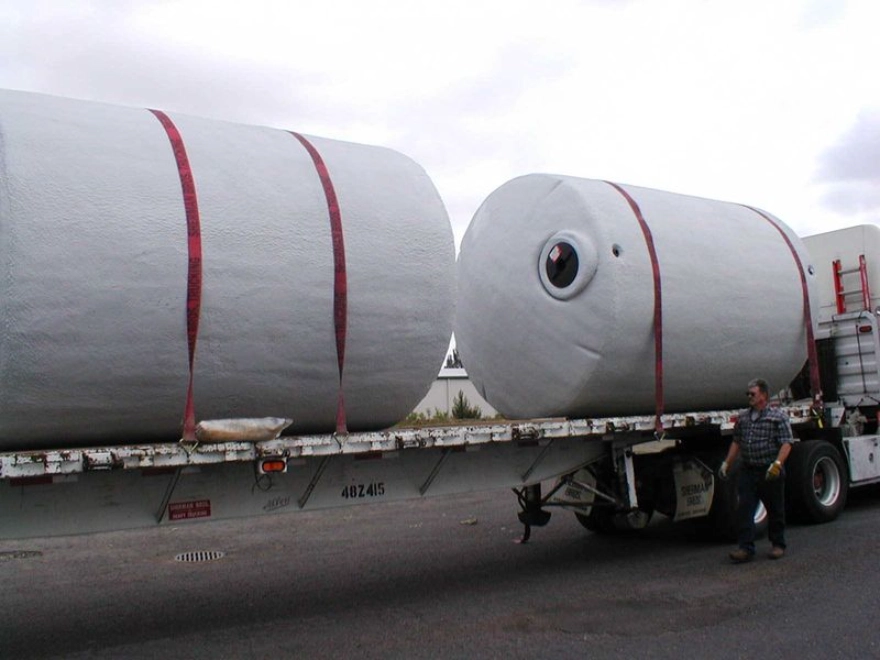
Insulating large industrial and water storage tanks in Vancouver, WA requires selecting methods that account for the Pacific Northwest’s wet, temperate marine climate with winter temperatures that regularly dip below freezing. The right approach depends on the tank’s contents, operating temperature, exposure conditions, and long-term maintenance plan. The primary methods available include closed-cell spray polyurethane foam, mineral fiber panel systems with metal jacketing, and removable blanket insulation, each offering distinct advantages depending on the application.
Vancouver, WA sits in a marine climate with mild, wet winters and dry summers. Temperatures routinely fall to the mid-30s from November through February, creating a real freeze risk for exposed water storage. Annual precipitation in the Portland-Vancouver metro area exceeds 40 inches, meaning any insulation system installed here faces persistent moisture exposure. According to the Wikipedia article on thermal insulation, the effectiveness of insulating materials depends on their thermal conductivity and how well they resist environmental degradation over time, factors that become especially relevant in high-moisture climates.
Beyond freeze protection, insulation reduces the energy required to maintain stored water or process fluids at target temperatures. On industrial sites, uninsulated tanks can lose substantial heat, driving up operating costs and increasing the load on heating systems. For municipal and agricultural water storage, insulation prevents freezing that can rupture pipes, damage valves, and put systems out of service during peak demand.
| Method | Best For | Key Advantages | Limitations |
|---|---|---|---|
| Closed-Cell Spray Polyurethane Foam | Water storage tanks, irregular geometries, and exposed outdoor tanks | Monolithic seal, high R-value per inch, moisture-resistant, conforms to any shape | Requires a protective topcoat, UV-sensitive without coating |
| Mineral Fiber Panels with Metal Jacketing | High-temperature industrial tanks, petrochemical, and food processing | Proven track record, allows inspection, fire-resistant, modular replacement | Joint seams can allow water intrusion, heavy, requires banding systems |
| Removable Insulation Blankets | Valves, flanges, access points, and tanks needing frequent inspection | Reusable, easy to install and remove, good for maintenance areas | Lower R-value than rigid systems, seams can gap over time |
| Foam Board (Rigid Polystyrene/Polyisocyanurate) | Flat-walled tanks, budget-conscious retrofits | Good thermal performance, readily available, uniform thickness | Not practical for curved surfaces, joints create thermal bridges |
For large water and industrial storage tanks in Vancouver, WA, closed-cell spray polyurethane foam is often the most effective single method. Here is why it stands out:
Moisture resistance. Closed-cell foam has a cellular structure that resists water absorption. In a climate that receives over 40 inches of annual rainfall, this matters. Unlike mineral fiber insulation, which can wick and hold water, closed-cell spray foam maintains its thermal performance even when exposed to prolonged dampness.
Continuous coverage. Spray foam is applied directly to the tank surface and expands to fill gaps, cracks, and irregular areas. This creates a seamless insulation layer with no joints or seams where water can penetrate, a common failure point in panel systems. The ASTM standard C945 covers the design considerations and spray application of rigid cellular polyurethane insulation systems on outdoor service vessels, establishing recognized installation practices, as outlined in ASTM International – Thermal Insulation Standards.
High R-value per inch. Closed-cell spray foam delivers R-6 to R-7 per inch, meaning thinner applications achieve the same thermal performance as thicker layers of other materials. For industrial tanks where adding bulk is impractical, this higher density-to-performance ratio makes a meaningful difference.
Structural adhesion. Spray foam bonds directly to metal, concrete, and composite substrates. It adds a degree of structural rigidity and will not sag, settle, or shift over time, the way blanket insulation can.
Corrosion under insulation, commonly known as CUI, is one of the most expensive and dangerous problems in tank insulation. Moisture that infiltrates past the outer protective layer becomes trapped against the steel shell, creating conditions for accelerated corrosion that can go undetected for years. Documented cases show tanks leaking just months after passing formal 10-year inspections because corrosion was hidden beneath jacketing and insulation.
Per API 653 best practices for insulated storage tanks, monthly visual inspections by knowledgeable on-site personnel should complement the formal 5-year external and 10-year internal inspection cycles. One recommended practice is to raise the insulation at the tank’s bottom corner weld, where the shell meets the chime or floor, so inspectors can visually monitor this high-stress area for moisture or corrosion. Inspection ports that allow ultrasonic thickness testing without removing insulation are another practical safeguard.
Preventing CUI requires three steps:
The energy code requirements that apply to insulated storage tanks in Washington State reference the International Energy Conservation Code (IECC). Vancouver falls within IECC Climate Zone 4C, a marine climate zone. The commercial energy provisions require that unfired storage tanks holding hot water above 130 degrees Fahrenheit be insulated with a minimum of R-2 additional insulation for every 10-degree increase above that threshold.
Beyond the energy code, industrial tank insulation projects should follow:
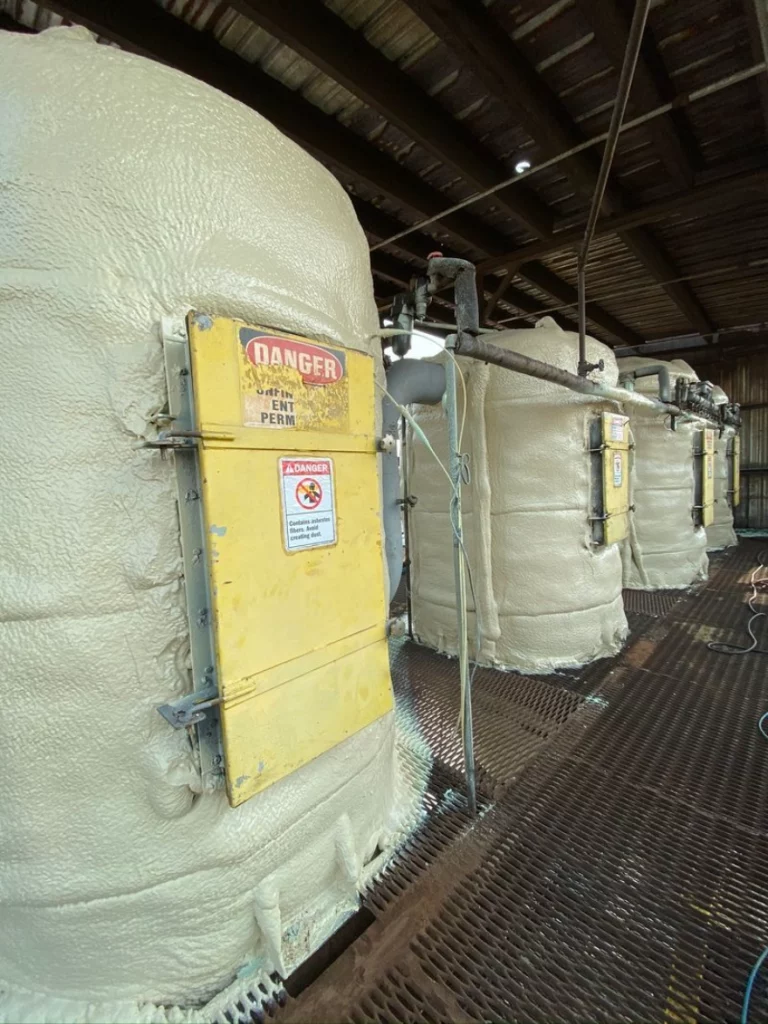
| Tank Type | Recommended Method | Why |
|---|---|---|
| Municipal water storage (above ground) | Closed-cell spray foam with UV-resistant elastomeric coating | Prevents freeze damage, seals all seams, and resists rain intrusion |
| Industrial process tanks (heated) | Mineral fiber panels with metal jacketing | Handles sustained high temperatures, allows periodic inspection |
| Agricultural water storage | Spray foam or foam board | Cost-effective for large flat surfaces, easy to apply |
| Thanks with frequent inspection needs | Removable blankets on access areas, spray foam on the main shell | Balances thermal performance with maintenance access |
| Food and beverage storage | Spray foam with food-safe coating | Seamless coverage prevents contamination pathways |
Selecting the right insulation contractor in Vancouver, WA and insulation system for your storage tanks goes beyond comparing materials. Watch for these indicators:
Spray-On Foam & Coatings brings extensive experience insulating large industrial and water storage tanks throughout the Vancouver, WA area. Our team evaluates each tank’s specific conditions, operating requirements, and exposure to recommend the insulation method that will perform reliably in the Pacific Northwest climate for years to come, aligning with efficiency goals supported by programs like the U.S. Department of Energy – Better Plants Program. Whether you need freeze protection for municipal water storage or thermal efficiency for heated process tanks, we handle projects of all sizes with closed-cell spray foam and other proven insulation systems.
Request a Quote | Schedule a Tank Assessment
Reach us at [email protected] or call (360) 667-1993 to discuss your project.
Closed-cell spray polyurethane foam with a protective elastomeric coating is typically the most effective choice because it creates a seamless, moisture-resistant barrier that handles both freeze risk and heavy rainfall.
CUI occurs when water infiltrates past the outer jacketing and becomes trapped against the steel shell, accelerating rust. It is prevented by applying proper protective coatings before insulation, using hydrophobic insulation materials, and maintaining sealed outer layers.
Requirements depend on whether the tank stores heated water. For tanks above 130 degrees Fahrenheit, the IECC requires R-2 additional insulation per 10 degrees above that threshold. Cold water tanks should be insulated primarily for freeze protection.
Yes, spray foam can be applied to in-service tanks in many cases, depending on the tank’s contents, temperature, and surface condition. A site assessment will determine whether the tank needs to be emptied or can remain operational.
API 653 recommends monthly visual inspections by on-site personnel, a formal external inspection every 5 years, and a full internal inspection every 10 years. Inspection ports and raised insulation at critical welds make these checks more effective.