

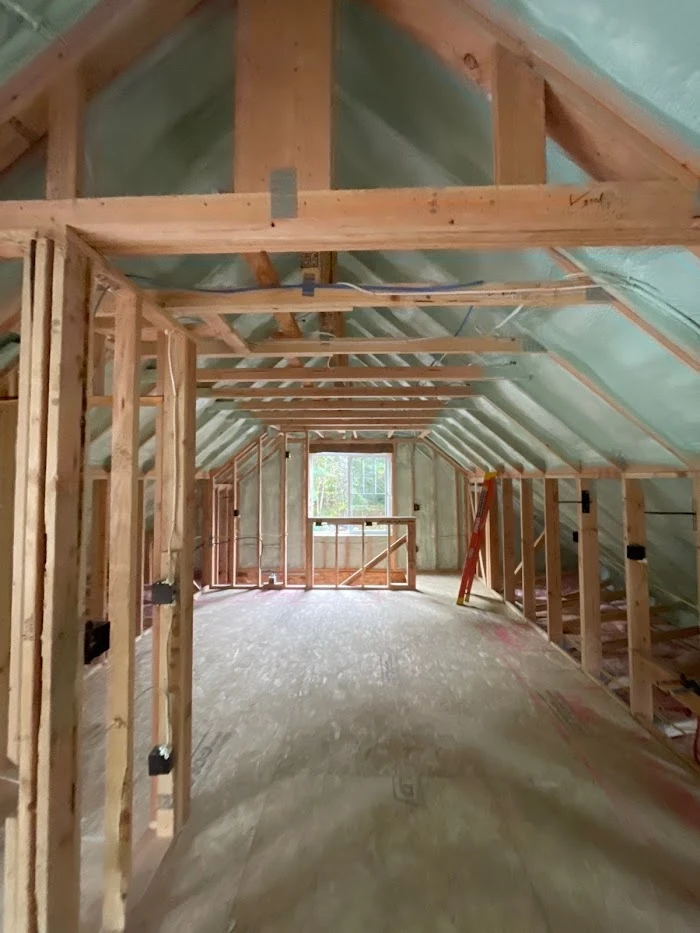
Builders choose closed-cell spray foam insulation because it does more than resist heat transfer. When sprayed into wall cavities, crawlspaces, and roof assemblies, the foam adheres directly to framing members and sheathing, creating a continuous structural bond while simultaneously sealing out moisture and air infiltration. The result is a building envelope that resists racking loads, eliminates convective loops, and prevents condensation damage in ways that fiberglass batts and blown-in cellulose simply cannot match. The right application strategy depends on climate zone, assembly type, and whether the project involves new construction or retrofit work.
Spray polyurethane foam comes in two main classes. Low-density open-cell foam weighs about 0.5 pounds per cubic foot and has an R-value around 3.5 per inch. High-density closed-cell foam weighs roughly 2 pounds per cubic foot and delivers approximately R-6.5 per inch, according to the U.S. Department of Energy’s Energy Saver program. Beyond the higher R-value, the closed-cell structure means the individual gas-filled cells are sealed off from each other, which gives the material its characteristic resistance to moisture transmission and its rigidity once cured.
The DOE notes that closed-cell foam provides “stronger resistance against moisture and air leakage” compared to open-cell products, and that the dense cellular structure also contributes to the foam’s load-bearing capacity within the wall assembly. That combination of thermal performance, moisture resistance, and structural contribution is what sets closed-cell foam apart from every other cavity insulation on the market.
When two-component liquid polyurethane is sprayed into a wall cavity, it expands and cures into a rigid, monolithic layer that bonds directly to every surface it touches: studs, plates, sheathing, electrical boxes, and plumbing penetrations. This adhesive connection means the insulation itself becomes part of the structural system.
Building Science Corporation’s residential spray foam guide explains that spray foam provides continuity across the building envelope by filling cracks, gaps, and irregular cavities that other insulation types cannot reach. That continuity does more than stop air leaks. It locks framing members together, distributing shear forces across the entire assembly rather than concentrating them at fasteners and connectors. In wall assemblies subjected to wind loads, this glued connection between sheathing and framing reduces racking deflection.
The structural benefit is most noticeable in light-frame construction, where the sheathing-to-stud connection is the primary mechanism resisting lateral loads. Closed-cell foam essentially creates a continuous bond line between the oriented strand board or plywood sheathing and the wood framing, supplementing the nails or screws that would otherwise carry those loads alone. Builders working in high-wind regions or seismic zones often cite this adhesive quality as a secondary but meaningful advantage, especially when paired with proper structural connectors.
| Property | Closed-Cell Spray Foam | Open-Cell Spray Foam | Fiberglass Batts |
|---|---|---|---|
| Density (lbs/ft3) | ~2.0 | ~0.5 | N/A (loose or batt) |
| R-value per inch | R-6.5 | R-3.5 | R-2.9 to R-3.8 |
| Vapor permeability | ~3 perms/inch (low) | ~50 perms/inch (high) | High (permeable) |
| Air barrier capability | Yes | Yes (at adequate depth) | No |
| Class II vapor retarder at 1.5″ | Yes | No | No |
| Structural adhesion to framing | Yes | Minimal | None |
| Below-grade suitability | Yes | Not recommended | No |
Moisture destroys buildings faster than any other mechanism. Water vapor moves through wall and roof assemblies by two pathways: air leakage (convection) and vapor diffusion. Closed-cell spray foam addresses both at the same time.
Airflow carries far more moisture than diffusion in most real-world conditions. When warm, humid interior air finds a path through gaps around electrical boxes, at sill plates, or through unsealed framing joints, it can deposit significant moisture inside the wall cavity. Building Science Corporation’s field research (Report RR-0912) confirmed that spray polyurethane foam of both types serves as part of an effective air barrier system when properly applied, noting that “wood-to-wood joints between double studs, at sill plates to floor sheathing, and joints around windows require sealing to provide a continuous air barrier.” Closed-cell foam, sprayed to adequate depth, eliminates those leakage paths by filling gaps completely.
At thicknesses above 1.5 inches, closed-cell foam meets the definition of a Class II vapor retarder under the International Residential Code. Research published by Building Science Corporation demonstrated that “closed-cell spray foam applied in thicknesses of over 2 inches will control vapor diffusion to safe levels in all climates up to 10,000 Heating Degree Days and interior winter-time relative humidities of up to over 50% RH.” This means that in most of North America, a properly detailed closed-cell spray foam application eliminates the need for an additional polyethylene sheet or other separate vapor retarder.
For vented crawlspaces, Building Science Corporation’s guidance is explicit: “Only high-density closed-cell spray polyurethane foam should be used in all IECC Climate Zones.” The foam’s low permeability prevents groundwater moisture and humid crawlspace air from reaching the floor framing above, protecting wood structural members from rot and fungal growth.
Spray foam applied directly to the interior of concrete foundation walls provides both thermal insulation and a capillary break against moisture migration. Building Science Corporation’s enclosure guide notes that “closed-cell spray foam is an air and vapor barrier, there are no risks to air leakage or vapor diffusion condensation” in foundation assemblies. The foam can also be used under basement slabs when applied over a granular capillary break, though open-cell foam should never be used below-grade.
Both vented and conditioned crawlspaces benefit from closed-cell spray foam applied to the floor framing above. In vented crawlspaces, the foam acts as a barrier between humid exterior air and the wood floor assembly. In conditioned crawlspaces, it provides the continuous insulation needed to bring the crawlspace within the building’s thermal envelope.
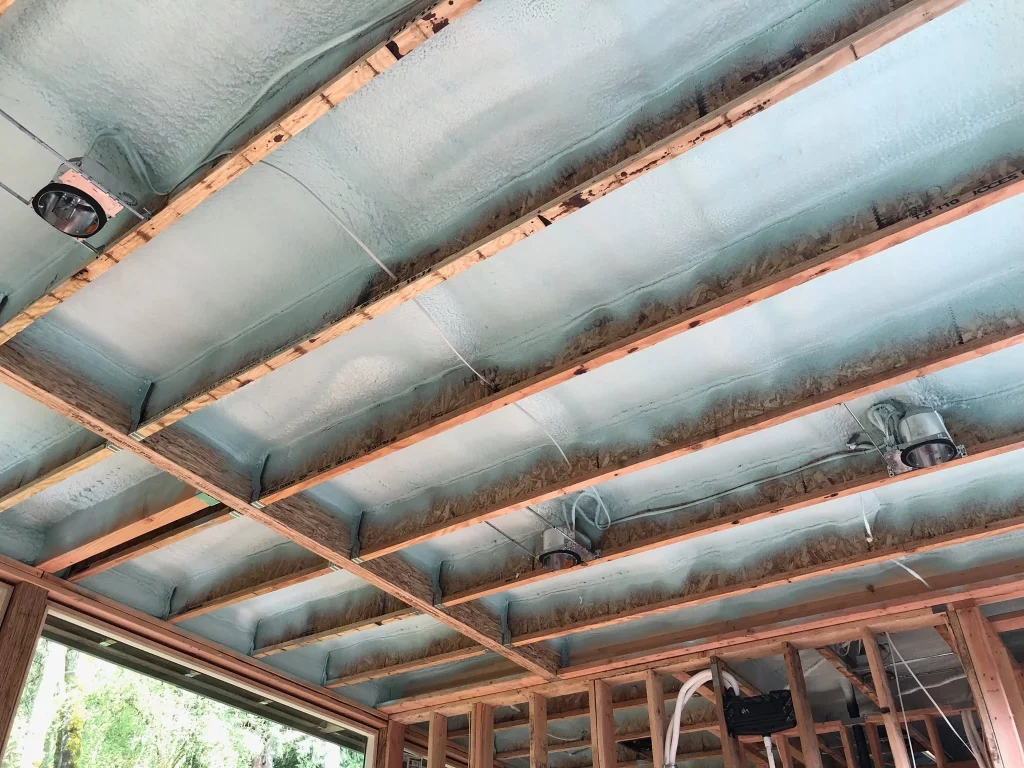
The rim joist area is one of the most common locations for air leakage and insulation gaps in conventional construction. Closed-cell spray foam fills the irregular cavities around floor joists, sill plates, and rim board, creating an airtight seal that also provides the vapor retarder needed to prevent condensation in cold climates.
In IECC Climate Zones 5 and above, closed-cell spray foam sprayed directly to the underside of the roof deck is the recommended approach for unvented conditioned attics. This keeps mechanical ductwork and HVAC equipment inside the conditioned space, eliminating the energy penalty of locating them in unconditioned attics. The foam provides the air barrier, vapor retarder, and thermal insulation in a single layer.
| Application | Recommended Approach | Key Considerations |
|---|---|---|
| New construction walls | Closed-cell foam full cavity or hybrid (closed-cell + fiberglass/cellulose) | Closed-cell at sheathing for vapor control, cavity fill for R-value |
| Retrofit existing walls | Closed-cell foam injection or cavity fill | Address access, verify stud depth for adequate thickness |
| Basement walls | Closed-cell foam directly on concrete interior | Do not use open-cell below grade |
| Crawlspaces | Closed-cell foam on floor framing from below | Add fiber cement protection board where required by code |
| Unvented attics (CZ 5+) | Closed-cell foam to roof deck underside | Minimum thickness per IRC Table R806.5 for condensation control |
| Rim joists | Closed-cell foam in bays and around penetrations | Fills irregular shapes better than any rigid board |
A qualified installer will discuss the specific control layers your assembly needs, rather than quoting a price and spraying without explanation. They will ask about your climate zone, the assembly type (wall, roof, or foundation), and whether the building will have mechanical ventilation. They will understand the difference between air barriers and vapor retarders and will know when closed-cell foam alone is sufficient and when additional vapor control measures are needed.
Quality installers also communicate honestly about curing times, off-gassing concerns, and the need for thermal barriers over exposed foam. They avoid recommending applications they know will fail, and they explain why certain assemblies require a specific foam type or minimum thickness. Our team evaluates every project on its own merits before recommending an approach, and we walk through the assembly details with each builder and homeowner before any material leaves the rig.
Spray-On Foam & Coatings has the experience and equipment to handle closed-cell spray foam installations for residential builders, commercial contractors, and retrofit projects across the Pacific Northwest. Whether you need structural reinforcement and moisture control for a new build or an energy-efficient upgrade for an existing home, our team can assess your building envelope and recommend the right application strategy. We serve Vancouver, Longview, Kelso, Portland, and the surrounding communities with professional installation backed by building science best practices.
Request a Quote | Schedule a Consultation
Reach us at (360) 667-1993 or [email protected] to discuss your project. We are ready to help you build stronger, drier, and more efficient structures with closed-cell spray foam insulation.
Closed-cell spray foam qualifies as a Class II vapor retarder at thicknesses greater than 1.5 inches, as specified in the International Residential Code section R702.7.
Yes, closed-cell foam is the only spray foam type recommended for below-grade and crawlspace applications because its low permeability prevents moisture absorption and resists groundwater vapor.
In most wall assemblies, closed-cell foam at adequate thickness eliminates the need for an interior polyethylene vapor retarder, but a water-resistive barrier on the exterior sheathing is still required for rain control.
The cured foam adheres to both framing members and sheathing, creating a continuous bond that distributes shear forces across the entire wall assembly and supplements nail and screw connections.
In IECC Climate Zones 5 and above, closed-cell foam provides the vapor retarder needed to prevent condensation on the roof deck, while open-cell foam lacks sufficient vapor resistance for those conditions.