

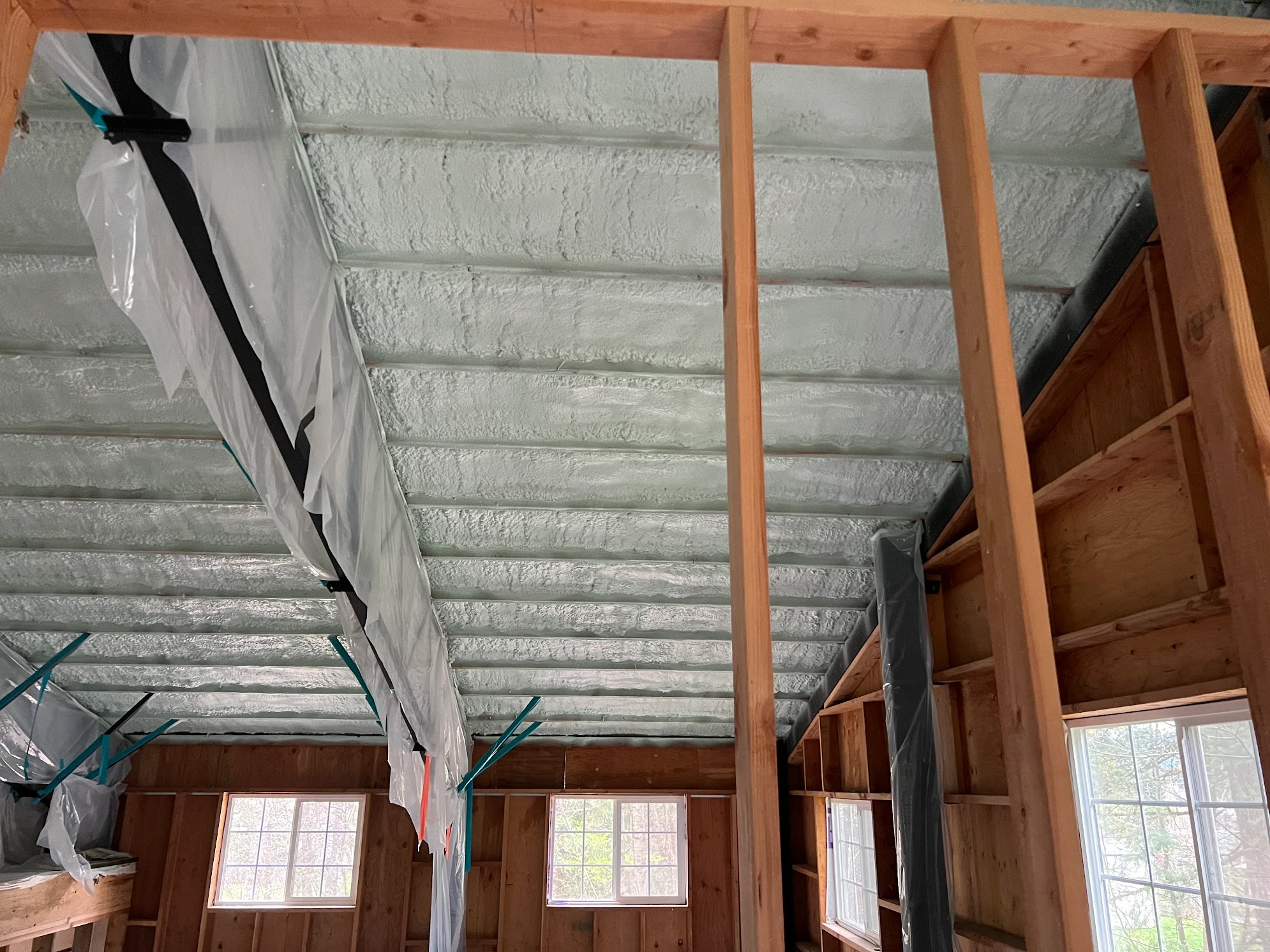
Closed-cell spray foam performs reliably around pipes, wiring, and structural openings when installation follows one discipline: inspect and correct the utilities first, then spray in controlled lifts. Because the foam expands 30 to 60 times its liquid volume and cures into a rigid, air-impermeable mass rated at roughly R-5.1 to R-6 per inch, it seals the small gaps around penetrations far better than fibrous insulation, which is not an air barrier at all. The tradeoffs are heat retention around aging or overloaded wiring, condensation management on cold pipe surfaces, and pressure distortion at window and door jambs if application is rushed. For homeowners and builders in Vancouver, WA and Portland, OR, results depend on preparation, sequencing, and installation quality, not just the foam chemistry.
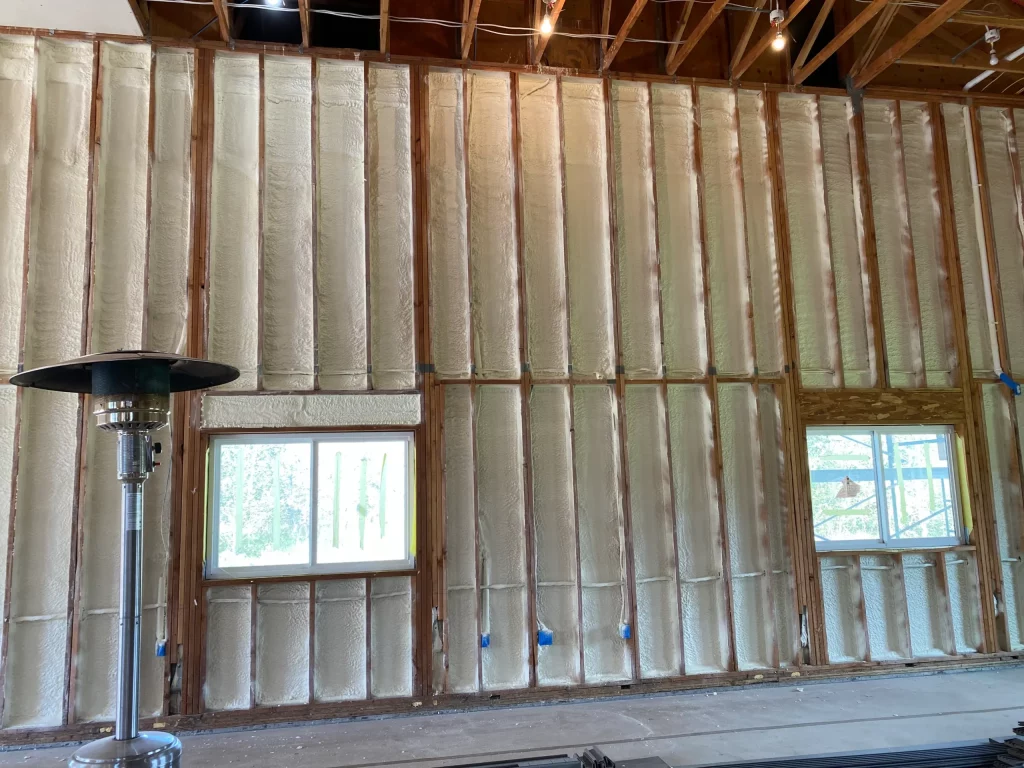
Closed-cell polyurethane foam starts as a two-part liquid mix that reacts and expands in place, up to 30 to 60 times its sprayed volume, then cures into a rigid thermoset plastic (Wikipedia). Three properties explain its performance around pipes, wiring, and openings:
That last point matters most in the Pacific Northwest, where wet winters push humid indoor air toward cold sheathing and pipe surfaces all season.
Wiring is where preparation matters more than product. Foam itself does not generate heat, but it does insulate whatever it covers, including a conductor’s normal operating heat. Our process follows the Building America Solution Center electrical sealing standard:
One practical note from the same DOE resource: spray foam degrades in sunlight, so exterior wire penetrations get caulk, gaskets, or flashing instead, and foam at outdoor gaps should be protected with copper mesh or hardware cloth to keep rodents from chewing through it.
Pipes create two different problems, and foam solves only one of them alone.
Condensation: Warm, moist household air leaking into a wall or rim joist can condense on cold water lines and drip onto framing. Because closed-cell foam stops air movement and doubles as a vapor retarder, it removes the moisture transport that causes this wetting. The DOE plumbing and piping air sealing guide confirms that sealing these penetrations prevents both energy loss and moisture movement between conditioned and unconditioned space.
Freeze protection: Foam helps, but it is not a guarantee. The same DOE guidance recommends water pipes be insulated to R-3 per the 2021 IECC even in interior walls, and it is explicit about placement: insulation on the exterior side of a pipe keeps it warmer in winter, while insulation on the interior side makes it colder. That is why we avoid running supply lines in exterior walls in cold climates when plans allow, and when pipes must stay, we keep foam coverage outboard of the pipe.
Our sealing details around plumbing include:
Window and door rough openings are the biggest holes in any wall. An Oak Ridge National Laboratory study cited by DOE’s window and door air sealing guide found that a window with a 3/4-inch rough-in gap had an equivalent leakage area of 28.2 cm²/m², and sealing that gap from the interior cut it to 0.5 cm²/m².
The nuance is product selection. The rough-opening gap itself gets low-expansion foam formulated for doors and windows, backer rod, or caulk. Ordinary expanding foam generates enough force to distort jambs, jam sashes, and void window warranties. Closed-cell spray foam belongs in the framing bays around the opening, not shoved into the gap between unit and jamb.
Two more structural details separate a good install from a failed one:
| Penetration Type | Closed-Cell Performance | Primary Risk | Our Best Practice |
|---|---|---|---|
| Wiring holes, top plates | Fills 1-inch drill gaps, blocks convective loops | Trapping heat at damaged or overloaded circuits | Electrician assessment first, fire-rated sealants at boxes |
| Supply and drain lines | Stops moist-air condensation, adds R-value | Frost-prone pipes insulated on the wrong side | R-3 pipe wrap, foam outboard of pipe, keep lines out of exterior walls |
| Window/door rough gaps | Air-tight when done with low-expansion products | Jamb distortion and voided warranties | Low-expansion foam in the gap, closed-cell only in framing bays |
| Rim joists and sill plates | Insulates and air seals in one pass | Gaps over 1 inch | Rigid blocking first, then foam over |
| Exterior wall penetrations | Seals well but degrades in UV | Sunlight damage and rodent chewing | Flash or tape over foam, add copper mesh |
| Audience / Context | Recommended Approach | Key Notes |
|---|---|---|
| Retrofit homeowners (1,500 to 2,500 sq ft homes) | Electrical inspection, then closed-cell or hybrid closed-cell plus fibrous fill | Fix leaks first; expect $1.50 per board foot on average jobs |
| New construction builders | 1-inch max holes, airtight boxes, low-expansion foam at openings | Sequence sealing after rough-ins, before drywall |
| Crawl space and rim joist projects | Full closed-cell application | Our crawl space projects typically run $1,500 to $35,000 depending on size |
| Pole barn and shop owners | Closed-cell directly on metal | Controls condensation on sheet metal in every season |
| Budget-focused upgrades | Standalone air sealing before insulating | Typical air sealing projects average $4,500, ranging from $1,500 to $10,000 |
Spray-On Foam & Coatings installs closed-cell spray foam across Vancouver, WA and the Portland, OR metro area, with every pipe run, cable hole, and rough opening inspected and detailed before we spray. Call us at (360) 667-1993 or email [email protected], and our team will build a scope that protects your wiring, plumbing, and framing while delivering the full thermal and air sealing value of the foam.
Request a Free Quote · Schedule a Site Assessment
Do it once, do it in the right order, and your envelope will perform for decades.
Yes, over modern cable that is code-compliant, undamaged, and properly loaded. Every retrofit we quote starts with an assessment for damaged or knob-and-tube wiring, and any concerns get cleared by a qualified electrician before insulation.
It helps by keeping heat near the pipe and blocking cold air movement, but it is not a freeze guarantee. We pair it with R-3 pipe insulation and keep foam coverage on the exterior side of the pipe where it does the most good.
Not when the right product goes in the right place. We use low-expansion foam in the rough-opening gap, because ordinary expanding foam can distort jambs and void warranties, and reserve closed-cell foam for the framing bays around the opening.
Visual inspection before drywall, followed by blower door testing, smoke pencil checks, and infrared imaging. These tools reveal any bypass at wiring holes, pipe penetrations, or framed corners while they are still easy to fix.
In our Vancouver and Portland service area, closed-cell foam typically runs $1.20 to $3.00 per board foot, with larger projects priced at the lower end and greater thickness or higher R-value targets increasing the rate.