

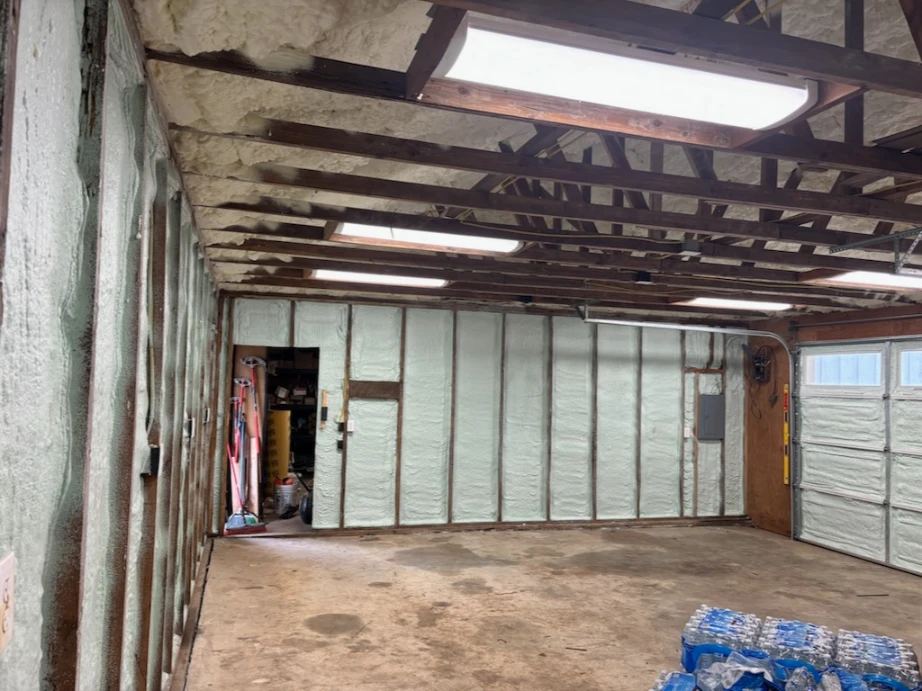
Spray foam insulation outperforms traditional thermal insulation materials like fiberglass and cellulose in Battle Ground, WA, particularly because of our marine climate zone (IECC Zone 4C), where moisture control and air sealing are as important as raw thermal resistance. Traditional insulation like fiberglass batts and blown-in cellulose has a lower R-value per inch and cannot seal air leaks on its own. Spray foam, on the other hand, expands to fill gaps and cracks, simultaneously providing thermal insulation, air sealing, and moisture vapor control in a single application. For homeowners and contractors in Battle Ground, WA, the combination of wet winters, high humidity, and cool-season heating demands makes spray foam the stronger long-term performer, especially in crawlspaces, rim joists, and attics, where moisture intrusion is a recurring concern.
Clark County sits west of the Cascade Mountain Range, placing Battle Ground squarely in IECC Climate Zone 4C, a marine climate characterized by mild but wet winters, moderate summers, and prolonged periods of high humidity. Temperatures in Battle Ground typically range from the low 30s in winter to the mid-80s in summer, with annual precipitation reaching approximately 51 inches. Relative humidity averages 86% during the wettest winter months.
This matters because in a marine climate, the temperature difference between conditioned indoor air and humid outdoor air drives moisture movement through building assemblies. Insulation that only resists heat flow but allows air and vapor to pass through can lead to condensation inside wall cavities, floor assemblies, and roof decks. According to the Washington State Legislature, all counties west of the Cascades, including Clark County, are assigned to Marine Zone 4C under the state energy code, which governs insulation requirements for new construction and renovations.
| Factor | Traditional Thermal Insulation (Fiberglass/Cellulose) | Spray Foam Insulation |
|---|---|---|
| R-value per inch | R-3.0 to R-3.7 (fiberglass), R-3.2 to R-3.8 (cellulose) | R-3.6 to R-4.3 (open cell), R-6.0 to R-7.0 (closed cell) |
| Air sealing | None requires a separate air barrier | Built-in air barrier seals gaps and cracks during application |
| Vapor control | Requires a separate vapor retarder | Closed cell acts as a Class II vapor retarder at 1.5″+ thickness |
| Moisture resistance | Absorbs moisture, loses R-value when damp | Closed cell resists water absorption; open cell is vapor permeable |
| Installation | Can be DIY for batts; blown-in requires equipment | Requires professional installation with specialized equipment |
| Best applications | Attic floors, standard wall cavities, and budget-conscious projects | Crawlspaces, rim joists, irregular cavities, and retrofit air sealing |
The U.S. Department of Energy notes that foam insulation products generally cost more than traditional batt insulation, but deliver higher R-values and form an air barrier that can eliminate separate weatherization tasks like caulking, housewrap installation, and joint taping.
Fiberglass batts and blown-in cellulose are the most common insulation materials found in older Battle Ground homes. They work by trapping air within their fibers to slow conductive heat flow. In a wall cavity, a standard fiberglass batt in a 2×4 frame delivers approximately R-13, while high-density variants can reach R-15.
The problem in a marine climate is that these materials are air-permeable. Warm, moist indoor air can pass through gaps around the insulation, reach the cooler exterior sheathing, and condense. Over time, this can lead to mold growth, wood rot, and degraded insulation performance. Fiberglass that becomes damp loses a portion of its effective R-value. The U.S. Department of Energy explains that the maximum thermal performance of insulation is highly dependent on proper installation, and even small gaps between batts and framing can significantly reduce effectiveness.
Spray foam is applied as a liquid that expands and cures in place, conforming to every surface it contacts. There are two primary types used in residential and light commercial construction:
Closed-cell spray foam has a higher density (approximately 2 pounds per cubic foot), delivers R-6 to R-7 per inch, and acts as both an air barrier and a Class II vapor retarder when applied at or above 1.5 inches. According to Building Science Corporation, closed-cell spray foam applied in thicknesses over 2 inches will control vapor diffusion to safe levels in all climates up to 10,000 heating degree days, which covers Battle Ground and the entire Pacific Northwest.
Open-cell spray foam has a lower density (approximately 0.5 pounds per cubic foot), delivers R-3.6 to R-4.3 per inch, and is vapor permeable. It seals air effectively but allows moisture vapor to pass through, which means it may require a separate vapor retarder in certain assemblies. Building Science Corporation’s residential spray foam guide recommends that, for IECC Climate Zone 5 and higher, high-density closed-cell spray foam is preferred for unvented conditioned attics, while both types work in most wall assemblies in marine climates.
For Battle Ground specifically, closed-cell spray foam is the better choice for crawlspaces, basements, and rim joists where ground moisture and condensation risks are highest. Open-cell spray foam works well in above-grade wall cavities and attic assemblies where vapor permeability is acceptable.
| Scenario | Property Type | Recommended Option | Why |
|---|---|---|---|
| Drafty crawlspace with moisture damage | 1970s ranch home, crawlspace foundation | Closed-cell spray foam | Seals rim joists, blocks moisture vapor, resists water absorption |
| Unfinished attic with existing fiberglass | 1990s two-story, vented attic | Air seal with spray foam + blown-in over top | Spray foam seals the ceiling plane; blown-in adds R-value affordably |
| New construction wall cavities | Custom build, 2×6 framing | Open or closed-cell spray foam (or hybrid) | Spray foam air seals; hybrid with fiberglass keeps costs manageable |
| Pole barn or workshop | Steel-framed agricultural building | Closed-cell spray foam | Seals irregular steel framing, provides condensation control on metal surfaces |
| Basement remodel with concrete walls | 1960s home, full basement | Closed-cell spray foam on interior walls | Adheres directly to concrete, acts as a vapor retarder, insulates, and seals in one step |
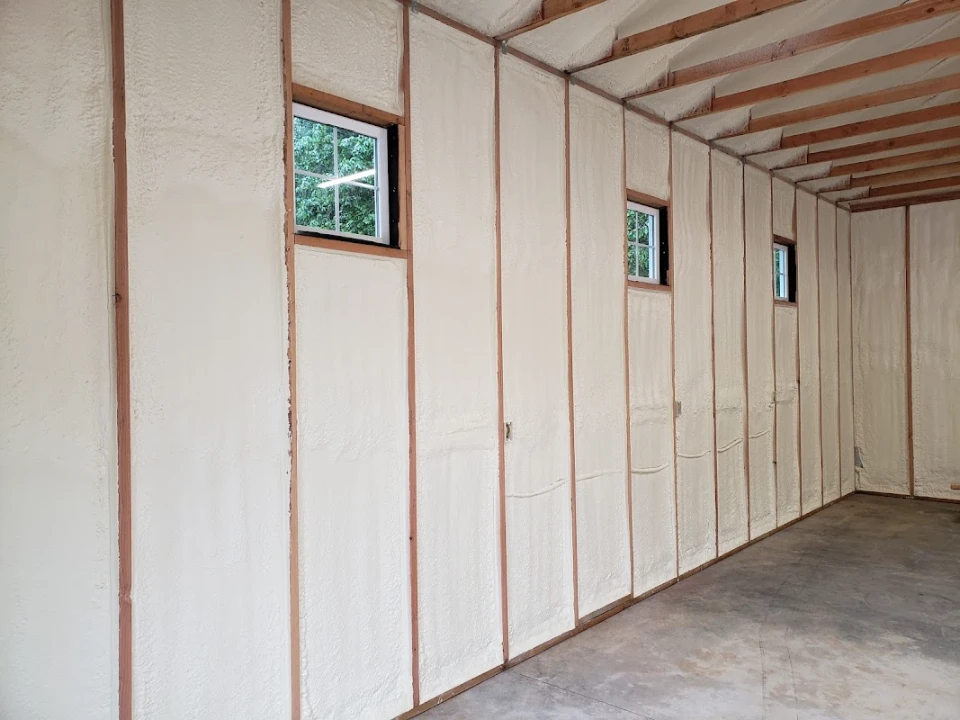
Several variables determine which insulation type delivers the best results for a specific project:
Spray foam is the right choice when:
Spray foam may not be the best fit when:
Choosing between traditional thermal insulation and spray foam comes down to your building’s specific conditions, your climate zone, and your performance goals. Our team at Spray-On Foam & Coatings has extensive experience working in Battle Ground and throughout Clark County, and we can evaluate your property to recommend the insulation approach that delivers the best return on investment. We handle both closed-cell and open-cell spray foam projects, from crawlspace encapsulations to full-home retrofits and new construction applications.
Request a Free Quote | Schedule an Insulation Assessment
Call us at (360) 667-1993 or email [email protected] to discuss your project. We serve Battle Ground, Vancouver, and the surrounding areas with professional spray foam installation backed by local knowledge and building science expertise.
Yes. In a marine climate like Clark County’s Zone 4C, spray foam’s ability to simultaneously insulate, air seal, and control moisture vapor provides long-term value that traditional insulation cannot match, particularly in crawlspaces and rim joists where moisture damage is common.
Closed-cell spray foam is impermeable to liquid water and acts as a Class II vapor retarder at 1.5 inches or more. This means it prevents condensation from forming inside wall and floor assemblies when warm indoor air meets cold exterior surfaces during the winter months.
Fiberglass batts in crawlspaces are susceptible to moisture absorption, mold growth, and gravity sag over time. Building science guidance recommends closed-cell spray foam for vented crawlspace floor assemblies in all climate zones because of its moisture resistance and air-sealing properties.
Closed-cell spray foam applied at 1.5 inches or more functions as a Class II vapor retarder on its own, eliminating the need for a separate polyethylene vapor barrier in most residential wall and crawlspace assemblies. Open-cell spray foam may still require an additional vapor retarder depending on the climate zone and assembly type.
Spray foam does not settle, compress, or degrade over time when properly installed. It maintains its R-value and air-sealing properties for the life of the building. Fiberglass and cellulose can settle, leaving gaps that reduce effective thermal performance, and fiberglass loses R-value when exposed to moisture.