

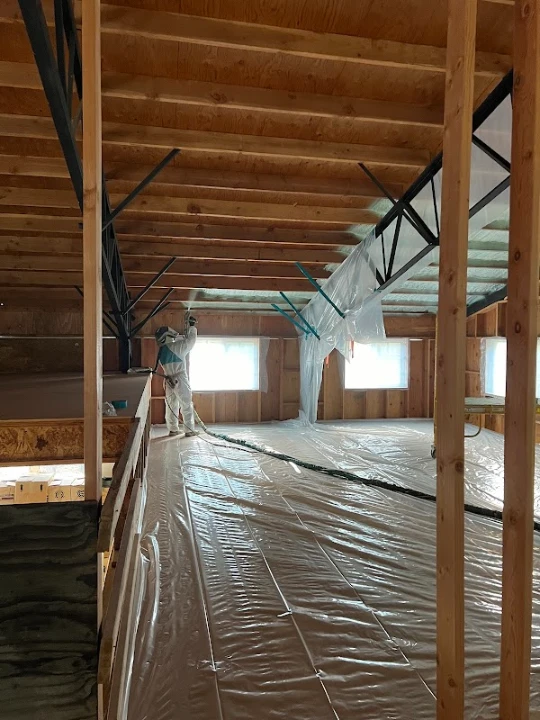
Spray foam acoustic insulation works by sealing the gaps, cracks, and voids in wall cavities, ceilings, and floors that allow sound waves to travel freely between spaces. In Seattle’s dense urban neighborhoods and mixed residential-commercial zones, unwanted noise from traffic, construction, and neighboring units is a daily concern. Spray foam addresses this by creating a continuous air barrier that eliminates the acoustic leakage paths responsible for much of the sound transmission in standard construction. The two main noise types, airborne and impact, respond differently to spray foam, and understanding how each behaves inside a building helps explain why this insulation material has become a practical choice for homeowners looking for quieter living spaces.
Before choosing any insulation material, it helps to understand the two categories of sound that affect indoor comfort.
Airborne noise travels through the air as pressure waves. Examples include conversations, television audio, traffic sounds, and barking dogs. This type of sound enters a building through any unsealed opening, no matter how small. Standard wall assemblies with fiberglass batts often leave tiny gaps around studs, pipes, and electrical boxes. Those gaps act as channels for airborne sound, which is why a house with an uninsulated or poorly sealed wall can have an STC rating as low as 25, where normal speech is clearly understood on the other side.
Impact noise travels through the physical structure of a building. Footsteps on a hardwood floor, a door slamming, or objects dropping onto a ceiling are classic examples. Impact noise does not need air to move; it vibrates directly through framing, subflooring, and drywall. Because of this mechanical transmission path, impact noise is harder to address with cavity insulation alone and typically requires decoupling strategies like resilient clips or staggered-stud framing in addition to insulation.
The most direct benefit of spray foam for airborne noise control is its ability to expand into and fill every crevice within a wall, ceiling, or floor cavity. Traditional insulation, like fiberglass batts, is cut to fit but rarely creates a perfect seal. The small gaps left behind become flanking paths for sound. According to acoustic engineering research, a gap as minor as a 1-inch square opening where a wall meets the floor can reduce a wall’s effective STC rating by as much as 10 points. Spray foam eliminates these gaps by expanding to conform to the exact shape of the cavity, creating a monolithic seal.
At a typical application thickness of 3 inches, sprayed polyurethane foam can help interior residential walls reach an STC rating of 35, the point at which loud speech becomes unintelligible through the barrier. This represents a meaningful jump from the STC 25 baseline of an uninsulated partition. The foam also achieves a Noise Reduction Coefficient (NRC) of approximately 0.70 at that thickness, meaning 70% of sound energy that contacts the material is absorbed rather than reflected.
Impact noise presents a different challenge. Spray foam, particularly closed-cell formulations, bonds directly to framing members and sheathing. This rigid connection can actually work against impact noise isolation because it creates a solid bridge that allows vibrations to transfer through the structure more efficiently. As noted in acoustic engineering analysis from the Journal of Light Construction, spray foam does not have enough mass to improve transmission loss on its own, and because the foam secures wall components together rather than decoupling them, vibrations from impacts can move through the assembly more easily.
That said, spray foam still contributes to impact noise reduction by eliminating hollow cavities. An empty wall or floor cavity acts as a resonant chamber that can amplify certain frequencies. By filling that space, spray foam reduces the resonance effect and dampens some of the vibrational energy. For meaningful impact noise control in Seattle, WA homes, our recommendation is to combine spray foam with decoupling techniques such as resilient channels, acoustic underlayment, or double-stud wall construction.
Choosing between open-cell and closed-cell spray foam involves trade-offs between sound absorption, thermal performance, and moisture resistance. Here is how the two compare for acoustic applications:
| Property | Open-Cell Spray Foam | Closed-Cell Spray Foam |
|---|---|---|
| Density | ~0.5 lb/ft³ | ~2.0 lb/ft³ |
| R-Value per Inch | R-3.8 | R-7.0 |
| Sound Absorption | Higher (absorbs sound energy) | Lower (tends to reflect sound) |
| Vapor Barrier | No (requires separate vapor barrier) | Yes (at 1.5 inches or greater) |
| Air Barrier | Yes (at 3.75 inches or greater) | Yes (at 1 inch or greater) |
| Best Acoustic Use | Interior partitions, ceilings, walls | Exterior walls where moisture control is the primary concern |
| Impact on Wall STC | Improves STC by 5 to 12 points | Improves STC by 3 to 5 points |
The porous structure of open-cell spray foam allows sound waves to enter the material and dissipate their energy within the open-cell network. Closed-cell foam, with its higher density and sealed gas pockets, tends to reflect sound waves rather than absorb them. For homeowners in Seattle prioritizing acoustic performance in interior walls and ceilings, open-cell spray foam is typically the better fit. For exterior walls in the Pacific Northwest climate, where moisture management is equally important, closed-cell foam provides the vapor barrier protection needed alongside its sound-dampening contribution.
Seattle operates under a detailed noise control framework through its Municipal Code Chapter 25.08, enforced by the Seattle Department of Construction and Inspections (SDCI). The ordinance sets decibel limits for exterior sound levels across residential, commercial, and industrial districts and specifies quiet hours for construction activity. For residential zones, construction is permitted from 7:00 a.m. to 7:00 p.m. on weekdays and 9:00 a.m. to 7:00 p.m. on weekends.
Washington State’s noise control regulations, Chapter 173-60 WAC, establish Environmental Designation for Noise Abatement (EDNA) zones that classify areas by land use type and set maximum permissible noise levels accordingly. These regulations apply not just to exterior noise sources but also to how buildings are designed to contain sound between units in multi-family construction.
For Seattle homeowners, especially those in mixed-use neighborhoods like Capitol Hill, Ballard, or South Lake Union where residential and commercial properties sit side by side, spray foam insulation serves a dual purpose. It helps a home meet or exceed acoustic separation targets while also providing thermal insulation and air sealing. The Pacific Northwest climate demands strong thermal performance from insulation, and spray foam delivers that alongside its noise control benefits.
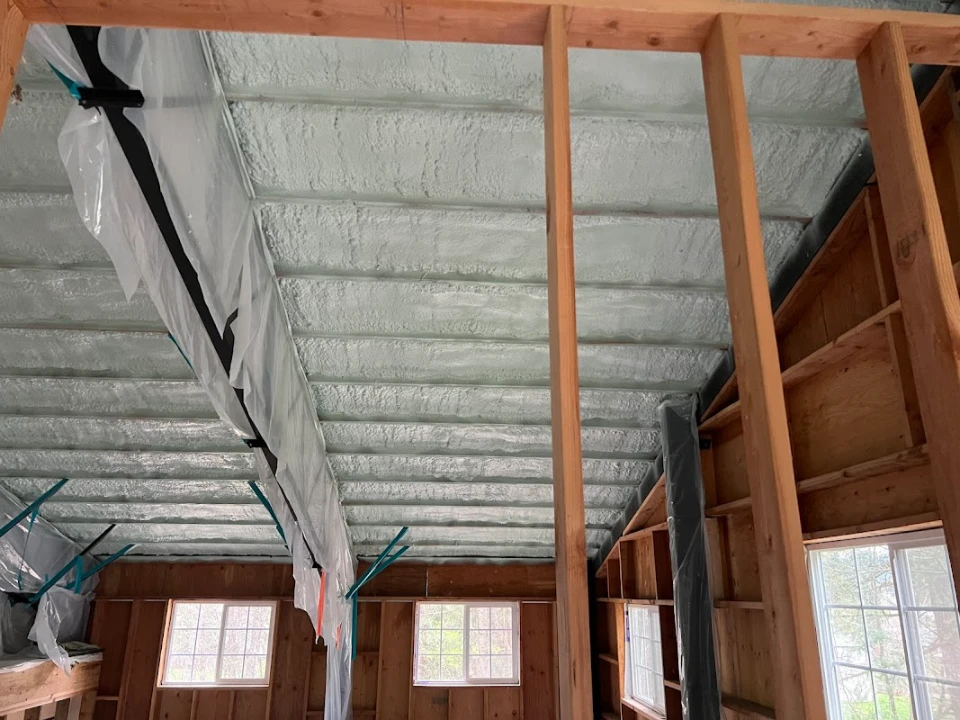
Not every noise problem calls for the same solution. The right approach depends on the source of the noise, the building assembly, and the performance targets.
Interior partition walls between rooms: Open-cell spray foam is the most appropriate choice here. Its sound absorption properties reduce the transmission of conversations, television audio, and other airborne sounds. In a standard 2×4 wall with half-inch drywall on both sides, filling the cavity with open-cell foam can move the STC rating from the low 30s to the high 30s.
Ceilings below upper-floor living spaces: This is where impact noise is most noticeable. Spray foam in the ceiling cavity reduces airborne noise from above and dampens some resonance, but for real impact noise isolation, we recommend pairing the foam with resilient channels and a separate acoustic underlayment on the floor above.
Exterior walls facing busy streets: Closed-cell spray foam provides the best overall performance here. Its higher R-value and vapor barrier properties address Seattle’s wet, cold climate while also sealing the exterior envelope against traffic noise. The air-sealing quality of closed-cell foam is the primary mechanism for noise reduction in this application.
Home offices and media rooms: For spaces where silence matters most, a layered approach gives the best results. Open-cell spray foam in the wall cavities, supplemented by mass-loaded vinyl on the drywall and resilient decoupling between the framing and finished surfaces, creates a high-performance acoustic assembly.
Choosing a qualified installer matters as much as choosing the right product. A few indicators separate experienced acoustic insulation contractors from the rest:
Spray-On Foam & Coatings provides professional spray foam insulation services for homeowners across the Pacific Northwest, including the Seattle metro area. Our team evaluates each project’s specific noise concerns, building assembly, and environmental conditions before recommending the right foam type and application thickness. Whether you need to quiet a home office, reduce street noise through exterior walls, or improve sound isolation between floors, we can design an insulation solution that fits your goals and your budget.
Request a Free Quote | Schedule an Acoustic Assessment
Call us at (360) 667-1993 or email [email protected] to discuss your project.
A: No insulation product provides complete soundproofing on its own. Spray foam significantly reduces airborne sound transmission by sealing gaps and absorbing sound energy, but meaningful acoustic isolation requires a combination of mass, decoupling, absorption, and proper sealing of all flanking paths.
A: Open-cell spray foam is generally more effective for acoustic applications because its porous structure absorbs sound waves rather than reflecting them. Closed-cell foam has a higher density and tends to reflect sound, though its superior air-sealing quality still contributes to noise reduction.
A: Spray foam alone has limited effectiveness against impact noise because it bonds to framing and can transmit vibrations. It does reduce cavity resonance, but for genuine impact noise isolation, it should be paired with decoupling methods such as resilient channels or acoustic underlayment.
A: Spray foam provides superior acoustic performance primarily because it creates a complete seal with no gaps or compression. Fiberglass batts can leave voids that allow sound to flank around the insulation, potentially reducing effective STC ratings by up to 10 points compared to a properly sealed assembly.
A: Seattle’s noise ordinance regulates exterior sound levels across different zone types, but specific interior sound insulation requirements depend on the building type and zoning classification. Multi-family construction has stricter acoustic separation requirements than single-family homes. Our team can help determine what applies to your specific project.